Showing posts with label education. Show all posts

Tuesday, 18 August 2009

School of Everything: Time to Unplug?

It's been ages since I've written anything about School of Everything on here. That's a reflection of the direction my life has taken since the start of 2009: I've gone from full time involvement with SoE to spending two days a week there and the other five starting all kinds of new projects. But for the next few weeks (and possibly longer) I'll be going back to basics and hosting School of Everything: Unplugged! on Wednesday mornings (10.30-12.30) at the Royal Festival Hall in London.
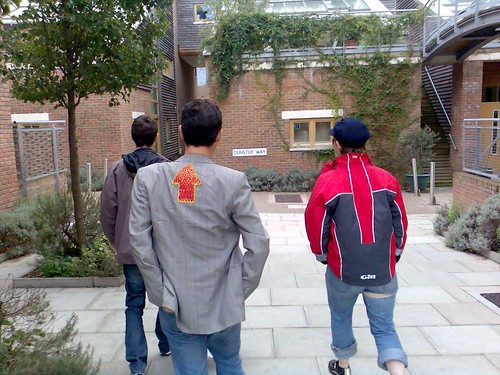
The only way is up: Paul, Pete and Mary at BedZed in October 2006, the day we started work on School of Everything


There were five of us who started School of Everything - Pete Brownell (aka Greenman), Andy Gibson, Mary Harrington (aka Sebastian Mary), Paul Miller and me. We met through a series of experiments with online/offline culture and DIY education - particularly the Pick Me Up email zine and the London School of Art and Business. (Bryony Hendersen, who helped start LSAB, remembers it as "a playful meeting place for established and emerging artists and businesses to meet, challenge each other and provoke learning systems.")

Individually or collectively, we'd also been involved in things like the University of Openness and the Boxing Club at Limehouse Town Hall, Access Space media lab in Sheffield and the Knowledge Lab events at Lancaster. It was those experiences which inspired School of Everything - along with the ideas of Ivan Illich's Deschooling Society and the story of the Free U at Palo Alto.

Over the past three years, the five of us have taken that inspiration and created a website which does some of what Illich envisaged when he wrote about "learning webs" and "peer-matching networks". We raised two rounds of funding from Channel 4, the Young Foundation and some great individuals who believed in us - and won a New Statesman New Media Award, a UK Catalyst Award, and were Honourees in the 2009 Webbys. The site now has over 20,000 members and thousands of people come to it every day, most of whom are looking to learn something new in their local area.

Along the way, I've tried to stay grounded in the culture of self-organised, curiosity-driven learning that School of Everything grew out of. Those roots have been nourished by experiences like the Illich colloquium in Cuernavaca in 2007 and the Temporary School of Thought this January, as well as working with organisations like Personalised Education Now and the Blackden Trust.

That said, the process of building a commercially-sustainable organisation means that the big picture can sometimes disappear from view. This was brought into focus a couple of months ago, by the lively discussions on TechCrunch when we were nominated for the Social Innovation category of their Europa awards. Dejan from aleveo.com asked what was so socially innovative about "aggregation of teacher ads"? At the time, Pete wrote a piece on the company blog which set out the difficult questions we've asked ourselves, as we've tried to balance vision and pragmatism:

School of Everything was founded on extremely lofty goals - we wanted to change the face of education... It is very important to us that our work is more than just a commercial enterprise - but it is just as important to us that it is a commercial enterprise. At the moment we are hard at work building the tools that will allow us to survive as a project... Perhaps we have been too quiet about our big idea, or does it make sense to quietly go about changing things step by step?

There's no easy answer to that, but as the guy with "strategy" in his job title - and standing a little further back than the full-time members of the team - I guess part of my role is to hold that long-term vision. So when one of our photography teachers, Tony Hall, suggested starting a face-to-face meetup in London, it felt like an opportunity to renew our roots in the sociable, playful, improvisational learning culture of Pick Me Up, the LSAB, the University of Openness and the rest.

That's why Tony and I have started School of Everything: Unplugged! on Wednesday mornings in the foyer of the Royal Festival Hall. Quite how these meetups will evolve neither of us knows. One inspiration is the simple, open format of Tuttle Club, the weekly meetup Lloyd Davis runs at the Institute for Contemporary Arts. We can talk about free-schooling, deschooling and e-schooling, about our own experiences of teaching and learning, or about anything else that's on our minds. There's free wifi for anyone who wants to bring their work with them, and there's coffee from the RFH cafe - though it's also the kind of place where you can hang out for hours without anyone expecting you to buy something. Various other members of the SoE team will be coming along over the next few weeks, so there will be a chance to talk about what we should do next with the site, as well as getting a makeover for your teaching profile - or advice on how to create one.

This is an experiment. If it works, Tony and I will make it an ongoing event, and we can look at working with others to start meetups at other times of week or in other parts of the country. If it doesn't, that's OK! Whatever happens, going by my experiences to date with School of Everything, I'm confident that we'll learn a lot along the way.


* Directions to the Royal Festival Hall are here. Once inside, we'll be in the foyer area, to the left of the dance floor, from 10.30 till 12.30. I'll take the big orange furry Every Thing along to make us easy to spot - but if you have difficulty finding us, give me a ring on 07810 650213.

Friday, 12 June 2009

Wanted: university leavers to try out Signpostr

Back in January, I asked how we could use social media to help people cope with the personal consequences of the recession. That post sparked a lot of conversations and several projects. From today, we're looking for people to start trying out one of those projects - specifically, young people who are leaving education into the toughest job market for a generation.

Signpostr is a response to the rapid rise in unemployment here in the UK and elsewhere. The site is about helping each other find a way through the recession. It gives people a space in which to:

  • talk honestly about the realities of the current job market

  • find and share information about resources that are useful for finding work and living cheaply

  • create projects, gather people and resources, and get things started

The situation is more urgent today than it was in January. Even if the current signs of economic recovery continue, hundreds of thousands of people are still expected lose their jobs in the months ahead. Among the harshest hit will be those leaving education this summer. As the Guardian reports this week:

figures compiled by the Higher Education Careers Service Unit, which works with careers services, suggest that one in 10 of this year's graduates will be out of work, and many more will be working in bars and retail to make ends meet, or leaving the country.

So it is with those graduates that we want to start testing Signpostr.

From today, the site is open to those with .ac.uk or .edu email addresses - and we are looking for people to try it out and help us improve it.

If you've just left college or university and are looking for work, try it out - add some Resource listings for things you've found that help save money or increase your chances of getting a job; create a Project for that idea you've got that you'd like to make happen; tell people what you need and what you can offer.

If that's not you, can you help us by spreading the word to people you know who are leaving education this summer? Send them a link to:

http://alpha.signpostr.com/

Finally, you can follow @signpostr on Twitter, where we'll be talking about the site, sharing ideas about looking for work, living cheaply and helping each other through the recession.

Thanks to everyone who's joined in the conversations that fed into this project - both online and face-to-face! I look forward to continuing those conversations as we put Signpostr to the test.

Saturday, 7 March 2009

Deschooling the Edublogosphere?

This post from NZ edublogger Leigh Blackall - which I picked up via Stephen Downes - hails (or at least hopes for) a comeback for Ivan Illich's 'Deschooling Society', which reminded me that I should blog the video of my Temporary School of Thought talk.


Many thanks to Vinay for filming that! He also blogged an audio recording of the event, which got picked up in a thoughtful post from Andrew J Cernaglia.

In a different key, I've just uploaded an article I wrote last year about Illich's influence on and warnings about the development of personal computing and the internet:

Carl Mitcham laughed when I told him I was working on an internet startup inspired by Deschooling Society. Now in his mid-sixties, Mitcham is a philosopher of technology, a professor at the Colorado School of Mines and former director of the Science-Technology-Society Programme at Penn State. He was also, from the late 1980s, a member of Illich's circle of friends and collaborators, the travelling circus which surrounded him from the closure of the Centre for Intercultural Documentation at Cuernavaca in 1976, until his death in 2002.

What made Mitcham laugh was his recollection of Illich telling him, in exasperation, “People are saying I invented this internet!” The thought of it was enough to make him throw up his hands in horror.

The story of Illich's influence on the internet and the reasons for his mistrust of it both deserve attention. Together, they present something like a paradox: how did a thinker whose vision of 'learning webs', 'educational networks' and 'convivial tools' inspired key figures in the development of personal computing come, by the late 1990s, to believe in 'the necessity of defending... our senses... against the insistent encroachments of multimedia from cyberspace'?

(Continued)

I just came across another blog that's picked up on Charlie Leadbeater's article on Illich and the DIY State this week, so it does feel like there's an appetite for these ideas at the moment. And if you were looking for more pieces of evidence, I guess you could say that us raising a second round of funding for School of Everything was also a good sign!

Sunday, 18 January 2009

Temporary School of Thought - a round-up

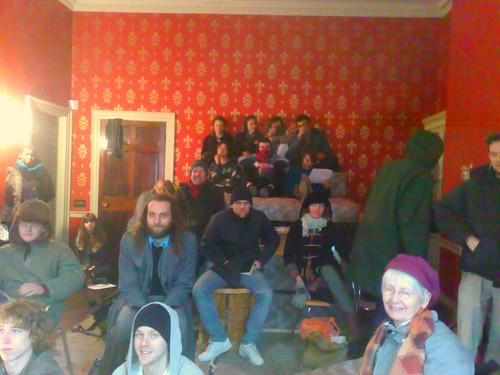
Image courtesy of Lloyd Davies

I've had a lot of people coming here over the last few days to read about the Temporary School of Thought in Mayfair. I'm hugely inspired by what the organisers there have achieved - not least because of the contrast to the introspective factionalism of the squatted social centres I used to hang out in a few years ago. So I thought I'd do a round up of some of the great blog posts, podcasts and pictures documenting what they've achieved over the last couple of weeks.

The Temporary School's curriculum has been impressively eclectic, with hands on workshops in everything from welding to treehouse-building to portrait photography. A number of the talks from the more ideas-based strand of its activities are now available online in various forms, including my talk on Deschooling Everything:

  • Vinay Gupta on Infrastructure for Anarchists - audio / lecture notes

  • Vinay Gupta on Avoiding Capitalism for the Next 4 Billion - audio / lecture notes

  • Dougald Hine on Deschooling Everything - audio (5 mins of chat before it starts)

  • Ben on Virtual Reality and the Immersive Ideal - audio

  • Mike Bennett on Setting up the Post-Capitalist Enterprise - audio

  • Vinay Gupta on Biometrics for Freedom - audio

I'll blog the video of my talk as soon as it's edited. Meanwhile, as a balance to the newspaper headlines, here are some more thoughtful accounts of the Temporary School and responses to it from around the blogosphere:

  • Londonist writes "What do you do with five floors of long-abandoned Mayfair luxury, complete with hand painted Chinese wallpaper and a warren of servants' quarters? Tidy the place up, for starters. Then launch your own school."

  • (You) Enoch has pictures which convey the full the grandeur of the place - while there are more images here.

  • Travels with my Teenager has a nice account of her visit, concluding: "This is real education. I just wish my daughter didn't have to spend so long at school."

  • Lloyd Davies tells how he ended up at the Temporary School as a result of The Tuttle Club - and has a video of the juggling workshop.

  • Dan Gould puts the Temporary School in the context of School of Everything and The School of Life (which I must go and check out soon...).

  • Badger on Fire went down for the Virtual Utopias session and ended up offering to run a Super 8 movie-making workshop.

  • Ligress focuses on the wider context of squatting and the number of empty properties in London and beyond - as well as the French book binding workshop.

  • Dave Bones reflects on how the Temporary School and squatters in general deal with the mainstream media. (For what it's worth, I agree with him about working with journalists rather than excluding them, though I understand why people are cautious about this.)

  • Speaking of the mainstream media, I was amused to discover TSoT had made The Washington Post! [Registration required.]

  • Contemporary art review site Axis has a rather snotty write-up from Josie Faure Walker, who - in true postmodernist style - seems to have difficulty remembering whether she's being ironic or not.

  • Finally, one of my favourite pieces is from the (difficult to link to) The More I [...] Blog:
    Worth observing about these schools is how much better than universities they are at promoting learning. Universities, these days – all thinkpods and co-ordinated swivel-chairs, in drab contrast to the joyfully cobbled-together Temporary School of Thought – all look much the same. The tube posters advertising higher education here in London echo this, be they intense and corporate, stressing the exact probability of a career after graduation, or trying desperately to be down-with-it. There just isn't enough be-tweeded, elbow-patched, avuncular rambling in those classrooms; nothing, in short, to hark back to a time before league tables.

    Instead, learning is miserably positioned as a means to an end. Compare, for instance, the respective websites for a leading university and the School of Life. The latter encourages a thorough flurry of clicks from the get-go, with the welcome accompaniment of intellectual whimsy. Most importantly, perhaps, it assumes a base level of scholarly curiosity. You don't get that with the university – instead, what comes across is a one-track treadmill; a site segregated immediately into department and subject, before you even get any proper sense of what the institution stands for. [see entry for Tuesday, 13 January 2009]

The organisers are finalising the programme for week 3 - and I'm back there on Wednesday at 5pm with a session on Economic Chemotherapy. (I'll be thinking out loud about the possibilities for reversing economic growth, why this might be desireable and how we could thrive in such a scenario.) Beyond that, who knows? I'm hoping the Temporary School is a sign of a renaissance of improvised, informal learning spaces across London and beyond in 2009. The London Free School folks are already organising a weekender for 20-22nd February. And there are plenty more under-used spaces around the city that could be put to use.


*UPDATE*


Jim pointed me towards his blog, The Posh Squatter, which has some great stories from the heart of the Temporary School. I particularly liked his account of the day the house's former owners, a down-at-heel aristocratic family, come round to visit:

When they left, they took my number so they could find out how we get on when the building's owners take us back to court. They wished us luck and wondered "Is there any chance you might get to keep it?"

Meanwhile, messenger-zine Moving Target has a great write-up of Jim's talk about his experiences as a bike messenger, No Fixed Ideas. It's a great example of the mixture of worlds that come into contact with each other in a temporary space like this.

Wednesday, 5 March 2008

School of Everywhere!

I've been really grateful for all the enthusiasm from regular readers for my work on School of Everything - the internet startup I started with friends in late 2006. If this blog has gone a bit quiet lately, it is because things are really getting busy over there. And today we've got some news: schoolofeverything.com is now officially global!

Until yesterday, you could only show up on the map if you were based in the UK - but last night, my colleague Paul Miller presented at the NY Tech Meetup. To coincide with this, we were able to open up the site to teachers around the world. Already, we have teachers in New York, Montreal, Berlin and San Francisco (hi, Nick!).

There's still loads we want to do to finetune things and make the site truly global, but we know there are already people connecting with each other and meeting up as a result of using it. And we've got work underway to take us closer to the vision that drove us to start this:

Our current education system was designed in the industrial revolution to prepare people for factory work. The world has changed a lot since then - and the time has come to rethink education from the bottom to the top.

At School of Everything, we believe that learning is personal, and starts not with what you 'should' learn but with what you're interested in. So we're building a tool to help anyone in the world learn what they want, when, where and in a way which suits them. Putting people in touch with each other, not with institutions.

This isn't about e-learning. There are lots of great online tools, but not much beats being in a room with someone who wants to teach you the thing you want to learn...

Read the rest here.

The most helpful thing for us at the moment is to have people using the site and telling us what would make it more useful for them. So if you know anyone with skills or knowledge that they would enjoy passing on, whether as a paid teacher or just for the love of it, do tell them what we're up to. And keep sending me your thoughts and ideas for directions we might go or people and projects with similar values.

I will try to get back to some regular blogging soon - and Anirudh, I'm aware I owe you a post about liberalism.

Thursday, 28 February 2008

openDemocracy article

Not much time for blogging at the moment, but I do have an article on openDemocracy. This was prompted by a British government proposal (reported in the Guardian) to make it compulsory for parents of school-age children to provide broadband access in the home.

The government's schools minister, Jim Knight, argues that this is no different to the expectation that families provide pupils with a school-uniform, pencil-case and gym-kit. Yet such comparisons serve only to highlight the unprecedented nature of the proposed requirement. When governments begin to oblige people to instal a communications technology in their own homes, this raises serious questions about the role of the state...

You can read the full article here.

Thursday, 3 January 2008

Education as "being us-and-no-one-else"

I've been writing about giving up television, but it's really a rather easy example for me, since I'm seldom tempted to watch more than a couple of hours a week. (Spending less time online is more of a challenge.)

My friend Anthony has been more of a TV watcher - though he could always give you a fascinating critical analysis of whatever he'd been watching, just in case you thought his brain switched off as the box switched on. Anyway, he posted the other day that he's unplugged his TV and is getting back to reading and writing, instead. Long may it last, because I'd love to see more of his thinking in print.

He's just republished, on his blog, some notes on the term 'tradition'. Reading these, I came across a passage on education which relates to some of my thinking-out-loud last month, about what an alternative to learning as 'knowledge production' (or teaching as 'information transmission') might look like:

Speaking as an educator, I find that approaching education as information transmission, protection, and/or preservation can easily lead me to ignore the richness of educational encounter, the personal, present, affectual dimensions of how education can work. Education in face-to-face contexts can be understood to be predominantly about being with, about living 'withness', about the attitudes of the people in the room, about the respect or lack of it within the interactions. When education or 'tradition' are understood as entity-transfer of some sort, it is very hard to even have discussions about respect, attitude, presence, or, dare I say it, gentleness. It's all too easy to default to those attitudes that facilitate the most efficient transaction of resources, those attitudes that allow us to distance ourselves from being us-and-no-one-else and instead allow us to play the roles of 'providers' in an exchange relationship (if you're lucky).

Do read the rest of his post - there's a lot of food for thought in it.

Monday, 17 December 2007

The Problem with the Gentlemanly University

Dan (whose relaunched blog, Covered in Bees, is worth checking out) commented on Friday's oversized post with a link to an elegantly barbed piece from the Times Higher. The author is the Cambridge philosopher Simon Blackburn, his target the much reviled Research Assessment Exercise to which academic departments in the UK are now subject. Blackburn has an angry kind of fun with the RAE, imagining how it might have processed the greats of philosophy:

In amongst the 4* management-speak encomia for team building and research environments we also find with gratitude that "the sub-panel is aware that research of high quality is very often carried out by individual scholars". Phew! A close call then for Plato, Leibniz, Hume, Kant, Wittgenstein and all the rest! They just squeak in, although whether in their own time they would have done so at the 1*, 2*, 3*, or 4* level might puzzle us to say... Like creative art, as often as not great and even good philosophy only slowly creates the sensibilities by which it gets recognized.

The hopeful part of me wonders whether the sheer lunacy of today's managerialism could have the effect of bringing down the whole knowledge factory?

I suggested the other day that earlier models of the university were already fundamentally "business-like" - in that a turn had already taken place away from the ancient assumption that learning requires otium (leisure), towards a model of learning as the "production of knowledge". However, their gentlemanly style of business left many of their inhabitants room to pursue something closer to the style of learning for which I care.

So, what was the problem? Well, my theory (which I'm making up as I go along - bear with me!) is that these institutions also played a critical role in producing the world as we find it - including the ways of thinking which lead to managerialism. (For example, the assumption that reality can be adequately/meaningfully/usefully treated as made up of resources, whose unique and specific qualities are wholly subordinate to their mathematical representation, or exchange value.)

If managerialism is not a barbarian invader, but the absurd heir to centuries of respectable thinking, this has implications for those who would defend learning against it.

The hope I referred to is this: there are many of us who, a generation or two ago, might have holed up comfortably in academia and who are now either sitting inside the university, feeling increasing discomfort - or already outside and improvising space for learning, thinking, reading and writing as best we can. These two groups form a pool in which I think I can make out a potential for new ways of organising learning. These may have some of the qualities I celebrate, without being bound to institutions which are antithetical to those qualities. Significantly, this pool includes people who do not share the kind of critique of the university per se which I have been trying to make.

In support of all this wishful thinking, I offer a passage from the theologian Prof Richard H Roberts which has been rattling around my head for three years now:

Given present conditions, I believe that the future survival of fundamental truth-seeking, the production of knowledge and genuinely 'owned' university teaching, together understood as part and parcel of the total way of life, may well only be assured through cultural migration, and the creation of new, subversive and marginal institutional embodiments.

Religion, Theology and the Human Sciences p.xi

'Fools rush in where wise men fear to tread' and all that... I realise I may be slashing about with a broadsword where what's required is a scalpel. Please, if you know any good surgeons trying to perform such an operation, point me towards them.

Friday, 14 December 2007

Why the only true schooling is a vacation (or "What I didn't do in my holidays")

It has been a week already since I got back from Mexico. I returned with all kinds of things to post about and no great desire to get posting.

Among the pleasures of the Illich colloquium, one was the almost total withdrawal from electronic communication. My reluctance to begin reporting back is partly a reluctance to complete my reintegration to the technological matrix, and partly a sense that the experiences and conversations at Cuernavaca took place not only in a different time zone, but in a different sort of time. Whilst there, they made perfect sense, but a process of careful and unrushed translation is needed, or they are in danger of becoming nonsense. (Leastways, that's my excuse for having been so inarticulate when people asked me how my trip went...)

The pleasure of withdrawing from technology would have been no surprise to Illich. One of the consistent strands in his work is a call to askesis, the discipline of freely chosen renunciation. The purpose of such renunciation is not self-punishment, nor does it imply a judgement on those who don't choose to join us in renouncing a particular habit, activity or technology. Rather, it is a way of making room for the pleasures of otium (of which, more in a moment).

All this, though, is foreign to us. When 'asceticism' is referred to today, it generally signifies a (probably perverse) religious practice. It suggests masochism - or, at least, that hatred of the body which the secular often regard as an essential feature of the religious. It is worth highlighting, then, that in Illich's writing, this aspect of asceticism is not simply downplayed, but explicitly countered. In a 1989 proposal for a five year course aimed at recovering 'the perceptions of self and other which led to the formation of ascetical disciplines,' he writes:

I will place the body rather than the mind at the center of my lectures, not because I can distinguish the two, but because I need a term, the term "body" to engage the student's interest in the traditional habits that cultivate personal centers which they might never have adverted to, such as the heart, the eyes, the limbs, the stomach, the flesh, the ears and the spirit.

'Ascetical habits' once stood in balance with 'critical habits' in the western tradition of learning, but were marginalised from 'the foundation of the University in the late Middle Ages'. Though he doesn't spell it out, I suspect Illich saw a direct connection between this and the disembodiment of knowledge characteristic of modern science. (An idea which deserves fleshing out in a post of its own.)

For now, back to the pleasures of otium, for which askesis makes room. In Latin, otium is leisure, peace and quiet, freedom from responsibility: something looked forward to in retirement or time off from worldly duties. It is the term used by Augustine to describe his calling to a life of study and contemplation, and it characterises the atmosphere required for learning in the monastic tradition. The connection is ancient: the Greek for otium is schole, from which we get 'school'. (And according to Strong's Greek Dictionary, schole is 'a vacation from physical work' and scholazo is 'to take a holiday', so the truest form of schooling really is a vacation!)

The opposite of otium is negotium, literally nec-otium, 'no-leisure'. This is business, occupation or employment - but also pains, trouble and difficulty. Such affairs may not be ultimately escapable. (For Augustine, the calling to otium is in tension with the negotium of ecclesiastical responsibilities.) Yet the value of escape, temporary or permanent, is not in doubt - and it is seen as essential for the pursuit of learning.

All this is of interest to those of us who enjoy the dance of words and ideas to the rhythm of history. The more practically minded may find it 'otiose' in the modern sense: idle, useless and a waste of time. (Mind you, those changed connotations do offer a striking measure of how values have shifted.) Yet there may be meat here for those of us who would negotiate the world of education today.

Both personally and on behalf of School of Everything, I am keen to take part in conversations about the future of the university and of higher learning in general. I share the opinion of those who see in the current crisis of Higher Education, not merely a need to defend the older professional model against managerialism (or to mourn its passing), but the hopeful possibility of new, marginal spaces in which we can explore other ways of organising learning. So I was intrigued, earlier this year, when I heard about the EduFactory project to explore the 'Conflicts and transformations of the university'.

Yet, not for the first time, I found myself disappointed by the conversation that ensued (through the medium of an unfortunately unarchived email list). A great volume of words was produced, theoretically dense, often leading to bad-tempered exchanges, yet suggesting also a great deal of intelligence and good intentions. It was perplexing. My friend Anthony, who has the advantage over me of being a certified academic, lost patience, told the list what he thought and went elsewhere. Essentially, he told them they were suffering from collective verbal diaorrhea, and he wasn't wrong, but what I hadn't located until I sat down to write this was the source of their incontinence.

Bearing in mind the concepts of otium and negotium, the problem may be seen from the name of the project, or from the prospectus for its second round (which began last month):

The first round of discussion on the edu-factory list showed that, despite the many differences between universities and countries, it is possible to identify a global trend and common experiences in the world of the university. These stem from the pervasiveness of the market and the processes of corporatisation that universities in many parts of the world are undergoing. But they also involve the struggles and movements that have contested academic borders as well as wider power structures, claiming the free circulation of knowledge and practicing alternative forms of knowledge production.

For the radicals of the edu-factory list, just as much as their supposed enemies, the university is conceived of as a factory for 'knowledge production'. No wonder they are so industrious in the manufacture of neologisms, or such Stakhanovites in their output of emails!

Government ministers often see universities (or, to be more precise, Oxford and Cambridge) as feudal anachronisms, holding out against good, rational, business management. The truth is stranger. The very roots of the modern university, as early as the 13th century, are in the turn away from otium as the proper atmosphere for study, towards worldy negotium. So the contemporary crisis is rather more like that of an old family business, run for generations on gentlemanly terms, which finds itself suddenly under new ownership and having its assets stripped.

After going on for eight centuries, most inhabitants of the university can barely imagine it as anything other than a factory for the production of knowledge. Yet the grounds for such imagination are just what study-as-otium can offer. Illich, again:

I want to cultivate the capacity for second thoughts, by which I mean the stance and the competence that makes it feasible to inquire into the obvious. This is what I call learning.

And, in another essay, 'The Cultivation of Conspiracy':

Learned and leisurely hospitality is the only antidote to the stance of deadly cleverness that is acquired in the professional pursuit of objectively secured knowledge. I remain certain that the quest for truth cannot thrive outside the nourishment of mutual trust flowering into a commitment to friendship.

Is there any hope for learning as a quest, rather than a production line? For these strange concepts of askesis and otium? 'The asceticism which can be practiced at the end of the 20th century,' Illich wrote, 'is something profoundly different from any previously known.'

I find hope in the company of those I met in Cuernavaca, but also in a series of encounters since I returned with some of the smartest, most technologically adept people I know. One is giving up sending email from his thirtieth birthday. Another will spend ten days over Christmas and New Year in a silent retreat. The third claimed to have spent the past few months 'shitting myself into a twelve inch screen' and to want reminding that she has a body. The possibilities are there.

Anyway, the great thing about otium is that you don't have to wait for the fulfilment of a grand project to enjoy it. You can start by switching off your computer, turning off your phone, stretching your work-cramped body and deciding to dedicate the weekend ahead to meditative idleness - which is just what I plan to do now.

Tuesday, 2 October 2007

School of Everything Goes Live!

When a new school opens in the UK, it's customary for a member of the royal family to cut a ribbon or unveil a plaque.

Adam asked me the other day if we had something similar planned for the opening of the School of Everything. I said it would probably be less an opening, more a case of leaving the door unlocked and seeing who wanders in...

Well, that's what we did! The site went live some time last Friday afternoon. (I missed the historic moment, as I was driving a van up the M1 at the time.) It's still very early days and there's a lot we need to fix, but it's exciting to see teachers starting to add themselves to the site.

So go and check it out, list something that you could teach, pass it on to your friends - and let us know what you think!

www.schoolofeverything.com

Monday, 10 September 2007

Illich - where to start?

Since I started this blog, I've name-checked Ivan Illich fairly regularly. His writing style takes a little getting used to, but his books and the various uncollected essays scattered across the web are pretty much all worth tracking down.

One question I get asked a lot is where someone who's new to his work should start. The long answer is, it depends on where you're coming from and what it is that most troubles you about the world in which we find ourselves - whether it is education or energy, health or work. Those looking for policy recipes were dismayed by his increasing withdrawal from that game, and mistake this for despair - but I find later texts, such as 'The Cultivation of Conspiracy', to be among the most genuinely (unillusionedly) hopeful responses to our times.

That's the long answer! The short answer is to try this little film, a reflection on 'Deschooling Society', which I discovered via Bricoleuse.

Wednesday, 1 August 2007

Serendipitous Learning and Zemblanitous Education

What did you learn today? It's a question plenty of kids get asked when they come home from school - but maybe one we don't ask ourselves so often as grown-ups...

Well, in the past twenty four hours I learned at least two things. One is that the word 'serendipity' comes from an old name for Sri Lanka - Serendip. For a word of such a vintage, its origins can be dated with unusual precision, to the 28th of January, 1754. It was coined by Horace Walpole in a letter, referring to a fairy tale called 'The Three Princes of Serendip'. These princes 'were always making discoveries by accidents and sagacity, of things they were not in quest of'. Hence, serendipity.

My second learning of the day was that serendipity has an opposite. An antonym, in fact. (And how often do you get to use that word?) 'Zemblanity' is a more recent coinage, the work of the novelist William Boyd:

So what is the opposite of Serendip, a southern land of spice and warmth, lush greenery and hummingbirds, seawashed, sunbasted? Think of another world in the far north, barren, icebound, cold, a world of flint and stone. Call it Zembla. Ergo: zemblanity, the opposite of serendipity, the faculty of making unhappy, unlucky and expected discoveries by design.

All this I learned by following up a presentation by a Finnish guy called Teemu Arina - which I came across thanks to a post from Artichoke. Teemu reckons (and I agree) that "making unhappy, unlucky and expected discoveries by design" is a pretty good description of what happens in formal education, when "learning outcomes" are specified in advance.

Meanwhile, elsewhere, Will Davies is concerned that "Web 2.0" threatens to eliminate serendipity from whole areas of our lives, in the pursuit of more efficient ways of finding music we'll like or people to whom we're indirectly connected:

Outside of the economy - and very often within the economy too - we find that the constraints and accidents of everyday life are the basis for enjoyable and meaningful activities. They don't necessarily connect us to the people we most want to speak to or the music we most want to listen to. Sometimes they even frustrate us.

But this shouldn't lead to business process re-engineering. ...when we vote, chat to neighbours, browse through a record shop we are not seeking some outcome in the most efficient manner available. We are engaging in an activity that we find valuable.

That reminded me of an experiment by Matt Jones (who's on our advisory board for the School of Everything). A few years ago, he asked the readers of his blog to help him make contact with Brian Eno - a quest in which he succeeded within two days. Afterwards, he reflected (in a less apocalyptic tone than Will) on the unsatisfactoriness of social networking tools which leave no room for serendipity:

...the goal of all the 'Sters is to collapse our social web to a surveyable size, bringing our friends and connections close enough to see beyond them to new people. A little like glancing over the shoulder of someone you’re talking to at a party in order to see who’s coming through the door.

The picturesque and playful exploring of our social connections is sacrificed. The mathematics of coincidence are intruding on the delusions we enjoyed every time we exclaimed to a new acquaintance the reassuring cliche “what a small world!”.

Where’s the business model in social networks? The same as email and other generators of information overload: the new luxury of meaning. I will pay to sustain the space, the silence and the signal. Give me privacy and anonymity, but also possibility. Extend my connections, but don’t collapse them.

I share Will's concern about the ways in which the tools we use shape us - deform us, even. There is too much hype about Web 2.0 and that means not only that its strengths are over-rated, but that its more troubling aspects are overlooked. Yet compared to the compulsory zemblanity of the education system, my meanderings across the internet continue to be spiced with serendipity...

Wednesday, 18 July 2007

Wounded and Hopeful

There's something rather wonderful about discovering that John Berger, whose books more or less changed my life, also happens to share my taste in music!

I mean, as man born the same year as my grandmother, it would be understandable if he had paid little attention to the popular song of recent decades. But in his new book, 'Hold Everything Dear: Dispatches on Survival and Resistance', there is an essay on erotic desire which quotes Nick Cave.

Then I came across this radio broadcast from the BBC World Service. (Be quick, it's only available till Saturday - the interview is about two thirds of the way through the programme.) Here he elaborates on his appreciation of Cave. "It's to do with the way that desperation and... not exactly pleasure, but fulfillment, are two profiles of the same face. Black beside gold, if you want to put it into colours."

He goes on to enthuse about Johnny Cash's final album, tracks from which have been haunting my playlist for months.

I've felt for a long time that there is a common theme, an attitude, which links the work of those artists and writers I admire - setting it apart from much else that you read or hear. It is touched on by the title of Berger's collected poems, 'Pages of the Wound'. What I am talking about is an attitude to brokenness which is quite at odds with the assumptions of our society - a recognition that the place of brokenness, the wound, is also the place of hope. In fact, the only place at which hope - which is quite different to optimism, or faith in Progress - can begin.

By contrast, most of our culture proclaims the desirability of unbroken perfection, fulfillment, satisfaction - so the wounds which we all carry become a source of shame, something to be evaded, or fixed with quack cures.

As I see it - and I suspect Berger and Cave might agree on this - the connection between brokenness and hope is the great, though often mislaid, insight of Christian theology.

In another key, the denial of brokenness characteristic of our culture may be connected to the categorisation of reality which Berger has always challenged. Years ago, he wrote about the last day in the life of his friend, the Austrian philosopher Ernst Fischer. A quote from Fischer has stuck with me:

The categories we make between different aspects of experience - so that, for instance, some people say I should not have spoken about love and about the Comintern in the same book - these categories are mostly there for the convenience of liars.

These categories are broken things presented as wholes. By challenging that presentation, by acknowledging the (damaged) connections between them, we may do something to limit the damage they continue to do.

In the World Service interview, Berger returns to this theme, when asked about the way he writes about Palestine, Iraq and the War on Terror alongside poetry, art and desire:

One of the reasons why we all can, at times, have a feeling of really being lost... is the way that - and this often begins at school, but now it goes on an enormous amount in the media - the way that subjects are divided up into special categories. [My understanding of this] may have something to do with the fact that I never went to a university - and universities are where all those categories and the walls between them... they are strongholds of those kinds of divisions. I never went to university, I left school when I was sixteen and that's all the formal education I ever had. After that I went to art school, but what did I do, I looked at films and drew naked models. Maybe it was something to do with that - maybe there was an advantage of feeling free to go from category to category...

I discovered Berger's books as I was beginning to recover from the disorienting experience of three years as an Oxford undergraduate. I learned from them a new way of learning, which was really an old way - led playfully, by curiosity, through conversations and encounters, across categories, wounded and hopeful. I don't know that any of my colleagues would realise this, but for me the vision of the School of Everything owes a great deal to John Berger.

About Me

My photo
London, United Kingdom
This blog was my online home between 2006 and 2009. Today, you'll find me scattered across the internet. To start looking, go to my personal website: http://dougald.co.uk/

My Projects

Signpostr School of Everything

MyBLOGLOG

Followers

My ClustrMap

From My Shelves

Labels