Showing posts with label paul kingsnorth. Show all posts

Thursday, 23 July 2009

Dark Mountain Project Update


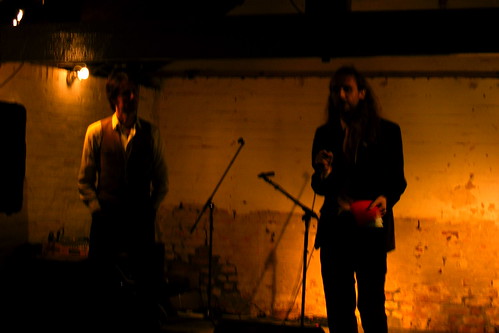
So there we were, last Friday night, in a barn in a field beside the Thames to launch the Dark Mountain Manifesto. (Those relying on sat nav to guide them in were foxed by the half mile walk from the nearest road, which added a suitably uncivilised edge to the evening.) Paul talked about how he got fed up with journalism and the environmental movement. I called George Monbiot some rude words. Get Cape Wear Cape Fly, Chris T-T and Marmaduke Dando lent us their voices, giving memorable and moving performances. Much good local beer was drunk and a fine night was had all round.

Almost a week on, I'm still posting off copies of the manifesto to our subscribers. (If you haven't received yours yet, apologies.) We've been reviewed by the Morning Star and the RSA's Arts & Ecology blog, whose editor called it "erudite, lyrical and, most of all, apolcalyptic in an almost William Blake-ish kind of way". Slowly, the word spreads outward, and Paul and I will be writing articles for various places over the weeks ahead.

Meanwhile, if you missed the launch, check out Andy Broomfield's beautiful photos. And if you're still wondering what all this Dark Mountain stuff is about, this interview I did with Anab Jain may help.


Dougald Hine talks about the Dark Mountain Project from Anab Jain / Superflux on Vimeo.

Thursday, 16 April 2009

Announcing 'The Dark Mountain Project'

Today is an exciting day. After a year or so of meetings in pubs and emails backwards and forwards, it is time to announce the Dark Mountain Project - a literary and artistic movement for a time of massive global change.

The project grew out of a conversation with Paul Kingsnorth, started by a blog post in which he proposed:

a new publication: not a magazine, exactly, not quite a journal either, but something between the two and somewhere else as well. A publication which will match the beauty of its writing with the beauty of its design. A publication whose mission will be to reclaim beauty and truth in writing, but without sounding too pompous about it. A publication which will reject both celebrity culture and consumer society with equal vehemence. A publication which will celebrate our true place in nature in prose, poetry and art; which will hunt down ancient truths for modern consumption.

Gradually, that idea has taken a fuller form, and between us we have written a pamphlet which is intended as a first step towards that magazine. Over the next three weeks, we aim to raise £1000 in donations towards the costs of publishing that pamphlet as the Dark Mountain Manifesto and building a website to support the movement.

Why are we doing this? Because of the times in which we find ourselves. Because a collapsing economy and a collapsing environment are turning all our assumptions on their heads. Because nothing that we currently take for granted seems likely to come through the 21st century unscathed. Because civilisation as we have known it is coming apart at the seams.

We don't believe that anyone - not politicians, not environmentalists, not writers - is really facing up to the magnitude of this. We are all still wedded to the idea that the future will be an upgraded version of the present. It is in our cultural DNA. Perhaps this is why, as the warning signs flash out ever more urgently, we still go shopping, or plan for more economic growth, or campaign for new energy technologies, or write novels about the country house or the inner city.

A civilisation is built not on oil, steel or bullets, but on stories; on the myths that shore it up and the tales it tells itself about its origins and destiny. We believe that we have herded ourselves to the edge of a precipice with the stories we have told ourselves about who we are: the story of 'progress', of the conquest of 'nature', of the centrality and supremacy of the human species.

We believe it is time for new stories. The Dark Mountain project aims to foster a new movement of writers, artists and creative thinkers, a new school of writing and art for an age of massive global disruption. We are calling it Uncivilisation.

Very soon, we will be launching the Dark Mountain Manifesto, as a hand-crafted pamphlet and online. At the same time, we will launch our website. If enough people seem interested, we then plan to begin publishing a journal of Uncivilised art and writing. And if that takes off, there is much more that this nascent movement can be doing to help create the stories that will define these new times.

For the moment, though, we are looking for help. The Dark Mountain Project is not a prescriptive attempt to tell people how to write or think, but the raising of a flag around which we hope like-minded people will gather. So we are looking for people who might want to be involved: writers, artists, illustrators, designers, thinkers - anyone with whom this strikes a chord.

The other kind of help we need is money. Zac Goldsmith has already generously donated £1000 towards the cost of publishing the manifesto and launching the full Dark Mountain website. We are looking to raise the same amount again in donations over the next three weeks. If you can afford to contribute towards getting this project off the ground, please visit our fundraising page on Fundable.com. (Everyone who donates $20 or more will receive a copy of the manifesto and an invitation to our launch event.)

The challenges of the 21st century are too often framed only as technical problems requiring solutions. I believe that this is a form of denial. What we face is a challenge to the imagination - the challenge of imagining a liveable future in a changed world. I hope that the Dark Mountain Project can help place the imagination at the heart of our response.

Sunday, 17 February 2008

Is Obama "Blair 2.0"?

Paul's comment on last week's Anarchists for Obama? post really got me thinking. I'd quoted a fairly lengthy chunk from one of Ran's posts about Obama, in which he imagines how the different presidential candidates might react to a major economic crisis. Paul responded:

For me it sums up the whole curious enigma of Obama: how everyone invests their hopes in him and sees what he wants to see. [Ran] actually has no idea what Obama would do in such a situation; neither do any of us. Neither, probably, does Obama. But he knows what he hopes for.

In this sense, Obamania reminds me of the attitude to Tony Blair circa 1996. Hard to credit it now but we invested extremely high hopes in him too. And look what happened.

Interesting that Clinton supporters keep complaining that Obama has 'no policies.' They don't understand that no-one cares; no-one wants 'policies'. They want hope after a period of darkness and Obama offers it because people have decided he is the right vessel for their expectations at this moment in time.

Viewed from this side of the Atlantic, there certainly seem to be parallels between the Obama phenomenon and what we saw in 1997. A charismatic, youthful leader captures the mood of a significant part of the public, promising a fresh start after an unpopular and discredited regime, while offering very little in terms of specifics. Blair famously managed to leave just about everyone who met him in the run up to the election convinced that he stood for their particular cause, while committing himself to almost nothing.

So, is Obama simply Blair 2.0?

I want to hold that (admittedly scary) thought, and go back to Ran's posts, because the passage I quoted before was slightly unfair. From a British perspective, right now, it's hard to imagine getting that excited about a politician - and when Ran admits that American politics is pretty 'cult-like', I'm guessing he recognises how that applies to him. But the following passage catches both the cult-like element and something more nuanced:

Barack Obama's candidacy is the kind of opportunity that only comes along once or twice a century. He has honesty, courage, intelligence, charisma, and great political instincts, but most important, he shows a willingness and ability to channel bottom-up energy, to challenge the people to act, and to serve as a focus for public passion, where the Clintons would go in the back room and flush it down the toilet. It doesn't matter where he is on the issues! That's gearhead thinking. When you look on the level of human spirit, Obama represents our only chance to renew America without passing through really horrific violence.

Admittedly, it's not much of a chance. Even if he manages to overcome the ruthlessness of the Clintons, and then not get assassinated, we can't just sit back and expect him to take care of us. That's the kind of thinking that ruined America in the first place, and Clinton supporters are trying to keep it going, answering Obama's "Yes we can" with "Yes she can." We're going to have to organize boycotts and strikes and local currencies and secession movements and illegal mutual aid networks and mass physical actions that are tactical and not merely symbolic. We'll have one, or four, or maybe eight years with Obama in office, and we should think of him not as a leader but as a weapon, a lever big enough to move the country. And the elite are going to have to stand down, to allow painful moderate changes instead of violent big ones. In the last hours before the French Revolution, the lawmakers relented and passed a bunch of huge reforms, but by the time anyone found out, it was too late -- they were already burning the chateaus.

Leaving aside the hyperbole, where here's where I think Ran is on the right track: the most important question we can ask about our politicians today and tomorrow is how far they are prepared to hold open the space for bottom-up alternatives. There are various complications to this:

  • The whole 'bottom-up' idea may be at risk of becoming diluted to the point where that language loses its meaning - not least through the hype around Web 2.0.
  • In policy-think, 'bottom-up alternatives' can easily translate as 'doing things on the cheap'. Governments, by default as much as by design, are likely to pervert bottom-up initiatives by seeing them as a way to outsource the cost while retaining control (in the name of "setting standards", etc).
  • Judging politicians by their willingness to hold open the space for genuine bottom-up alternatives may or may not map coherently onto our existing frames of reference ("left" and "right", "liberal", "conservative", etc). In particular - and this is a topic I want to return to in a future post - 'liberalism', in all its varying senses, may turn out to be less of a friend to the bottom-up approach than some of us expect.
  • It may or may not be possible to make meaningful judgements about how candidates will actually behave in office. (Paul gives the pessimistic take on this when he says that none of us - up to and possibly including the man himself - have any idea how Obama would behave in the scenario Ran imagines.)

Two thoughts on all of this, for now, before I go to bed!

There is every chance of Obama turning out to be Blair 2.0 - but there seems to be a difference in the hopes being invested in him. Ran may not be the most representative voice, but the significance of the "yes we can" slogan which he points to is larger. Part of Obama's appeal does seem to be connected to a bottom-up message, however deep or shallow that turns out to be. By contrast, whatever hopes were invested in Blair in 1997, people already knew that he was a control freak - we had watched him establish an iron grip over the Labour party over the previous three years. Inside and outside the party, the hope was that the ends would justify the means. Blair's message was "trust me", not "trust yourselves".

Secondly, a thought on the question of whether it is possible to make meaningful judgements about how a candidate will behave in office - particularly, whether they will hold open the space for bottom-up alternatives or allow them to be crushed (or crush them directly). It seems to me that we make judgements like this about people we meet in our daily lives - friends, colleagues, dates... - and most of us trust our own judgement to be more right than wrong. My guess is we can make similar judgements about candidates for office, but that this gets less reliable the greater the distance from our lives. In other words, Obama notwithstanding, I hold out more hope for the chances of electing candidates at a local level who we can trust to hold open that space - and less hope for the more remote layers of government, where politics is more bound up with the operations of the media.

Thursday, 14 February 2008

Anarchists for Obama?

A couple of weeks ago, Paul Kingsnorth posted his interior monologue about Barack Obama:

Wow, this is really quite exciting. I wonder if he could be the next JFK?

Hang on: JFK started the Vietnam war.

And then he got assassinated.

Say what you like though, the guy has charisma.

And he does have a nice smile. And he used to write poetry and smoke weed, so he can't be all bad.

I wonder what his policies are.

I really hate Hillary Clinton; vile little plastic goldfish. I hope she loses.

I really hate myself for being taken in by this admittedly impressive PR.

Imagine Obama in the White House though. Wouldn't that be something?

Why do people keep calling him 'black? He's mixed race, but no one calls him 'white'?

Humans have an apparently limitless need to believe in leaders who will liberate them from the drudgery of reality. Idiots.

It's quite exciting though.

Then this week Ran Prieur - someone I'd have assumed to be even more opted out of electoral politics than Paul - has made a series of fascinating posts about why he's campaigning for Obama. This really got my attention. (I'm posting a big chunk, because Ran hasn't given this post a permalink yet):

By January 2009, when the next president takes office, it will be obvious that we are in a Greater Depression. Tens of millions of Americans will be angry and desperate and uncomfortably awakened and confused. People will be losing their homes, their incomes, their ability to buy food and fuel and health care. And giant predators, from banks and corporations to foreign property owners to Blackwater, will be trying to exploit the crisis for selfish gain.

Now imagine that you are part of an organized movement that's technically against the law. Maybe a few hundred people have occupied an abandoned suburb and you are tearing down houses and making gardens. Or some farmers are refusing to leave land that the banks claim to own, and they've blockaded the roads with tractors and pulled out their hunting rifles. Or some truck drivers have gridlocked a major port to protest fuel prices. Or the people in one poor neighborhood have run out of food, and they march to the Whole Foods in a rich neighborhood and take what they need. Or half a million people march to protest the Iraq war, and because they don't have jobs or health insurance to lose, they don't go home, but occupy the center of a major city for days.

Now, what would President McCain do? He would send in the fucking military and smoke your ass, and if you weren't killed, you would be shipped to a "detention facility," and never heard from again.

What would President Clinton do? She would talk to all her big donors and neocon advisers, and do whatever they told her to do. And then she would talk to all her pollsters and spinners and focus groupers, and go on TV and say whatever bullshit they told her to say. We could do worse, but we could also do much better, because the elite will be too removed from reality to make good decisions, and her words would be so different from her actions that people would just get more cynical and angry.

What would President Obama do? I could be wrong, but I think he would go in person and listen to you, ask you what you needed and how he could help. Then he would go back to the big money people, and explain your position to them, and ask them what they needed. Then he would work out a compromise, and he would go on TV and explain the whole situation and how he resolved it and why. Nobody would be completely happy, but we would avoid a big disaster and gain in understanding.

The main thing we would understand is that we are powerful, that we can illegally threaten the status quo and win concessions. Tactical organized mass actions would break out all over. It would be anarchy! And I mean that in mostly a good way. One way or another, energy from below will take apart the system and build a new one, because that's the end of all empires. I really can't see the future clearly enough to be more specific. But with Clinton or especially McCain, it would be a much worse kind of anarchy.

Thursday, 25 January 2007

Offset Your Infidelity!

No sooner had I posted about the wonders of First Life, than I came across another overdue solution to the moral ambiguities of existence in 2007.

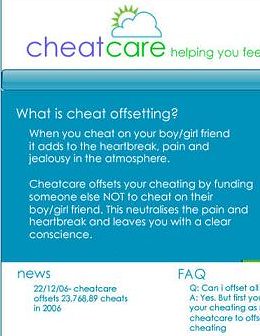
I present to you, Cheatcare: helping you feel better about bad stuff:

Your cheating is offset by these people who we pay not to cheat on their partners...

(Courtesy of the highly recommended Paul Kingsnorth.)

About Me

My photo
London, United Kingdom
This blog was my online home between 2006 and 2009. Today, you'll find me scattered across the internet. To start looking, go to my personal website: http://dougald.co.uk/

My Projects

Signpostr School of Everything

MyBLOGLOG

Followers

My ClustrMap

From My Shelves

Labels