Wednesday, 26 September 2007

Bureaucracy, Care & Attention

(There will be some examples of Plan B coming up soon - meanwhile, this started as an over-sized comment elsewhere, so I decided to post here instead...)

I've been thinking a lot about "attention" lately. Then I read Andy's post about Factory Records, Products that don't care if you buy them:

I love the Factory story. Not only did they produce some of my all-time favourite music, but I also find their anarchic approach really inspiring. It's a great example of a particular kind of story: the "we didn't care, and that's why it worked" story.

Anthony commented on this:

I was glad that the documentary on Factory didn't completely ignore the way that the members of Joy Division/New Order got completely shafted by Factory's ad hoc way of working. They didn't seem too bitter about it, but they did lose hundreds of thousands if not millions of pounds. Ad hoc is fine, but not so much if people get harmed by it in the process?

This all got me thinking...

The Factory approach feels like an antidote to the standard "managerial" approach to running an organisation/etc. It seems to me that managerialism is (among other things) a way of keeping an organisation/project/whatever running in a relatively stable way with the minimum amount of attention to the personal.

By structuring processes to be as rational, predictable and defined as possible, you limit the consequences of not paying attention to the personal (i.e. the fact that your organisation is actually made up of people).

Of course, you also limit things like autonomy and creativity and meaningfulness. If you want a more creative organisation, you can try to dispense with managerial processes, etc. But unless this is accompanied by a much greater level of attention to the personal, this will tend to increase the extent to which people get harmed.

I can see three kinds of response to this:

(1) A tendency to treat the people getting hurt as "collateral damage" - unfortunate, but a price worth paying. (This kind of attitude is in keeping with a lot of the messages we get - from politicians, the media, the education industry - about what life is like.)

(2) A nostalgia for older, more hierarchical and bureaucratic ways of running organisations. There's a cluster of thinkers and writers on the left who exhibit this - people like Richard Sennett, Zygmunt Bauman, Madeleine Bunting and Barbara Ehrenreich. (Sennett in particular recants his earlier enthusiasm for the New Left and its desire for more autonomous ways of living.) While this is motivated by a proper recognition of how people get hurt by newer, anti-bureaucratic organisational styles, I think it leads to an unnecessarily bleak position.

(3) A deeper, practical critique of our organisations and workplaces. If doing things together in a creative, autonomous and meaningful way requires greater attention to the personal, then maybe we need to lower our prized "productivity" and spend more time attending to each other as people? Maybe in addition to "doing things badly", The New Sociablism should encourage us to "do things slowly" and "do less".

This could sound like the kind of impractical proposal that requires a different world to the one we currently live and work in. But my experience is that other worlds already exist in the gaps and cracks and folds of the World towards which our attention is generally directed...

Finally, to go back to "We didn't care, and that's why it worked" - I remember my singing teacher telling me at 17, "A lot of people in this school think that you don't care, but I think you do." (By which I understood her to mean that I really wanted to be good and obedient and was putting on a show of rebellion in order to be cool.) I was silently incandescent and would still like to go back and tell her that I did and do care - just not about the things she thought were worth caring about.

So rather than celebrating not caring, let's celebrate choosing what to care about. (And don't "care" and "attention" refer to more or less the same thing?)

Saturday, 15 September 2007

Plan B

After Thursday's lengthy post, I remembered another stand-out passage from that Ran Prieur essay, one that relates to a lot of conversations I've had over the last couple of years. He's talking about the motives for what policy-makers call "behaviour change":

We think we're turning off the air conditioner and bicycling to work to save the Earth. In fact, other people and other economies will just take our place at the Earth-gobbling table and eat it just as fast. What we're really saving is our future sanity, by practicing for the day when we're forced to reduce consumption...

This is the honest answer when someone asks, "What's the point?" But it's an answer that even the greenest mainstream companies and politicians are unlikely to give you - because it involves imagining a world in which they lose their current dominance.

Here in the UK, the upmarket retailer Marks & Spencer has been running a campaign to change its behaviour, under the banner: 'Plan A - Because There Is No Plan B'. I find that a really disturbing message, because personally I can imagine a world in which people live well without much of the current retail apparatus. So while there may be no Plan B for a company like Marks & Spencer, that's not an argument for putting all our eggs in one (supermarket) basket...*

In fact, over the last two years I've met all kinds of people who are developing something that looks a lot like a Plan B. It doesn't look much like a plan, more like a great distributed research project with no overseeing structure. For months now, I've been intending to write a longer article about this - something I may still do. But in the mean time, I've decided to dedicate most of my blogging for the next little while to writing about examples of this kind of 'action research' - people who are practicing for the day when we're forced to change our ways of living.


* Just to be clear, I'm not saying Marks & Spencer shouldn't be doing what they're doing - reducing their carbon footprint, stocking fair trade products, encouraging people to use less plastic bags. But the slogan they've chosen provides an unusually clear statement of a far more widespread approach to 'sustainability', the subtext of which is that we must preserve our current lifestyles at all costs.

Thursday, 13 September 2007

All Fall Down: Jared Diamond and Ran Prieur

Not long ago, I finally got around to reading Jared Diamond's Collapse: How Societies Choose to Fail or Succeed. I can see why it has attracted such acclaim - and yet I couldn't help feeling slightly short-changed. Then, last week (via Laura and Tim), I discovered another writer who thinks deeply and practically about the fall of civilisations, past and present. His essays helped bring into focus my disappointment with Diamond's book.

Let's get the praise out of the way first! I learned a great deal from the descriptive material in Collapse. The chapters on Easter Island and Norse Greenland are fascinating - as are the modern case studies on countries such as Rwanda and the Dominican Republic/Haiti. It was also a relief to read a popular non-fiction book which isn't flogging a single Theory of Everything (a trend Will Davies was decrying recently). In fact, I could pick out several theoretical strands in Collapse, and the two which get most emphasis from Diamond are both valid and important. To paraphrase*:

  • Critical to the survival or extinction of groups of humans living in a particular place are the choices they make about their way of life - and how those choices interact with ecological factors.
  • Where an elite has become isolated from the sources of its material wealth, people are less likely to make timely changes to their way of life which might avert ecological disaster.

So far, so much to agree with. So why do I feel short-changed?

Let's start with the ending. Having illustrated how quickly societies can tumble from their peak of material wealth to catastrophic collapse, and suggested that this scenario may be playing out today on a global scale, Diamond leaves us with a picture of the forces of good and evil in a race to the finish - and, buried in the 'Further Reading' section, a rather feeble list of positive actions and ways that consumers can put pressure on big business to save the world.

What is missing here is any sense of just how different our ways of life would have to be to escape the kind of collapse that may already be underway. Having conjured such powerful scenes of ancient worlds and how they fell apart, Diamond's imagination seems to desert him.

I would trace this back to some of the book's background assumptions - assumptions which prevent Diamond achieving any real perspective on our current way of living. The kind of perspective I'm referring to is not the lidless vision of a satellite looking down on the earth - but that sense of our own strangeness which comes from sitting quietly with others who do not see the world as we do, until we begin to glimpse ourselves through their eyes. This may be through direct contact with people who live very differently to us, or through a deep and sensitive familiarity with the writings of other eras.

Despite his best intentions and the thoroughness of his research, Diamond lacks this kind of perspective - and so he tends to read others through our ways of approaching reality. Consider, for example, the book's subtitle: How Societies Choose to Fail or Succeed. What if approaching life in terms of "failure" and "success" is actually part of the ways of thinking which are accelerating us towards collapse?

That is certainly what Ran Prieur reckons. A section of his essay How to Survive the Crash and Save the Earth is headed 'You are here to help':

We are trained to think of ourselves as here to "succeed," to build wealth and status and walls around ourselves, to get what we desire, to win in games where winning is given meaning by others losing. It is a simple and profound shift to think of ourselves instead as here to help -- to serve the greatest good that we can perceive in whatever way is right in front of us...

In the real world, being here to help is easier and less stressful, because you will frequently be in a situation where you can't win, but you will almost never be in a situation where there's nothing you can do to help. Being here to win only makes sense in an artificial world rigged so you can win all the time. Thousands of years ago only kings were in that position, and they reacted by massacring all enemies and bathing in blood. Now, through a perfect conjunction of Empire and oil energy, we just put the entire American middle class in that position for 50 years. No one should be surprised that we're so stupid, selfish, cowardly, and irresponsible...

Where Diamond sees us caught up in a horse race between the environmental movement and the forces of destruction, Prieur suggests we walk away from the winner-takes-all mentality. Instead, start learning skills and adapting in preparation for what happens when our current ways of living become impossible. Easily said! But I'm more convinced by his approach than by one which can't imagine any alternative to the perpetuation - through some magic of "sustainability" - of the status quo.

I could go on at greater length about the other assumptions and vaguenesses constraining Diamond's imagination - or about Prieur's clearer-sighted visions of how our civilisation might collapse, and of the possibilities on the far side of such a collapse. But you'd be better off reading his latest essay, How to Save Civilisation.

To give you a taste, here's the closing paragraph - which made me think of my low-tech, computer-recycling friends at Access Space:

I don't think we'll have any technology in 2100 that can't be done in 2050 in a garage -- or in a network of garages and scrap collections. If there's anything we want to save, we need to begin adapting it now so it can be done on that level, bottom to top. Garage industry doesn't have to profit or die. It doesn't require wage laborers who will quit when money no longer buys food. Technology will be carried through industrial collapse by dedicated amateurs, and then, whether the next world is stable or unstable, they will plant the seeds of a new tech system... which is very likely to make another epic mistake.


* I should probably add that I wrote this several months after reading Collapse, without a copy to hand. Apologies, therefore, for the lack of close reference to the text. On the other hand, with such a large and wide-ranging book, perhaps there's something to be said for focusing on those elements which stick in the mind at such a distance?

Wednesday, 12 September 2007

Space Hijackers: They Did It!

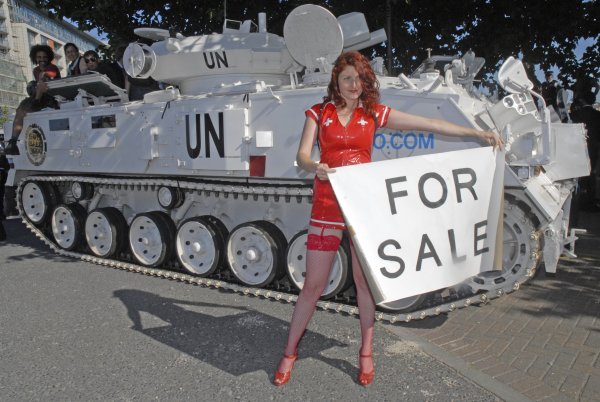
The Space Hijackers pulled a classic bait-and-switch on the police yesterday, to achieve their goal of auctioning a tank outside the front doors of the DSEi arms fair! The Met had spent all weekend following the Saracen Mk 1 which the Hijackers bought last week, finally pouncing as it left its storage location - when they pulled it over on the grounds that the suspension was dodgy.

At this point, a member of the crew climbed on top of the vehicle to announce that it was in fact a decoy! Round the corner, a rather larger tank (complete with tracks and gun turret) was rolling off the back of a low loader and up to the venue!


The auction took place, with bids of bodily organs and first-born children being turned down in favour of $50 in cash - money being worth more than human lives, when it comes to the arms trade...

Will it make any difference to anything? Who knows! On the whole, if you want to "change the world", I believe your time is better spent growing good things than protesting against bad things. But if you're going to make a protest that might well turn out to have been futile, you can at least make sure you have fun - and that's one thing you can count on with the Space Hijackers.

Monday, 10 September 2007

Illich - where to start?

Since I started this blog, I've name-checked Ivan Illich fairly regularly. His writing style takes a little getting used to, but his books and the various uncollected essays scattered across the web are pretty much all worth tracking down.

One question I get asked a lot is where someone who's new to his work should start. The long answer is, it depends on where you're coming from and what it is that most troubles you about the world in which we find ourselves - whether it is education or energy, health or work. Those looking for policy recipes were dismayed by his increasing withdrawal from that game, and mistake this for despair - but I find later texts, such as 'The Cultivation of Conspiracy', to be among the most genuinely (unillusionedly) hopeful responses to our times.

That's the long answer! The short answer is to try this little film, a reflection on 'Deschooling Society', which I discovered via Bricoleuse.

Sunday, 9 September 2007

Space Hijackers: Tank Update

You might remember the Space Hijackers and their quest for a tank, which I flagged up earlier in the summer. Well, they did it!


The Saracen Mk 1 was delivered last week and received its number plates from the DVLA on Friday. Apparently the owners of the venue where it was initially parked were put under a certain amount of pressure by the authorities - and the hijacker team has spent the rest of the weekend playing cat and mouse with the Met.

According to their press release, the plan is to drive the tank to the DSEi Arms Fair - taking place, rather tastefully, on September 11th - and auction it to the highest bidder:

If this so happens to be an angry teenager in a balaclava, then so be it. We don't see how destruction caused with our tank can possibly be our responsibility.

Several people have got in touch with us claiming that this kind of behavior is slightly reckless "what if someone drives over a police car in your tank?" Our response is simple: we are simply looking to make a profit, it's just business transaction. As with the arms dealers and their weapons, once the goods are out of our hands, how can we be held accountable for how they are used?

It's the kind of stunt that's bound to draw a certain amount of criticism - and given the trigger-happy track record of London's finest, I'd personally think twice about playing with military equipment in their vicinity...

But with organisers Reed Elsevier already quitting the arms fair business as a result of some impressive campaigning, it feels like, if enough attention is drawn to this year's event, there's just the scent of a chance that local politicians will decide it's more trouble than it's worth - and we could see this festival of death kicked out of London for good.

Thursday, 30 August 2007

Exciting times for The School of Everything

When I moved to Sheffield a few years ago, I soon discovered that the city's newsagents were more likely to stock the Morning Star than the Financial Times. If you're interested in stories with long-term consequences rather than short-term news value, either paper generally beats the rest of the British press. But when I stepped out this morning, it was in search of the distinctive salmon pink pages of the FT. At the third shop, I found a copy.

Why this urgent quest? Because today's the day the paper was to announce the finalists for Seedcamp. In fact, the article inside was mostly about Seedcamp itself - a week-long masterclass for Europe's most promising high-tech startups, with coaching from many of the leading figures in the internet scene. You had to visit FT.com for the rundown of the 20 finalists, picked from 270 applicants to participate in next week's event.

But what matters - or, at least, the reason for my trek around Sheffield's newsagents - is that The School of Everything made the list! (We'd known for a few days, but there's nothing like seeing it in print - or hypertext, as it happens...)

It's been an amazing year for Team Everything, since we quit our "proper jobs" to work on this - and the excitement has been growing over the past few weeks. We're still a little way off having a public version of the site, but making progress fast. I believe what we're building has the potential to bridge between the long-standing networks of informal learning which sit on the edge of today's education system - in areas such as music teaching or driving instruction - and the vision which many people have been reaching towards of a society in which learning is no longer thought of primarily in terms of schools, classrooms, curricula and the other structures of industrialised education.

It's a pretty grand project! You might even say we're trying to "change the world" - though that doesn't mean much until we actually do it. I wouldn't believe we had a chance, if I wasn't working with four people I trust to be good at the stuff I'm not good at. Not to mention an incredible network of older and wiser heads who've been lending us their support and credibility along the way.

Things are certainly getting exciting - but there's still a hell of a way to go before we've achieved anything substantial. Roll on next week, though. I'm looking forward to meeting all the other teams, learning from each other - and from the amazing range of mentors the Seedcamp organisers have drawn in to work with us over the week!

(Meanwhile, I'm off to spend the weekend singing folk songs and drinking good beer in a cowshed on the North York Moors...)

Tuesday, 21 August 2007

In case you wondered where I've been...

Anthony and Dougald make headlinesAnthony and I spotted this outside Holborn tube while we were waiting for Andy. It was too tempting to resist.

Tuesday, 14 August 2007

Separated at Birth?

This blog has been lacking a sense of humour lately, I fear. Blame it on the unfunny amounts of time I currently spend living on friends' sofas. (I'm lucky to have some very tolerant friends...) Normal service should resume when I finally move to London properly.

Meanwhile, relief arrives in the form of a rather random email from a reader at KPMG (who clearly has too little work on at the moment):

Dougald,

I hope you are well. You bear a striking resemblance to Jordan Collier from USA cult sci-fi series 'the 4400'. Are you in fact the same person?

Thanks,

Matt

He even goes to the trouble of attaching pictures of us both.

Now, I must expose a lacuna in my frame of cultural reference - I've never seen an episode of The 4400. So if anyone has any insight as to how flattered/alarmed I should be at the comparison, do please share it!

Sunday, 12 August 2007

Do Have Nightmares!

A couple of weeks ago, I was musing about the impact of TV on the elderly. "If I were frail and lonely and reliant on BBC news for my picture of the world, I think I'd soon be too afraid to leave the house..."

Well, my friend Lucy just drew my attention to this post from the American political reporter Rick Perlstein (via the excellent Making Light):

Shortly before she died, my grandmother — one of the people, naturally, I loved the most in the world — broke my heart. Celia Perlstein, like most of our grandparents, didn't get out much in her final years; in fact, for the last few years of her life, I'm not sure she got out of her old folks home at all. I don't think she really wanted to. She was sure that beyond its threshold lay dragons: far-far-far leftists out to steal her Social Security; turbaned terrorists just itching to fly a jet into the First Wisconsin tower a few blocks to the south; quisling Democrats itching to help them do it; grandma-gutting criminal marauders just outside her door.

I'd look out of her eighth floor picture window, down at the scene she saw every day, half expecting to find that nightmare landscape before me. Nope: same as always, the brightly colored sailboats on Lake Michigan, kids and their parents feeding the ducks (Grandma used to take me to feed the ducks), happy, strolling Milwaukee couples—paradise. Where was she getting these fantasies?

One evening's visit, all became clear. She gestured at the blaring TV set. The excruciating grandma-volume was even more excruciating than usual, because she was visiting with her best TV friend. She told me how much she adored Bill O'Reilly. My wife and I cringed. Watching our latter-day Joe McCarthy on TV every night, she had learned, late in life—for this development was entirely new—how to hate her fellow Americans. I almost cried, because one of the people she was learning how to hate was me.

Over here in the UK, broadcasting regulations mean we have (thankfully) no equivalent to Fox News. So for me to pick on the BBC may be a case of not knowing how lucky you are. (It was also kind of a self-criticism, since I used to be a BBC journalist - albeit a fairly lowly one.)

Yet, powerful as I found his post, I wonder whether Perlstein isn't merging two issues? Bad journalism and outright propaganda deserve censure. One consequence of this, however, can be to present "good journalism" in an uncritical light - and overlook those structural issues which affect the news industry as a whole.

I suspect that even in the UK there are elderly people afraid to leave home because of the picture of the world they get from the news. Maybe we can blame this on the Daily Mail - or the influence that papers like the Mail have over the news agenda of the broadcast media. But can we imagine a sort of "news" which did not consist largely of the misfortunes of people we do not know - misfortunes which affect us little, except (by their retelling) to raise our general level of anxiety?

I'm reminded of a programme I haven't seen for years, but which is still a regular in the BBC1 schedules. 'Crimewatch' specialises in reconstructions of unsolved crimes, while a team stands by to field calls from viewers who think they may have information that will solve them. In a sense, this is the rebuttal of my argument - some, at least, of the misfortunes that make up our news diet are retold because someone out there might be able to help.

What comes back to me, though, is the catchphrase with which the presenter would end each show, as if to counteract the effect of the preceding 29 minutes. "Remember, the crimes featured here are rare," he'd say as he turned to the camera, "so sleep well - and don't have nightmares!"

And I wonder, isn't that just what the news industry does to us all - makes us sleep less soundly in our beds?

Wednesday, 1 August 2007

Serendipitous Learning and Zemblanitous Education

What did you learn today? It's a question plenty of kids get asked when they come home from school - but maybe one we don't ask ourselves so often as grown-ups...

Well, in the past twenty four hours I learned at least two things. One is that the word 'serendipity' comes from an old name for Sri Lanka - Serendip. For a word of such a vintage, its origins can be dated with unusual precision, to the 28th of January, 1754. It was coined by Horace Walpole in a letter, referring to a fairy tale called 'The Three Princes of Serendip'. These princes 'were always making discoveries by accidents and sagacity, of things they were not in quest of'. Hence, serendipity.

My second learning of the day was that serendipity has an opposite. An antonym, in fact. (And how often do you get to use that word?) 'Zemblanity' is a more recent coinage, the work of the novelist William Boyd:

So what is the opposite of Serendip, a southern land of spice and warmth, lush greenery and hummingbirds, seawashed, sunbasted? Think of another world in the far north, barren, icebound, cold, a world of flint and stone. Call it Zembla. Ergo: zemblanity, the opposite of serendipity, the faculty of making unhappy, unlucky and expected discoveries by design.

All this I learned by following up a presentation by a Finnish guy called Teemu Arina - which I came across thanks to a post from Artichoke. Teemu reckons (and I agree) that "making unhappy, unlucky and expected discoveries by design" is a pretty good description of what happens in formal education, when "learning outcomes" are specified in advance.

Meanwhile, elsewhere, Will Davies is concerned that "Web 2.0" threatens to eliminate serendipity from whole areas of our lives, in the pursuit of more efficient ways of finding music we'll like or people to whom we're indirectly connected:

Outside of the economy - and very often within the economy too - we find that the constraints and accidents of everyday life are the basis for enjoyable and meaningful activities. They don't necessarily connect us to the people we most want to speak to or the music we most want to listen to. Sometimes they even frustrate us.

But this shouldn't lead to business process re-engineering. ...when we vote, chat to neighbours, browse through a record shop we are not seeking some outcome in the most efficient manner available. We are engaging in an activity that we find valuable.

That reminded me of an experiment by Matt Jones (who's on our advisory board for the School of Everything). A few years ago, he asked the readers of his blog to help him make contact with Brian Eno - a quest in which he succeeded within two days. Afterwards, he reflected (in a less apocalyptic tone than Will) on the unsatisfactoriness of social networking tools which leave no room for serendipity:

...the goal of all the 'Sters is to collapse our social web to a surveyable size, bringing our friends and connections close enough to see beyond them to new people. A little like glancing over the shoulder of someone you’re talking to at a party in order to see who’s coming through the door.

The picturesque and playful exploring of our social connections is sacrificed. The mathematics of coincidence are intruding on the delusions we enjoyed every time we exclaimed to a new acquaintance the reassuring cliche “what a small world!”.

Where’s the business model in social networks? The same as email and other generators of information overload: the new luxury of meaning. I will pay to sustain the space, the silence and the signal. Give me privacy and anonymity, but also possibility. Extend my connections, but don’t collapse them.

I share Will's concern about the ways in which the tools we use shape us - deform us, even. There is too much hype about Web 2.0 and that means not only that its strengths are over-rated, but that its more troubling aspects are overlooked. Yet compared to the compulsory zemblanity of the education system, my meanderings across the internet continue to be spiced with serendipity...

Friday, 27 July 2007

Good news is no news...

It's always good to discover thoughtful voices in the blogosphere - so I'm grateful to Tom for pointing me towards Andrew Brown's Helmintholog.

Brown used to be religious affairs correspondent for the Independent - and seems to have written intelligently about an intimidating range of other subjects. On the blog, he makes neat work of the "new atheism", but I was particularly struck by another post about the effect of reporting on religion:

I don’t myself know any religious correspondent whose faith has survived writing about it — possibly some of the more radically pessimistic Catholics, but even there I am not sure... The most one can believe is that some of these deluded people are doing better, both for themselves and for the world, than they would be without their delusions. This is quite enough to keep me from full-on pharyngular atheism. I don’t think human nature is modular enough that you can simply swap out the delusional bits, and leave the rest intact. Believing fewer false things is a very long struggle. Journalism teaches you that, too, if you want to learn it.

I like the way he explains his position, even if I don't share it. But the thought which came to me was that the loss of faith he describes sounds like a variant of the general tendency to cynicism among journalists. It's an occupational hazard (and one of the reasons I was glad to quit the newsroom): an understandable response to prolonged, close-quarters exposure to "news", skewed as it is towards the worst in life. Most of the things which make life worth living aren't remotely newsworthy.

This leads to another thought. Once upon a time, people used to worry about the influence of TV on young people. What I worry about is its influence on the elderly. If I were frail and lonely and reliant on BBC news for my picture of the world, I think I'd soon be too afraid to leave the house...

(Other suggestions for blogs I should check out gratefully received, by the way.)

About Me

My photo
London, United Kingdom
This blog was my online home between 2006 and 2009. Today, you'll find me scattered across the internet. To start looking, go to my personal website: http://dougald.co.uk/

My Projects

Signpostr School of Everything

MyBLOGLOG

Followers

My ClustrMap

From My Shelves

Labels