Civilization!*
* Some restrictions apply
(Hat tip to Aaron at Villageblog)

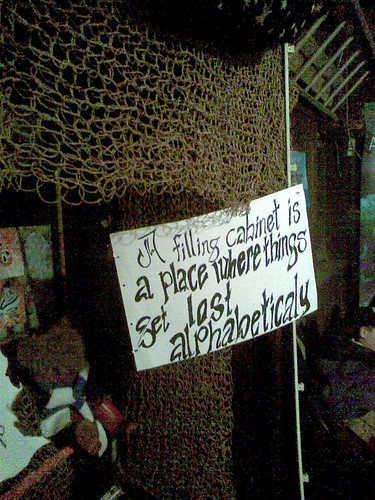
Spotted at last night's Soirée Micronomique. (More over at the School of Everything blog.)
Following all the discussion of how to spend less time with technology, I've been thinking about the contrast between attitudes to TV in my childhood and attitudes to the internet today. Lots more to say about this, but for now I'm just glad to have tracked down a clip of 'Why Don't You?'
For non-Brits, this was a programme shown in the school holidays by the BBC, the full title of which was 'Why Don't You Just Switch Off Your Television Set and Go and Do Something Less Boring Instead?'
I don't know what other influences it had, but 'Why Don't You?' was certainly a reference point for us at Pick Me Up - and, for that matter, at School of Everything.
Anyone else got any memories of it?
I've already blogged about one piece from Tom Hodgkinson today - but several people have sent me the article about Facebook he wrote for yesterday's Guardian. There have been plenty of conspiracy theories doing the rounds about Facebook. Personally, I think the CIA and neo-con connections, brought up again in Tom's article, are exaggerated.
The thing about capitalism is that you can explain a lot of what goes on without reference to conspiracies, by virtue of the desire of people who already have money to use it to make more of the same. At least, that's what I would have said a few months ago. Actually, having come through the process of raising funding for School of Everything, it's fair to say that - particularly with early-stage startups - there are investors who make decisions based on their values and their desire to change the world, rather than simply the returns on offer. Is that a bad thing? You might say it depends on the values in question.
One of the things we decided when we founded School of Everything was that we didn't want to encourage people to spend more time sat at computers. Our focus has always been on using the internet in smart ways, so as to spend more time doing interesting stuff in the real world.
Conspiracies aside, I think Tom puts his finger on a genuine difference of vision between those who see a future in which humans have transcended nature and those who are profoundly troubled by this vision. I'm certainly in the latter camp - and the final paragraph of his article does a wonderful job of summing up the positive reasons why:
For my own part, I am going to retreat from the whole thing, remain as unplugged as possible, and spend the time I save by not going on Facebook doing something useful, such as reading books. Why would I want to waste my time on Facebook when I still haven't read Keats' Endymion? And when there are seeds to be sown in my own back yard? I don't want to retreat from nature, I want to reconnect with it. Damn air-conditioning! And if I want to connect with the people around me, I will revert to an old piece of technology. It's free, it's easy and it delivers a uniquely individual experience in sharing information: it's called talking.
People often mistake me for a vegetarian. (Maybe it's the beard?) I'm not, but thinking about where our food - and in particular our meat - comes from is something which brings home to me how sick the world is right now. In particular, the juxtaposition of factory farming, in all its obscenity, with the criminalisation of older and more respectful ways of rearing and killing animals.
This short piece from Tom Hodgkinson, editor of the Idler, is the kind of thing I have in mind:
Yesterday morning we had a knock at the door from our local environmental health officer. He had come round to tell us that according to a law that was brought in two years ago, what we had done with our pigs—that is to say, have them killed at home— was illegal. You are not allowed to kill and eat your own pigs. The law says that you have to take them to the slaughterhouse. This is, they say, so they can be checked by the slaughterhouse for disease. We argued that it is surely more humane to have them killed at home, because the pig does not suffer the stress of being bundled into a van and then lined up on the racks in an unfamiliar place and killed. He actually agreed that meat that has been killed at home, stress-free, tastes better than meat that has gone through the abattoir. So that is why our meat tasted so good: because it was killed at home. But that is illegal now.
One of the friends I gained through the Illich colloquium in Cuernavaca is Dean Bavington. I've already mentioned his powerful presentation on the history of the Newfoundland cod fishery. At the core of Dean's argument is the distinction between treating fish as food and treating it as a commodity.
Certain processes, certain laws, even certain well-intentioned environmental measures, only become thinkable* once you have stopped thinking about things that you can actually experience (taste, smell, touch...) and started treating the world as made up of interchangeable units and mathematical patterns.
* For 'become thinkable', I almost wrote 'make sense' - but the issue here is precisely the absence of 'sense'.
Another very interesting comment from Dan on my post about the sixties. He suggests that there's a 'law of crowds' involved:
both culturally and knowledge-wise, the world has becoming increasingly crowded, and increasingly connected.
In terms of learning and knowledge, this has meant that (and I can't remember where I heard this quote, but I paraphrase) it was last possible to be a generalist at the turn of the 20th century. Now you're either a tiny ant helping maintain the academic hive (walking in journal stacks *really* brings this home to me!) or you're accepting the loss of meaning and pissing about with symbology.
I have to confess to being quite sceptical about the idea that the sum of human knowledge is increasing exponentially. The size of academic journal stacks has a lot to do with a particular way of framing learning as the production of knowledge, where "knowledge" has become a commodity. (As I've been arguing, this goes a long way back into the history of the university.)
Even if we accept that knowledge is something which can be meaningfully counted - and I don't - it would seem clear that vast amounts of knowledge have been destroyed in the last few centuries. The loss of languages, and therefore of much of the local ways of seeing and the stories which went with them, is only one of the more obvious examples.
In my own case, I find it humbling to think about how illiterate I am when walking in the countryside, compared to my ancestors of only two or three generations back. I can give you my take on the differing trajectories of Keats' nightingale and Shelley's skylark, but I couldn't tell the song of one from the other.
There's another point which comes through from Dan's post:
Culturally, the same problem exists. There's a loss of belief in the whole point of creating culture because there's just so much of the stuff: archaeological layers, vast fields stretching as far as the eye can see. One can imagine how the Arctic Monkeys might think picking up titles from old movies and music from old artists was just the way the game's done now. I hate the word, but, um, its all pastiche, and that's maybe OK.
Having said that, in the realm of the acoustic guitar singer-songwriter, I'd never think there'd be anything able to move me much again, but then I saw the Channel 4 funded film Once, and now have the music, and by God its wonderful.
The anxiety over the sheer amount of culture easily becomes entangled with the anxiety for constant, radical innovation, generally recognised as a feature of the arts in western societies since the Romantic era. Again with the scepticism, I don't see why something should have to be new to be great - so it's good to hear Dan's example of being moved by something that isn't necessarily pushing at any boundaries.
My observation that the sixties have an unusual hold on our imagination is not intended to damn the unimaginativeness of the Arctic Monkeys, or anyone else. Rather, I'm interested in whether this is evidence for the significance of the years between 1958 and 1974 as a historical moment, the like of which we haven't seen since. Perhaps there's no great need to look for evidence. The claim is hardly controversial - but I'm curious about the conflicting accounts of that moment, and some of the less explored possibilities underlying them.
I've been reading Arthur Marwick's The Sixties: an enormous, fascinating, one volume cultural history. For most of his career, Marwick was Professor of History at the Open University, itself a product of that decade (which, by his generous definition, stretched from 1958 to 1974). His book argues, convincingly, that those years saw a lasting cultural revolution.
There is another story to be told about the significance of that revolution, but what is striking is the sense that we are still living in the sixties. This is a suggestion I've come across in all sorts of places recently. A recent issue of Newsweek, dedicated to 1968: The Year That Changed Everything, claimed that "all of us, young and old, are stuck in the '60s, hostages to a decade we define ourselves as for or against."
Meanwhile, at Radio 3's Free Thinking festival, the film director Mike Figgis argued that our culture is stagnating because modern technologies of film and sound recording have preserved too well the icons of the era, beginning in the late fifties, in which they first reached their zenith. Rock stars, film makers and fashion designers today are all, according to Figgis, too aware of Elvis, Marilyn Monroe and Jimi Hendrix for their own good. (You can listen to his lecture here.) There's something in this, though again I don't think it's the whole story. But I do keep coming across more examples of the long reach of Marwick's long decade. I knew, for example, that The Smiths' albums which I discovered as a teenager were full of deliberate echoes of the films of the British New Wave. What made me sit up, though, half way through watching Saturday Night and Sunday Morning (1960), was when Arthur Seaton tells himself, "Whatever people say I am, that's what I'm not." I could have told you that the Arctic Monkeys owed their line-up (two guitars, bass and drums) to the sixties, but I hadn't realised it was where they got their album titles.
So, have we ever really left the sixties?
Following the last few posts, I've been thinking about the similarities and differences between the way we relate to television and the internet - and the way that both technologies have been represented. Along the way, I discovered this wonderful piece of doggerel of Roald Dahl's from 1964:
The most important thing we've learned,
So far as children are concerned,
Is never, NEVER, NEVER let
Them near your television set -
Or better still, just don't install
The idiotic thing at all.
In almost every house we've been,
We've watched them gaping at the screen.
They loll and slop and lounge about,
And stare until their eyes pop out.
(Last week in someone's place we saw
A dozen eyeballs on the floor.)
They sit and stare and stare and sit
Until they're hypnotised by it,
Until they're absolutely drunk
With all that shocking ghastly junk.
Oh yes, we know it keeps them still,
They don't climb out the window sill,
They never fight or kick or punch,
They leave you free to cook the lunch
And wash the dishes in the sink --
But did you ever stop to think,
To wonder just exactly what
This does to your beloved tot?
IT ROTS THE SENSE IN THE HEAD!
IT KILLS IMAGINATION DEAD!
IT CLOGS AND CLUTTERS UP THE MIND!
IT MAKES A CHILD SO DULL AND BLIND
HE CAN NO LONGER UNDERSTAND
A FANTASY, A FAIRYLAND!
HIS BRAIN BECOMES AS SOFT AS CHEESE!
HIS POWERS OF THINKING RUST AND FREEZE!
HE CANNOT THINK -- HE ONLY SEES!
There's lots more of it.
(From another site, I discovered that it's actually a song sung by the Oompa-Lumpas in 'Charlie and the Chocolate Factory'.)
I've been writing about giving up television, but it's really a rather easy example for me, since I'm seldom tempted to watch more than a couple of hours a week. (Spending less time online is more of a challenge.)
My friend Anthony has been more of a TV watcher - though he could always give you a fascinating critical analysis of whatever he'd been watching, just in case you thought his brain switched off as the box switched on. Anyway, he posted the other day that he's unplugged his TV and is getting back to reading and writing, instead. Long may it last, because I'd love to see more of his thinking in print.
He's just republished, on his blog, some notes on the term 'tradition'. Reading these, I came across a passage on education which relates to some of my thinking-out-loud last month, about what an alternative to learning as 'knowledge production' (or teaching as 'information transmission') might look like:
Speaking as an educator, I find that approaching education as information transmission, protection, and/or preservation can easily lead me to ignore the richness of educational encounter, the personal, present, affectual dimensions of how education can work. Education in face-to-face contexts can be understood to be predominantly about being with, about living 'withness', about the attitudes of the people in the room, about the respect or lack of it within the interactions. When education or 'tradition' are understood as entity-transfer of some sort, it is very hard to even have discussions about respect, attitude, presence, or, dare I say it, gentleness. It's all too easy to default to those attitudes that facilitate the most efficient transaction of resources, those attitudes that allow us to distance ourselves from being us-and-no-one-else and instead allow us to play the roles of 'providers' in an exchange relationship (if you're lucky).
Do read the rest of his post - there's a lot of food for thought in it.
Where is the TV in your house?
Following my latest post about technology and askesis, a comment from Anirudh got me thinking about this. When it comes to giving up particular technologies or habits, will-power isn't always very helpful. For instance, having decided to reduce your TV habit, you can rely on your strength of will - or you can unplug the TV set and move it to the spare room. In my experience, the second method is more effective.
Though I can't find the reference, I'm sure Christopher Hitchens advises aspiring contrarians to give a bookshelf that pride of place in their living quarters commonly afforded to the TV. Visiting Alastair McIntosh a few years ago, I remember him referring to the wood stove in his front room as "our television".
There is certainly something mesmeric about an open fire: the way it holds the eye, becomes the focal point of a room. The word focus itself originally refers to the hearth, which held a central position in the Roman household, both physically and spiritually. (The journey from this meaning to its modern, technical usage probably deserves more thought.) The hearth was associated with the lares, the household gods, who had their own shrine, the lararium, around which the household would gather daily.
Thinking about all this, I came across the picture (below) of the lararium in the House of the Vetti at Pompey. To my eye, it does look rather like a precedent for the magic box around which families gather in the modern household - and whose observances are stepped up on high days and holy days.
On which note, Happy Christmas!
I mentioned the other day that, returning from Cuernavaca with the concepts of askesis and otium on my mind, I seemed to keep bumping into friends who were choosing to give things up or trying to spend less time with technology and get back to their bodies. Well, here's an example.
Saul Albert is an extremely smart guy, someone I've been crossing paths with for years, and whose understanding of computers is in a different league to mine. He's an artist and technologist, and (among much else) co-founder of The People Speak which develops 'Tools For The World To Take Over Itself'.
He's also just given up email.
In the spirit of Pick Me Up, he's written a ten step plan of how he's going about this. Here's a taste:
- I’m going to talk to all the people I’m collaborating and communicating with via email, and work out together how we can continue this relationship without email.
- I’m going to unsubscribe from all my mailing lists (while making sure I can follow them via RSS).
- I’m going to tell all my friends and family about this experiment, and make sure they know how to contact me...
You can read the rest over on his blog, along with his reasons for quitting. What struck me was the tenth step of his plan:
- Finally, I’m going to organise my time in a way that suits me. This is what I’m most excited about. The thought of time without email, or worrying about email accumulating is really enticing. This will include regularly being in places where I can meet people (by arrangement or randomly) - having certain times of the day for calls and voicemail, and having other parts of the day for work - but just work, as in doing things I need to do - rather than simply shovelling the top off the growing email pile.
This is precisely what askesis should mean: not self-denial, but a deliberate decision to make room for people and things that matter to us.
UnLtdWorld is a new social networking site which aims to bring together people who want to "generate social impact" - in other words, change the world. I've met Alberto, who's running it, and I was impressed by his experience and the way he's approaching the project.
So this morning I sat down to create my profile on their Beta site, when I came to two questions which temporarily stumped me:
They are entirely appropriate questions for the site, just not ones that I'm very good at answering.
In the end, I decided that what most concerns me is 'the loss of the sense of timeliness'. And the single change I would make would be to 'cancel first world debt'.
I didn't notice until afterwards, but these answers pinpoint two of the three things I would like to write about, at that distant period in my life when I finally have the time to write something more coherent than a blog. They are also connected: the effect of being in debt shapes your experience of and relationship to time. And, since the cultural and economic shifts of the 1960s, debt has become the primary mechanism of social control that keeps us bound to our untimely way of living. But that's a long story...
What prompted me to blog about this was that, having been thinking about the cancellation of debt, I stumbled across this article (via Ran):
Laws that periodically canceled debts, freed Israelite debt-servants, and returned lands to their traditional holders have confused Biblical students for centuries. They have long been virtually ignored by historians on the ground that, to modern eyes, they would seem to wreak economic havoc.
Recent discoveries of Bronze Age Near Eastern royal proclamations dating from 2400 to 1600 BCE leave no doubt that these edicts were implemented. During the Babylonian period they grew more elaborate and detailed, capped by Ammisaduqa’s Edict of 1646 BCE. Now that these edicts are understood, the Biblical laws no longer stand alone as utopian or other-worldly ideals; they take their place in a 2,000-year continuum of periodic and regular economic renewal based on freedom from debt-servitude and from the loss of access to self-support on the land...
Rome was the first society not to cancel its debts. And we all know what happened to it. Classical historians such as Plutarch, Livy, and Diodorus attributed Rome’s decline and fall to the fact that creditors got the entire economy in their debt, expropriated the land and public domain, and strangled the economy.
The author is Michael Hudson, an economist at the University of Missouri, and there's a lot more on his website. I'm very glad to have found it, because I've wondered for a long time whether the Jubilee laws of the Old Testament were more than wishful thinking, and - despite coming from a family of theologians - noone was able to tell me.


