Saturday, 7 March 2009

Deschooling the Edublogosphere?

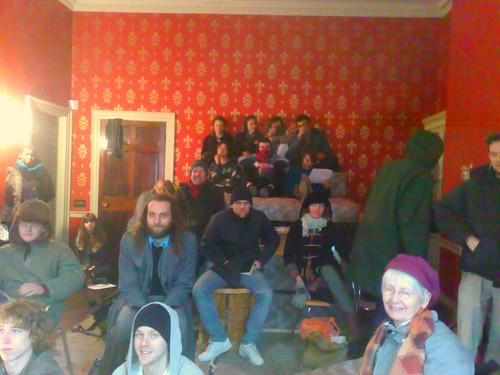
This post from NZ edublogger Leigh Blackall - which I picked up via Stephen Downes - hails (or at least hopes for) a comeback for Ivan Illich's 'Deschooling Society', which reminded me that I should blog the video of my Temporary School of Thought talk.


Many thanks to Vinay for filming that! He also blogged an audio recording of the event, which got picked up in a thoughtful post from Andrew J Cernaglia.

In a different key, I've just uploaded an article I wrote last year about Illich's influence on and warnings about the development of personal computing and the internet:

Carl Mitcham laughed when I told him I was working on an internet startup inspired by Deschooling Society. Now in his mid-sixties, Mitcham is a philosopher of technology, a professor at the Colorado School of Mines and former director of the Science-Technology-Society Programme at Penn State. He was also, from the late 1980s, a member of Illich's circle of friends and collaborators, the travelling circus which surrounded him from the closure of the Centre for Intercultural Documentation at Cuernavaca in 1976, until his death in 2002.

What made Mitcham laugh was his recollection of Illich telling him, in exasperation, “People are saying I invented this internet!” The thought of it was enough to make him throw up his hands in horror.

The story of Illich's influence on the internet and the reasons for his mistrust of it both deserve attention. Together, they present something like a paradox: how did a thinker whose vision of 'learning webs', 'educational networks' and 'convivial tools' inspired key figures in the development of personal computing come, by the late 1990s, to believe in 'the necessity of defending... our senses... against the insistent encroachments of multimedia from cyberspace'?

(Continued)

I just came across another blog that's picked up on Charlie Leadbeater's article on Illich and the DIY State this week, so it does feel like there's an appetite for these ideas at the moment. And if you were looking for more pieces of evidence, I guess you could say that us raising a second round of funding for School of Everything was also a good sign!

Tuesday, 17 February 2009

'The Future of Unemployment'

Slightly belatedly, here's the article I wrote for last week's Agit8 magazine:

What do you do when you find yourself with a lot more time and a lot less money on your hands than you’re used to? That may be the most important question of 2009.

Start with the numbers: worldwide, the UN estimates as many as 51 million people could become unemployed this year. Here in Britain, if the analysts are right, one million people who currently have jobs won’t do in twelve months’ time. What happens next for those people will shape the kind of society we live in, over the next decade and beyond.

I want to think about some of the ways this situation could play out. In particular, I’m interested in whether the things we’ve learned from social media over the last few years can play a role in lessening the hardship of this recession and shaping the world which comes out the other side.

(Continued...)

Thursday, 12 February 2009

Hacking The Recession - TOMORROW!

If you're in London and free tomorrow, come down to the Hacking the Recession day at Birkbeck College - one of the projects that's spun out of the conversations I've been blogging about over the last few weeks. People with geek skills are particularly welcome, but they're letting non-coders like me come too.

To get a clearer idea of what to expect, I interviewed Mamading Ceesay, the brains behind the event.

DH: What do you want out of the day?

MC: We want to inspire people to come up with creative solutions to not only surviving, but thriving during the recession - that improves outcomes not only for individuals and their families, but entire communities. These solutions should not be based on needing state or local authority action but rather on ordinary people coming together and collaborating in similar ways to that enabled by the likes of Wikipedia and Pledgebank.

DH: And what about people who come along?

MC: It's about ensuring that there are options for you and the people you care about to lead purposeful, meaningful lives, even in a time of mass unemployment when there may be no jobs available.

DH: So what would success look like?

MC: Any of the following would be a really successful outcome, I think:

  • Working code that implements an idea that helps people deal with the impact of the recession.
  • Documentation of a potential solution for recession-caused issues, that provides enough information for a team to implement it.
  • A presentation/pitch that could be used to persuade funders and other kinds of supporters to back the implementation of a solution.

DH: Have you got some examples of the kind of thing you have in mind?

MC: Well, think about the kind of tools you use for jobs around the house. If there's a lot less money around, then there's less opportunity for people to have their own drills and so on. However, if there is some sort of tool library/directory system, you can find out who in your area has tools that you can borrow to get a much needed piece of DIY done. When you borrow a tool, it's recorded in the system as is the return of the tool. This enables more effective sharing and pooling of resources in a community that can no longer rely on money and the market for getting things done.

Another example - people being able to barter their time and skills with each other using a system combining the web and SMS. This would make it easier for a community to survive and thrive with much less money. It also helps people to be gainfully employed without a salaried job.


Hacking The Recession is happening tomorrow - Friday 13th February - at Room 540, Birkbeck College, WC1E 7HX. (Entrance off Torrington Square.)

For more details, contact Mamading.

Friday, 6 February 2009

Clay Shirky at the LSE

Clay Shirky may be right that a loose collection of bloggers can't replace a newsroom full of journalists, but London's social reporters did a pretty good job of covering his visit this week. David Wilcox has a great write-up of his Tuesday night talk at the LSE, which I was there for, while Michael Mahemoff posted detailed notes from the ICA on Wednesday.

It was Shirky's change of mind on the democratic potential of the web which made headlines. "We are not ready for massive legitimating moves of unstructured participation across the larger issues," he told the LSE audience. "That’s the first time I’ve said that in public."

The key example he returned to during the discussion was change.gov - the Obama administration's official transition website, which asked people to vote on what should be his first priority in office. The issue that came out on top was the legalisation of marijuana.

Andy Gibson from Sociability points out that this doesn't actually prove anything about how people behave in a context of collaborative decision-making, since the site only gave them an opportunity to get attention. An exercise without any consequences isn't much of a guide to how people will act in a more serious situation. "If you want to know how people behave in power, look at how we run our organisations, our communities, our families, our relationships."

Meanwhile, JP Rangaswami - who was at the ICA talk - muses about whether choice over the allocation of our taxes might be the way to get beyond the limits of voting systems. That would certainly be one way to add that necessary seriousness. (And if it sounds unrealistic, check out the history of Porto Alegre's participative budget - and the UK government's plans for local participatory budgets in the near future.)

Interesting discussions - and a reminder of why I'm glad to work with such bright people as Andy and JP on School of Everything. But I wanted to pick out four other ideas which Shirky touched on, which relate to my recent posts about social media and the recession.

The sudden shift in role for new technologies in a time of crisis: For example, the London tube bombings took camera phones and video-sharing sites from "that's interesting" (or not, according to your opinion), to "this is a critical tool that we must have."

If this can happen as a result of a one-off event, what about longer historical moments of crisis, such as the one we're living through? "The global financial crisis we're in the middle of means that the speed and depth of adoption of some of these tools is going to surprise us - because we're in a situation where none of the old things work."

The complex relationship between money and motivation: Someone asked a question about how you pay the rent, if you devote yourself to a collaborative project. In response, Shirky brought up Edward Deci's experiment into the relationship between external reward and intrinsic motivation.

Deci set two groups of students the task of solving a kind of puzzle. One group were paid per puzzle solved, the other group weren't paid at all. After telling them that they had completed the task, he left each group in the room and observed their behaviour over the next few minutes. He found that those who hadn't been paid continued playing with the puzzles - whereas those who were paid tended not to. Conclusion: being paid to do something can actually reduce the intrinsic reward you might otherwise have found in the activity. Or, as Shirky put it:

The link between solving the grocery shortage problem and doing what you have to do isn't, in fact, linear - and there are places where money actually worsens the transaction. If you have a nice date, it's acceptable to send flowers the next day, it is not acceptable to send the amount of money the flowers would have cost!

It seems to me that, if - as I wrote last week - we need to get beyond the binary of employed/unemployed, the subtle relationship between intrinsically-rewarding activity and financially reward which Deci's experiment highlighted is worth bearing in mind.

The possibilities of the "cognitive surplus": I'm cheating slightly here, since Shirky didn't really talk about "cognitive surplus" on Tuesday - though he did when I saw him last year at Demos (here's the podcast). The basic idea is that major social changes can liberate a lot of time and energy, which initially gets channelled into an addictive activity which at least keeps people docile. According to Shirky, this happened in the early Industrial Revolution with gin, and again in the 20th century with television. After the gin era, the same energy was channelled more fruitfully into the social reform of the 19th century, the age of public libraries and self-improvement societies. So what comes after the TV era...?

Now, I'm not comfortable with the kind of treating-people-as-resources thinking which a phrase like "cognitive surplus" represents. But it's certainly true that one of the stereotypes of unemployment is of someone sitting at home in front of the TV all day. If there are suddenly a lot more people who are used to working full time and now need something else to do, how could we make it easier to use that extra time and energy in other ways?

The main characteristic of emerging models is their diversity: Shirky was talking specifically about making money. "This isn't a transition from Business Model A to Business Model B, it's a transition from Business Model A to Business Models B to Z."

To me, the emphasis on not trying to find a single replacement model applies similarly to the traditional concept of the "job" - I'm convinced that less of us will have "jobs" in future, but that that doesn't have to mean that more of us are "unemployed", in the sense of having nothing to do and being unable to support ourselves. It also applies (as we've been discussing in the comments on last week's post) to the kinds of spaces for learning, making, collaborating, hanging out and starting new projects which I wrote about: a national, one-size-fits-all programme to create such spaces would be a disaster.

I realise that's a lot of ground skimmed over quite quickly. I'm writing more about some of this for Monday's issue of Agit8, and I look forward to carrying on the conversation - here, there and elsewhere.


Tuesday, 3 February 2009

A moment of pragmatism?

I'm heading off to LSE in a few minutes, where Clay Shirky is speaking tonight. Journalism.co.uk has an interesting interview with him today - the following passage jumped out, in relation to my recent posts:

Significant changes often come at times of crisis, like the current financial downturn, adds Shirky, who says we are entering a two-three year period which could shape society for decades.

"In a crisis people lay their hands on what works without regard to how they've done it the past," he says. Often seen as informal changes, significant technological shifts quickly become part of the established political landscape, he says.

Shirky hopes that specifically British issues will get raised at tonight's debate. "When this stuff charges in the US the questions are 'what are the kids doing?' and 'what is it going to do to companies?' In the UK it is 'what is it going to do for the government and social exclusion?'

Two ideas there that resonate with the conversations I've been involved in over the last couple of weeks. Firstly, that the UK already stands out for applying ideas from the social web to solving social problems. (That doesn't mean we've done it brilliantly, just that it seems to be more of a focus of people's thinking and activity in the British startup scene.)

The second one is the idea that a major crisis can generate a moment of pragmatism - a point at which new ideas and approaches may suddenly get taken seriously, with lasting consequences. I don't know about anyone else, but I've been aware of a pragmatic openness to radical ideas lately, from a surprising range of directions.

Sunday, 1 February 2009

Social Media vs the Recession - an update

Thanks to everyone who made it to Bethnal Green on Thursday to talk about social media responses to the recession - and to those who couldn't come, but asked to be kept in touch. Trying to summarise all the threads of discussion would make for a long post, but three plans came out of the evening:

(1) To host a larger conversation about social media and the recession, somewhere other than on this blog! This will include gathering information and sharing stories about the ways people are using existing tools and networks (or building new ones), as well as about the kind of "real world spaces which reflect the collaborative values of social media". We're going to launch a group blog to do this and are looking for guest posts from various perspectives. We're also looking for co-hosts for a larger meetup where we can carry on this conversation face-to-face!

(2) To build a simple site which people can use to map resources, not just for the unemployed, but for anyone who finds themselves more cash poor and/or time rich than they're used to being. As a first step, Colin, Vinay and I are experimenting with building a prototype over the next couple of weeks.

(3) To organise a Hacking the Recession day on Friday 13th February, as part of JISC's Developer Happiness Days. Mamading is organising this and has posted some more information here.

I look forward to more interesting conversations about all this in the week ahead! If you're in London and coming to GlueSniffers on Monday or Clay Shirky/NetSquared on Tuesday, let's talk about it there.


UPDATE: GlueSniffers meetup postponed till next Monday (9th) due to snow

Wednesday, 28 January 2009

Social Media vs the Recession?

I've spent a lot of time lately talking to people about the economic crisis, how it's starting to play out in people's lives - and what the things we've learned from social media over the last few years might contribute, in regards to lessening the hardship and shaping the world that comes out the other side. Following from those conversations, it feels like it's time to start sketching some of this out in a meaningful way.

Looked at very simply: hundreds of thousands of people are finding or are about to find themselves with a lot more time and a lot less money than they are used to. The result is at least three sets of needs:

  • practical/financial (e.g. how do I pay the rent/avoid my house being repossessed?)

  • emotional/psychological (e.g. how do I face my friends? where do I get my identity from now I don't have a job?)

  • directional (e.g. what do I do with my time? how do I find work?)

With a huge wave of unemployment breaking on the system, public services are likely to be overwhelmed - and yet need to be more responsive than under normal economic circumstances:

"Time is of the essence. The newly unemployed are not usually a focus of government policy because most will find work quickly. This is not true in a recession... Decisive government action now will prevent a temporary slide in employment becoming a permanent slump." Charles Leadbeater & others, 'Attacking the Recession', NESTA

During last week's new media breakfast at the Foreign Office, I was struck by a remark from a UKTI official: if this recession is to be different to previous recessions, he said, our industry has a crucial role to play in that. I guess he may have had in mind the way Finland's tech industry pulled it out of a deep recession in the 1990s, but it also set me thinking about the way the internet has been changing society at large.

Arguably the biggest thing that has changed in countries like the UK since there was last a major recession is that most people are networked by the internet and have some experience of its potential for self-organisation (whether through a myriad of internet dating sites, or through group social interactions such as Facebook, Meetup, Bebo, MySpace, and others - all carry the potential to connect people, both in the virtual and in the physical space). There has never been a major surge in unemployment in a context where these ways of "organising without organisations" were available.

As my School of Everything co-founder Paul Miller has written, London's tech scene is distinctive for the increasing focus on applying these technologies to huge social issues - rather than throwing sheep! Agility and the ability to mobilise and gather momentum quickly are characteristics of social media and online self-organisation, in ways that government, NGOs and large corporations regard with a healthy envy.

So, with that, the conversations I've been having keep coming back to this central question: is there a way we can constructively mobilise to respond to this situation in the days and weeks ahead?


Some ideas on what this might look like

One principle to keep in mind: access to tools and provision should not be limited to the unemployed. It is possible to design tools and offer services which are open to all, but have particular value to those with more time and less money. However, if these are walled off as exclusively for that group, this is stigmatising - and, more important, will stifle creativity by artificially restricting the range of possible interactions and connections. (This valuable approach towards open access is something I experienced first-hand over several years hanging out at Access Space in Sheffield, the UK's longest-running internet learning centre, where I as a (then) BBC journalist found myself learning to build my own website alongside guys who in some cases had been on the dole for much of their adult lives, and for whom the centre offered a route to starting a business, getting a skilled job, or getting funding for their creative activities.)

What follows is not a particularly structured list, though there are a few themes. The basic idea is that we're talking about digital resource-maps for people who have lost access to the market as a source of resources, with an aim to be an enablement tool for all levels of the participant community:

  • Information sharing for dealing with practical consequences of redundancy or job insecurity. You can see this happening already on a site like the Sheffield Forum.

  • Indexes of local resources of use to the newly-unemployed - including educational and training opportunities - built up in a user-generated style.

  • Tools for reducing the cost of living. These already exist - LiftShare, Freecycle, etc. - so it's a question of more effective access and whether there are quick ways to signpost people towards these, or link together existing services better.

  • An identification of skills, not just for potential employers but so people can find each other and organise, both around each other and emergent initiatives that grow in a fertile, socially-networked context.

If the aim is to avoid this recession creating a new tranche of long-term unemployed (as happened in the 1980s), then softening the distinction between the employed and unemployed is vital. In social media, we've already seen considerable softening of the line between producer and consumer in all kinds of areas, and there must be lessons to draw from this in how we view any large-scale initiative.

As I see it, such a softening would involve not only the kind of online tools and spaces suggested above, but the spread of real world spaces which reflect the collaborative values of social media. Examples of such spaces already exist:

Again, if these spaces are to work, access to them should be open, not restricted to the unemployed. (If, as some are predicting, we see the return of the three day week, the value of spaces like this open to all becomes even more obvious!) In order for this to work, such spaces would need to be organised with the understanding that hanging out can be as valuable as more visibly productive activities - both because of the resilience that comes from building social connections, and because of the potential for information sharing and the sparking of new projects. There would also be a need for incubator spaces for projects that emerge from these spaces and are ready to move to the next level.


What next?

These are some ideas that have come out of conversations with Vinay, Colin, Kalam, David, Mamading, Mike, Josef and others over the last couple of weeks. I'm keen to broaden those conversations, because I'm sure we can build on and better these ideas. I'm also keen to get some action going on - so a group of us are getting together at the School of Everything offices in Bethnal Green tomorrow night (Thursday 29th) to work on a first version of a site. Get in touch if you'd like to contribute!

Tuesday, 20 January 2009

Plugging tomorrow's talk

Quick plug for my next talk at the wonderful Temporary School of Thought. If you're in London and free tomorrow (Weds) at 5pm, come down to 39A Clarges Mews, where I'll be thinking out loud about 'Economic Chemotherapy'.

Erm... as in, cheap treatments for cancer? Nope. As in "What if we tried looking at economic growth as something unhealthy?"

Why would anyone want to do that? Well, some people say we need to because of climate change. Other people say we're going to have to because of Peak Oil. But what really interests me is the possibility that there might be deeper reasons, to do with the way we look at the world.

Is this going to be one of your abstract philosophical ramblings with lots of footnotes that have no relevance to the real world? Um... I hope not. I do want to talk a bit about the history of questioning growth and some of the different ideas that are out there, but that's only the background. The real action comes when we start talking about ways of thriving when the economy is shrinking. (And whatever you think about the desirability of growth, that sounds pretty relevant right now, doesn't it?) I've got several suggestions, but I'm hoping other people will have too.

OK, you've convinced me. When's this all happening, again? 5pm, Weds 21/01/09 at 39A Clarges Mews, off Curzon Street, Mayfair, London, which is about two minutes walk from Green Park tube.

And what if I've, like, got a proper job so I can't go hanging out in posh squats at five o'clock on a Wednesday afternoon? Fear not - video and podcasts will be available in due course. (Though you won't find heckling me half as satisfying.)

Within a few hours of arriving, I have been given a juggling lesson and an invitation to labyrinth building... and attended a talk on anarchy (the besuited lecturer was recording the talk for his files — apparently, even anarchists keep records). Sunday Times, 18/01/09

Sunday, 18 January 2009

Celebrate the OUTauguration!

A conversation at last Wednesday's SI Camp meet-up prompted me to start a Facebook group dedicated to celebrating this week's OUTauguration - the much-anticipated departure of the 43rd President of the United States.

Obviously lots of people will be celebrating the inauguration of Barack Obama - but, while I'm cautiously optimistic, I can't help thinking we should reserve judgement. The departure of George W Bush, on the other hand, is beyond doubt a positive moment in world history and calls for a party! So join the group, invite your friends and let's dance together on Dubya's grave!

(Should we need a tune to dance to, what could be more appropriate than grindcore outfit Reptiljan's Outauguration of the Chimp Zombie...?)

Temporary School of Thought - a round-up

Image courtesy of Lloyd Davies

I've had a lot of people coming here over the last few days to read about the Temporary School of Thought in Mayfair. I'm hugely inspired by what the organisers there have achieved - not least because of the contrast to the introspective factionalism of the squatted social centres I used to hang out in a few years ago. So I thought I'd do a round up of some of the great blog posts, podcasts and pictures documenting what they've achieved over the last couple of weeks.

The Temporary School's curriculum has been impressively eclectic, with hands on workshops in everything from welding to treehouse-building to portrait photography. A number of the talks from the more ideas-based strand of its activities are now available online in various forms, including my talk on Deschooling Everything:

  • Vinay Gupta on Infrastructure for Anarchists - audio / lecture notes

  • Vinay Gupta on Avoiding Capitalism for the Next 4 Billion - audio / lecture notes

  • Dougald Hine on Deschooling Everything - audio (5 mins of chat before it starts)

  • Ben on Virtual Reality and the Immersive Ideal - audio

  • Mike Bennett on Setting up the Post-Capitalist Enterprise - audio

  • Vinay Gupta on Biometrics for Freedom - audio

I'll blog the video of my talk as soon as it's edited. Meanwhile, as a balance to the newspaper headlines, here are some more thoughtful accounts of the Temporary School and responses to it from around the blogosphere:

  • Londonist writes "What do you do with five floors of long-abandoned Mayfair luxury, complete with hand painted Chinese wallpaper and a warren of servants' quarters? Tidy the place up, for starters. Then launch your own school."

  • (You) Enoch has pictures which convey the full the grandeur of the place - while there are more images here.

  • Travels with my Teenager has a nice account of her visit, concluding: "This is real education. I just wish my daughter didn't have to spend so long at school."

  • Lloyd Davies tells how he ended up at the Temporary School as a result of The Tuttle Club - and has a video of the juggling workshop.

  • Dan Gould puts the Temporary School in the context of School of Everything and The School of Life (which I must go and check out soon...).

  • Badger on Fire went down for the Virtual Utopias session and ended up offering to run a Super 8 movie-making workshop.

  • Ligress focuses on the wider context of squatting and the number of empty properties in London and beyond - as well as the French book binding workshop.

  • Dave Bones reflects on how the Temporary School and squatters in general deal with the mainstream media. (For what it's worth, I agree with him about working with journalists rather than excluding them, though I understand why people are cautious about this.)

  • Speaking of the mainstream media, I was amused to discover TSoT had made The Washington Post! [Registration required.]

  • Contemporary art review site Axis has a rather snotty write-up from Josie Faure Walker, who - in true postmodernist style - seems to have difficulty remembering whether she's being ironic or not.

  • Finally, one of my favourite pieces is from the (difficult to link to) The More I [...] Blog:
    Worth observing about these schools is how much better than universities they are at promoting learning. Universities, these days – all thinkpods and co-ordinated swivel-chairs, in drab contrast to the joyfully cobbled-together Temporary School of Thought – all look much the same. The tube posters advertising higher education here in London echo this, be they intense and corporate, stressing the exact probability of a career after graduation, or trying desperately to be down-with-it. There just isn't enough be-tweeded, elbow-patched, avuncular rambling in those classrooms; nothing, in short, to hark back to a time before league tables.

    Instead, learning is miserably positioned as a means to an end. Compare, for instance, the respective websites for a leading university and the School of Life. The latter encourages a thorough flurry of clicks from the get-go, with the welcome accompaniment of intellectual whimsy. Most importantly, perhaps, it assumes a base level of scholarly curiosity. You don't get that with the university – instead, what comes across is a one-track treadmill; a site segregated immediately into department and subject, before you even get any proper sense of what the institution stands for. [see entry for Tuesday, 13 January 2009]

The organisers are finalising the programme for week 3 - and I'm back there on Wednesday at 5pm with a session on Economic Chemotherapy. (I'll be thinking out loud about the possibilities for reversing economic growth, why this might be desireable and how we could thrive in such a scenario.) Beyond that, who knows? I'm hoping the Temporary School is a sign of a renaissance of improvised, informal learning spaces across London and beyond in 2009. The London Free School folks are already organising a weekender for 20-22nd February. And there are plenty more under-used spaces around the city that could be put to use.


*UPDATE*


Jim pointed me towards his blog, The Posh Squatter, which has some great stories from the heart of the Temporary School. I particularly liked his account of the day the house's former owners, a down-at-heel aristocratic family, come round to visit:

When they left, they took my number so they could find out how we get on when the building's owners take us back to court. They wished us luck and wondered "Is there any chance you might get to keep it?"

Meanwhile, messenger-zine Moving Target has a great write-up of Jim's talk about his experiences as a bike messenger, No Fixed Ideas. It's a great example of the mixture of worlds that come into contact with each other in a temporary space like this.

Saturday, 10 January 2009

Hold the front page!

Gosh... That's been quite a week! And not over yet, by a long shot.


For starters, it's not often one of my talks gets a plug on the front page of the London Lite...


Article about Temporary School of Thought

From column 4: 'The squat's website, temporaryschool.org lists sessions including "labyrinth building with Steph" tomorrow followed by "deschooling society".' Guess I'd better get on with writing that talk, then!


The Temporary School of Thought also featured in Friday's Guardian, while Vinay's video of it has been picked up by the Evening Standard. Check it out:


Congratulations to the organisers on successfully getting the court case adjourned! Another two weeks in the building is going to be huge, if the amount of exciting stuff that's gone on in the past few days is anything to go by. I know they have mixed feelings about all this media interest - and particularly the focus on the property value, which is a bit of a distraction - but as an ex-journalist, I've got to say the coverage is really about as positive as I've ever seen for a story about a squat, once you get past the headlines. And most of the comments on the Standard site are very positive.


Speaking of comments, thanks for all the thoughtful responses to my questions about meditation. I'll take some time to think about them and come back to the subject. (I'm feeling a lot clearer about the "radio in your head" stuff after the Meditation & Magic session at TSoT the other night - thanks, Bad Swami!)


Had a brilliant time this morning at the Tuttle Club. It was my first time at this regular Friday gathering, which you get to by turning up at the back door of the ICA. Met some fascinating people and had three hours of back-to-back great conversation. For example, I spent ages chatting to Chris Unitt who runs the Created in Birmingham blog - exactly the kind of thing I wish had existed for the Creative Industries Quarter in Sheffield in my days there. (Oh, and if you find Melanie Phillips as unpleasant as I do, please vote for Created in Birmingham in the 2008 Weblog Awards - they've just overtaken her in the running for Best UK Blog, but it's a close run thing!)


Finally, I couldn't put the week to bed without mentioning the amazing morris men and women who swarmed through School of Everything over the last few days! We started out responding to the news stories about the gloomy prognosis for this most English of traditions - but soon discovered that reports of its death had been greatly exaggerated. The energy, enthusiasm and sense of fun that Claire and I found in the response to our little campaign made it one of my favourite weeks since School of Everything launched.


Right, time to start writing that talk. If you're in London and free, then I hope to see you at 5pm tomorrow at 39A Clarges Mews, off Curzon Street, Mayfair. There may be some surprises. (For those out of town/busy/lazy, video will be available next week.)

Tuesday, 6 January 2009

Listening to the radio in your head

Some of my blogging friends are pretty serious about their meditation - I'm thinking of Nick and Dan, in particular - whereas I am a complete beginner. Our office is round the corner from London's Buddhist Village and Pete, our Chief Technology Officer, has been encouraging other members of the School of Everything team to come along with him to lunchtime meditation a couple of days a week. Today was my second time - and I definitely have a long way to go.


The first time I went, I was quite nervous beforehand, but really enjoyed it. Today was harder - I struggled to focus, even for a few moments, partly because I kept thinking about something the teacher had said at the beginning of the session. The meditation we were doing was the Mindfulness of Breathing, and he was talking about avoiding thinking about one thing whilst doing another. "For example," he said, "I try not to listen to the radio while I'm washing the dishes, because then my mind would be elsewhere."


I grew up in a home where the radio was nearly always on and the habit stuck. A housemate in my early 20s, when I was less well domesticated, once famously ended a rant to another housemate about my misdeeds with "...and he listens to Radio 4 in the bath!" I even had a career as a radio journalist for a while (you can hear the evidence on the Internet Archive...). And, where I can happily live without TV, I've always thought of radio as mind-expanding.


Then I remembered a metaphor I used to use during my summers selling books door-to-door as a student. It was the toughest job most of us would ever do, not least in terms of the mental and emotional strain, and I learned a lot about mental self-discipline along the way. Training other students for their first summer knocking doors, I used to encourage them to tune in to the radio in their heads and listen to the things they were saying to themselves all day. "There are things you say to yourself," I told them, "which if anyone else said to you, you'd probably punch them."


The trouble is, I was remembering all this instead of concentrating on my breathing, which doesn't say a great deal for my mental self-discipline these days. But it did all make me more curious about developing mindfulness - and I'd be interested to hear more from those of you who have more experience of meditation. I'm so used to my mind being full of words and ideas and a constant stream of connections, much of the time very enjoyably so, that I find it a real challenge to get out of my head, as it were. Also, I'm curious about where the limits to mindfulness might lie - is it really better to wash up mindfully than to do it absent-mindedly while listening to Melvin Bragg talk about Charles Darwin?


What I do know is that I could definitely benefit from becoming more mindful, so I'll be persisting with the lunchtime sessions. And I'm looking forward to Vinay's workshop on Meditation and Magic tomorrow at the Temporary School of Thought.

About Me

My photo
London, United Kingdom
This blog was my online home between 2006 and 2009. Today, you'll find me scattered across the internet. To start looking, go to my personal website: http://dougald.co.uk/

My Projects

Signpostr School of Everything

MyBLOGLOG

Followers

My ClustrMap

From My Shelves

Labels