Tuesday, 3 July 2007

Time for Tea

This came via Tim.

I've felt for years that we suffer from the loss of a sense of 'timeliness' - or at least its marginalisation, edged out by Ben Franklin's famous equation of time with money. Believe that and time becomes purely a matter of quantity, a currency to be exchanged.

For me, the qualities of time are important: apparently contradictory actions may be equally proper at their different occasions. Lose sight of this - of the incommensurability of what matters - and life becomes harshly impoverished.

Thursday, 28 June 2007

It's wet up north...

By the time I got out of Sheffield on Monday morning, they were already cancelling trains. On Radio 4, a presenter said something about "the wettest day for fifty years" - but I was heading to a conference in Stoke and, beyond the nuisance of having damp feet all day, didn't give it much thought. Or not until the end of the afternoon, when I stopped to check my email and saw the pictures.


It's been a strange week to be out of town. My girlfriend got stranded and had to camp out in her office for most of the first night. My old colleagues at Radio Sheffield were working 24 hour shifts, getting official information out and talking to people on the ground. Even as the flooding went down in the city itself, there have been rolling black-outs, foul mud covering large areas, and traffic chaos with the M1 closed for days.

The Fire Brigades Union general secretary, Matt Wrack, gives a sense of the scale of events:

We have witnessed the biggest rescue effort in peacetime Britain by our emergency services, and it's not over yet. Fire crews and officers have been working to the point of collapse. Emergency fire control operators have been under major pressure, with thousands of extra calls for assistance from the public...

The government has not understood the scale, gravity and severity of what has happened.

The same could be said of large parts of the London media (the Guardian included) - which have prioritised not only the Downing Street handover, but such momentous events as the release of Paris Hilton and the Spice Girls reunion. If it were Bluewater [big shopping centre, near London] and not Meadowhall that was six feet deep in water and sewage, there would be rather more fuss.


I was in two minds whether to write this post. It seems kind of petty to moan about the metropolitan parochialism of the British media, when there are plenty of more useful things to be done. But I'm not at home to pitch in - so all I can do is admire the efforts of members of the Sheffield Forum and the local Freecycle group, and contrast them to the BBC producer who could be heard expressing his opinion over footage of the floods: "I do hate the Sheffield Accent with a passion... sorry, I don't mean to be a snob... they sound ignorant." [The offending clip has now been removed from BBC Online, but I heard it with my own ears.]

One piece of bigotry like that, for all it lets down the BBC's staff on the ground, would hardly be worth mentioning - if it wasn't something that us northerners experience on a daily basis. Stuart Maconie, a BBC broadcaster himself, writes eloquently about the same phenomenon in the conclusion to his wonderful 'Pies and Prejudice: In Search of the North':

On a rainy drive across the Lancashire moors, I caught a short Radio 4 'issue-based' story about childlessness but, for me, it was the minor detail that provoked the most thought. The protagonist was an academic with a cut-glass accent. She had lost a daughter called Cordelia and her neighbour was a TV producer. At no point was there any suggestion that these people and this milieu were in any way out of the ordinary. This was incredibly telling, I thought. Most people have never met either a Cordelia or a television producer. But as they discussed their (literally) extraordinar lives in voices of crystalline poshness, their remoteness from life as most of us live it was never acknowledged.

If, however, you turn on a Radio 4 play and the voices are northern, it will inevitably be all about 'being northern'. About how poor or cute or funny or indomitable we are. It will never be simply set in Sheffield or Hull or Wigan because it can be and should be. It will never be about an adulterous dentist who just happens to live in Bootle. It will be in some ways about his Scouseness... Some writers may think this is complimentary. In fact, it's patronising. It's in effect saying that you have to have a strong dramatic reason, a 'hook', in order to set your play outside the M25. The fact that most of the country actually lives there isn't good enough evidently.

Quite.

Sunday, 24 June 2007

Black Bloc, White Bloc - Part II

Back to the book I never wrote - the one about good protesters, bad protesters, governments and terrorists...
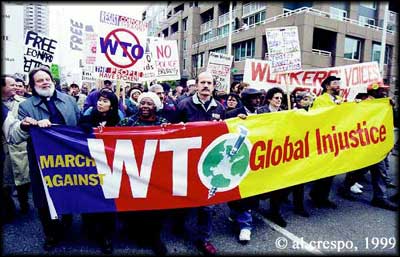
In the discussion on my post from a couple of weeks ago, Tim reminded me of the (in)famous protests at the WTO meeting in Seattle in 1999:

The only thing I remember of it is images of chaos, tear gas, bandaned young people throwing rocks, police behind barricades, fires, looting (I may be adding that now to the memory). It was a series of clips which spoke of danger, chaos, anarchy, etc.

Did it happen? Yes.

Did it come close to describing what the majority of people who were at the protest wanted to be seen and heard? My guess is, probably not. But it made for good sound and video bites.

Part of what drew me into trying to write about events like this is that, as a journalist, I felt the news media were peculiarly bad at handling them - and I was both fascinated and troubled by the way this interacted with the agendas of politicians and different groups of protesters.

The Gleneagles summit was the second time the G8 leaders had met in the UK since New Labour came to power. The fact that they met this time in the wilds of Scotland rather than in a major city was a reflection of the bandwagon of international protests, for which the Seattle WTO is often seen as the starting point. However, for the Blair government, there was also the memory of the 1998 summit in Birmingham - where their media managers were wrong-footed by the scale of public protest.

I remember arriving that day with a seasoned activist, a veteran of the anti-road building and Reclaim The Streets protests of the 1990s, who was simply gobsmacked by the coachload after coachload of ordinary people who had turned up to picket the world leaders - 70,000 of them formed a human chain around the city centre. This was the work of Jubilee 2000, a campaign for the cancellation of third world debt (which my School of Everything colleague Paul Miller helped organise), which did an outstanding job of raising consciousness of global injustice and mobilising a new constituency of protesters, many of them white-haired churchgoers, through an alliance of mainstream charities and campaign groups. Ann Pettifor, the campaign's founder, has written about the impact this had on the summit:

In what we thought of as a calculated move to de-mobilise our supporters, (but which they argued was just a security measure) the Foreign Office had made a surprise announcement the Tuesday before: G7 leaders would not be in Birmingham on Saturday 16th...

And so it was, that on the day, at 11 a.m. Birmingham was brimming with 70,000 peaceful, cheerful Jubilee 2000 campaigners, their banners and posters. Present also, were about 3,000 journalists, sent to cover the event. Only the G7 leaders were absent, giving the journalists very little to write about. So naturally they turned to the demonstrators. Overwhelmed by calls from hacks, we had done dozens of interviews by 11 a.m. It did not take long for No. 10’s spin doctors to realise that a major strategic error had been made. Soon the call came. The Prime Minister, Tony Blair, was flying back from the country-house meeting earlier than expected. Would it be possible to meet with Jubilee 2000’s leaders?

Given New Labour's permanent anxiety about controlling the media agenda, it is easy to imagine that avoiding any such strategic errors came high on the agenda in the planning of the Gleneagles summit. And so, months beforehand, a strategy seems to have been adopted to polarise activists into two apparently antithetical camps - the good protesters and the bad protesters. This was spelt out by Blair himself, in a newspaper interview in March 2005 (republished on Indymedia):

It would be very odd if people came to protest against this G8, as we're focusing on poverty in Africa and climate change. I don't quite know what they'll be protesting against... There will be people who come out on the street in favour of the Make Poverty History campaign and that's a good thing.

This strategy was at once reasonable-sounding and dangerous - dangerous, because all legitimate, non-violent, "good" protesters are represented as supporters of the government, while all opposition becomes associated with violence, irrationality and illegitimacy. (In the same interview, Blair told the reporter he "couldn't rule out" using recently passed anti-terrorist laws against anti-G8 protesters.)

On the ground, for anyone looking for more than a soundbite, it was obvious that this black-and-white polarisation didn't hold. There was a spectrum of dissent, of deep concern and anger at the consequences of the policies the G8 leaders represented, which ran from the white-clad Make Poverty History marchers through the various shades of red and green and no particular colour, to the black bloc anarchists at the other end.

However, the effectiveness of the government's media management was reinforced by journalists' desire for simple, black-and-white narratives.
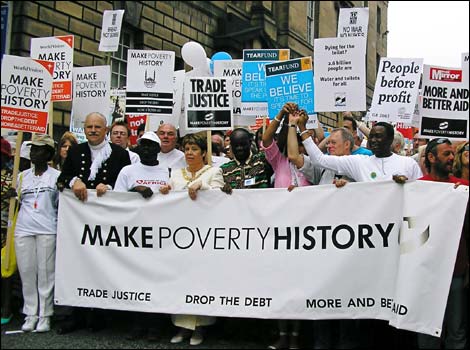

One measure of its success was the BBC's uncritical presentation of the Make Poverty History campaign and the Live 8 concerts. This was the subject of an official report just this week, which acknowledged that:

the BBC’s involvement with Make Poverty History in 2005 presented challenging dilemmas and was, for some, a difficult experience... there remain, even now, scars which have not fully healed.

Libby Purves, herself a well-known BBC presenter, expresses this discomfort more explicitly:

Personally, I applaud the nerve and passion of [campaign organisers] Geldof and Curtis, but not the BBC’s massive loss of perspective over Live 8. Carried by the vastness and suddenness of the enterprise... senior management rolled over whenever the campaigners – backed by Gordon Brown – pushed. Valid scepticism about Live 8’s demands was ignored. Even when Geldof arrogantly told Paul Martin, the Canadian Prime Minister, he was “not welcome” at the G8 summit unless he obeyed, the BBC continued presenting the event as uncritically as a Prom. It was all very uncomfortable and clearly won’t be allowed to happen again.

What Purves doesn't highlight is the way uncritical representation of the "good protesters" compounded the false polarisation of that wider spectrum of protest.

I spent the day of the Edinburgh march reporting for Make Poverty History Radio - a temporary station with no need for impartiality! But towards the end of the afternoon, I remember ducking into a pub a few streets away to catch some of the BBC coverage. As I watched, they cut from a helicopter view of a small group of black bloc kids penned in by riot police, to a reporter striding side by side with a group of marchers, chatting away to them. Whatever the exigencies of covering such an event, the contrast between the two shots - the embedded reporter with the "official" protesters, the aerial view of the trouble-makers - told its own story, one which chimed with much of that week's coverage.

There are various reasons why the unoffical protesters seldom get a hearing for their side of the story. Some of it has to do with their own suspicion and sometimes hostility towards the mainstream media, and the fact that they often become visible only when a minority start smashing windows. Some of it has to do with journalists' preference for talking to people their audience can identify with or who they themselves feel comfortable around. One big piece in the puzzle, though, is the relationship between the police and the media.

In the ordinary course of news reporting, the police are a privileged source of information. So much of the daily news agenda is made up of crime stories, court reports and other situations in which the police speak with authority. As a rule, you don't see interviewers challenge police officers the way they challenge politicians. This is just how things work, and while not always perfect, it's hard to think of an alternative.

The problem comes, though, when the police become one side of a story. Protests which don't have the endorsement of the authorities are a feature of democracy - a situation in which you can only protest with the government's permission is undemocratic. But such protests are often the scene of confrontations in which the police play a role - sometimes on their own initiative, sometimes on political orders - which is worthy of journalistic questioning. On the whole, however, this is not recognised, and it is common practice for the police version of events to be reported with the same uncritical attitude as in a crime story. (One TV reporter told me how his copy was rewritten to tally with a police press release, with the effect that shots of an activist being beaten by police were accompanied by a newsreader's description of "violence by protesters".)

For activists who see themselves misrepresented, it is easy to buy into conspiracy narratives about the forces which control the media. In my experience, what actually goes on is slipperier and less driven by intentions, though the effect may sometimes look like a conspiracy.

But there are at least two good reasons why anyone who wants to change the world should avoid conspiracy narratives. One is that if you believe them, you might as well give up - since the logic of the conspiracy narrative involves imputing such overwhelming power and capacity for control to the state/the multinationals/the 12ft-high lizards. The second reason is that, if you attribute your failures to conspiracies against you, you're unlikely to engage in the kind of reflection that gives you a chance of achieving more next time round.

The time I spent hanging out with anti-globalisation activists and getting involved with those campaigns was incredibly inspiring, as well as (sometimes) deeply frustrating. Whatever else, it challenged me to do something more constructive with my life than working as a mainstream news reporter. And, while I never got that book published, the process of writing allowed me to think through how you turn good intentions into making a real difference for people's lives - which certainly contributed to what I'm doing now.

But more on that in a future post...

Tuesday, 19 June 2007

A Sheffield Icon Under Threat

After yesterday's hopeful news, today brings a more disappointing story - or rather, a challenge to avoid one.

The Tinsley cooling towers stand alongside the M1, England's principal arterial motorway, as it crosses the Lower Don Valley on the edge of Sheffield. Familiar to millions of drivers, they are as striking a roadside landmark as Antony Gormley's rightly famous Angel of the North. But unlike Gateshead's iconic figure, the towers' aesthetic impact is incidental to their origin - as part of the Blackburn Meadows Power Station, demolished nearly 40 years ago.

More recently, the towers have become icons for something larger and less tangible. It happened because of two indecently talented young men, both named Tom, who started a fanzine called Go! Sheffo - a visual and lyrical love letter to an undersung city, and a rallying call to defend its distinctiveness against a tide of blandness masquerading as regeneration. They found a voice which resonated with all kinds of people in the city. And one of the best things they did was to organise a competition to turn the towers into a work of art.

Out of that competition came a campaign that seemed like it might succeed, that gathered media coverage and endorsements from the great and the good. Finally, however, it seems to have hit a wall with the towers' owners, the electricity generator Eon, who announced today that they're going to demolish them.

It's a strange thing to get excited about, a pair of cooling towers. Especially when there's a primary school next door to the same stretch of motorway which should have been moved elsewhere years ago and still hasn't. (Though there's no reason to set the two causes against one another.)

But the message Tom and Tom just sent out gives a sense of what they've come to stand for:

We’ve always said that Sheffield needs something to represent the changes that this city has gone through, and the good things that happen here. A new icon.

We’ve always said that the cooling towers are perfect for this. They’re in a perfect position, and represent both Sheffield’s ugly past and its potentially beautiful future...

This is crunch time. We need someone else to put their money where their mouths are. We haven’t got the resources or the time to mastermind a process that ends up with two old cooling towers transformed into new symbols. We don’t get paid to do this. Maybe the people who do, should.

If the leaders of this city want to see the cooling towers transformed into spaces for international works of public art, like the Tate Modern turbine hall, like the Gasometer in Oberhausen, Germany, it needs to happen now.

If our leaders really want Sheffield to be ‘a Distinctive City of European Significance’ then do something to make it distinctive. This is an organic, positive idea, that only Sheffield can do. No-one else has two massive structures next to the M1. No-one else could change what their city means at a stroke. Not Newcastle, not Manchester, certainly not Leeds.

And here’s a message to the city.

Unless you do something big and bold soon in the regeneration of Sheffield, no-one will care. Literally, no-one outside the city will care. No-one will care about a city with the same shops as everywhere else, the same flats as everywhere else, the same cafes as everywhere else, but slightly uglier buildings.

For the last two and a half years, we’ve been trying to make a good idea happen. We still believe it’s a brilliant idea. The question is, what are you going to do about it?

Monday, 18 June 2007

Sheffield becomes first City of Sanctuary

City of SanctuarI fully intend to carry on the conversation I've been having with Tim on my previous post, but meanwhile I just wanted to share some good news.

City of Sanctuary is a movement started by a friend of mine, Craig Barnett, to build a "culture of hospitality" for refugees and asylum-seekers. The idea is to work below the (often toxic) national debate, at a level which is closer to people's everyday lives, to change the conversation about asylum. It's modelled on the Fairtrade City movement, which has been extremely effective at raising awareness and changing behaviour by working at the level of the town or city and gaining commitments from all kinds of groups and organisations, with the goal of persuading local politicians to join them.

Well, the good news is that, at the start of this year's Refugee Week, the Mayor of Sheffield has announced the council's support for the campaign - making us the first city in the UK to make a public commitment to welcome asylum seekers and refugees. This reflects a lot of hard work by Craig and others.

In his speech, the Mayor said, 'I'm pleased to announce today that the City Council declares its support for City of Sanctuary, this means that the City Council is now publicly committed to working with others to promote a welcoming city for asylum-seekers and refugees.'

There is still plenty of work to be done in encouraging other local organisations to become involved, and in working with the City Council and others on finding ways to translate this commitment into practice.

But it is a major landmark in the movement to create a culture of hospitality for asylum-seekers and refugees, and we would like to express our thanks to all of our supporters for making it possible. We hope soon to begin discussions with groups in other cities to try to create Cities of Sanctuary around the UK.

Why not come and celebrate this success with us at the City of Sanctuary Ceilidh on Saturday 23rd June, 7-10pm at Croft House Settlement, Garden Street, off Broad Lane S1. Admission free!

If you have the opportunity, please spread this idea - it would be great to see other cities follow suit.

Sunday, 10 June 2007

Black Bloc, White Bloc

This blog got its name from a book I failed to write.

It was July 7th 2005 and, as news came through of the terrorist attacks on London, I was in the middle of an anti-G8 protest camp in Scotland. For the past week, I had been weaving in and out of different groups of campaigners, from the Make Poverty History march to a collective of anarchist hill-walkers, from the Black Bloc kids fighting with the police at Gleneagles to the Edinburgh leg of Bob Geldof's Live8 concerts.

After staying for James Brown's last encore at Murrayfield, I ended up spending the night on the steps of Waverley station with a group of teenage concert-goers who'd missed the last train home - and it was there, in the early hours of July 7th, that I had a conversation which brought my puzzlement into focus. "What I don't get," said the girl from Middlesbrough, "is these anti-G8 protesters. I mean, why do they want to stop the G8 making poverty history?"

Here was this intelligent young woman, trying to make sense of the world on the basis of what she saw on the news and read in the papers, and she'd decided that the anti-G8 protests must be some kind of pro-poverty campaign. It was at once insane and an entirely understandable conclusion.

The next morning, back inside the police lines at Stirling, I was still thinking about that conversation when the news from London spread through the camp. The mood changed in moments. People clustered around wind-up radios, listening to the live news reports, or tried to call friends and relatives to check that they were safe. The confirmation came through that this was being treated as a terrorist attack.

A few minutes later, I heard the BBC presenter interview a terrorism expert, a man called MJ Gohel. Yes, he said, this looked like a coordinated attack, but we mustn't be too quick to point the finger of blame: it could be Al Q'aeda, but it was "equally possible" (those were his precise words) that this had been done by people protesting against the G8.

For months, I kept going back to those words. You had to tread carefully, in the context of so much horror and grief, to place significance on one pundit's off the cuff opinion. Yet what I wanted to know was how it became thinkable for a "terrorism expert" to put the anti-G8 activists on a par with Osama bin Laden as likely suspects for an act of mass murder.

So far as I could tell, the only deaths with which the anti-globalisation movement had been associated were the shooting by Italian police of a young protester at Genoa, and the self-immolation of a Korean farmer during the protests at Cancun. Anyway, I had spent months hanging out with these activists - and, while the more militant believed in the destruction of property and picking fights with the police, even this minority had no taste for violence against innocent civilians. In that respect, they stood in contrast to the leaders gathered inside the Gleneagles Hotel, among them the architects of the invasion of Iraq. Anyone suggesting Bush and Blair might have a hand in the London bombings would (understandably, I think) be branded a conspiracy theorist - yet the anti-G8 activists had somehow become plausible suspects.

This plausibility was, I felt sure, part of the same distortion that had confused the girl from Middlesbrough. Somehow the spectrum of protest I had seen on the ground in Scotland was polarised, in the media and the language of politicians, until it seemed like two opposed forces - the moderates and the extremists. I started writing about this, trying to work out how it came about. Plenty of the activists I talked to were happy to believe it was a deliberate policy on the part of the media - yet I had worked in BBC newsrooms and I knew that such "paranoia" (as journalists saw it) was part of why activists were treated with suspicion. At the same time, I was fascinated by the way that elements within the different groups of protesters seemed to contribute to the polarised portrayal - most obviously, in the iconic (if accidental) contrast between the "infamous" Black Bloc anarchists and the white-clad Make Poverty History marchers. (None of which excused journalistic laziness or political cynicism.)

As the summer went on, it became clear that something very similar was happening in the portrayal of British Islam in the wake of the bombings. Muslims were divided (by the media and politicians) into "moderates", whose leaders were happy to be photographed shaking hands with government ministers, and "extremists", who were evil and beyond reason. It was striking how this mirrored the representation of campaigners in the run up to Gleneagles - Geldof with his arm round Blair's shoulder, while police chiefs thundered warnings about the dangerous and irrational anti-G8 protesters...

To cut a long story short, I wrote a first draft of the book over the summer and, after some delay, found an agent who wanted to help me get it published - but as I tried to act on her advice, the project seemed to lose shape. To be honest, I wasn't ready to write a book - I hadn't grasped the disciplines of form which apply to a project of that scale and are quite distinct from the ability to write a half-decent sentence or paragraph. But every now and then, when I watch news reports (such as those from Germany last week) or hear a politician speaking, I am reminded of those themes and find myself wishing I'd managed to give them the treatment they deserved.

Thursday, 31 May 2007

Guinea Pigs Sought!

I realise I've been a bit slack at replying to people's comments and emails this month. Sorry! It's not wilful neglect - only the knock-on effect of things getting really busy with the School of Everything. We're in the middle of talking to investors, plotting lots of exciting things to do with the first working version of the site (coming soon...), moving into a new (temporary) office in Bethnal Green - and looking for guinea pigs!

I posted a request earlier on the School of Everything blog, and I thought I'd repost it here. If you think you know anyone (in the UK) who'd be interested, please repost or pass it on as appropriate. Thanks!

The Highly Educated Guinea Pig - taken by Kerry

We're building a tool to help people organise learning - so we want to make sure it's helpful to people who are already out there working as independent teachers.

What do we mean by independent teachers? Well, we reckon there are around 100,000 people in the UK who make a living partly or wholly through teaching on a self-employed basis, outside of institutions. That could mean offering guitar lessons, running yoga classes or photography courses, or teaching astrophysics from a garden shed. (It includes freelance driving instructors, but not those who work for a larger driving school.) Depending on the subject, they may teach from home, travel to their students, or rent a venue. For some, it's a full-time job - for others, a way of supporting their studies or creative projects...

If any of that sounds like you, we want to hear from you!

We're putting together a small pool of teachers who are willing to meet up occasionally over the next few months, to share their experience and give us feedback - as well as a larger number who are prepared to answer some questions over the phone or by email.

If you're interested and you want to know more, drop me a line:

dougald@schoolofeverything.com

Monday, 14 May 2007

Pick Me Up (Again)

How many people can say an email changed their life?

Probably quite a few these days, actually - and some with more dramatic stories than mine. But, for what it's worth, the email in question was Pick Me Up - a weekly newsletter of stories, events listings and requests, run by volunteers and held together by a DIY approach to life.

Made up of two or three line snippets, each with a link to a longer article or a website, it married culture and activism with a hopeful, playful attitude. Nothing got written about unless it involved someone actually making something happen, then telling the story in their own words. Over two years, that included:

- providing air hostess service on the London Underground
- grazing cows in the city
- stealing a concert hall from the Sarajevo mafia
- installing a street piano in Sheffield
- and naming at least one baby!

So did it really change my life? Well, by the time I became an editor for Pick Me Up, I already had form as a journalist and an activist. But working with Charlie Davies - who started the email after the demise of The Face - challenged me to raise my game, and to push at the limits of those roles.

If I hadn't got involved with Pick Me Up, I'd probably still be working in a BBC newsroom. I certainly wouldn't have left to start the School of Everything, since it was through the email that I met three of my co-founders.


Charlie Davies (right) with Sebastian Mary HarringtonPick Me Up founder Charlie Davies (right) with sMary from the School of Everything

After reaching its hundredth issue last summer, Pick Me Up went to sleep for a while. As editors, many of us had become busy with new projects. It felt like we'd graduated from the email, and to keep it going out of a sense of duty would have been missing the point.

Still, I was excited when a brand new issue arrived in my inbox earlier this year - and recently, it seems to be returning to something like its original frequency. (As you'll gather, I'm not directly involved at the moment.)

My only concern is that, where three years ago Pick Me Up felt incredibly fresh and distinctive, today the attitude it embodied seems to be all over the place! Every time I pick up an issue of Time Out, I find stories like this, about the "Guerrilla Benchers" who reinstall seating where local councils have taken it away. Where our relationship with our readers - who often provided the best stories - felt like a contrast to the cynicism of some BBC colleagues, now "user-generated content" is all across the media. Such cynicism is hardly dead, yet just tonight I was struck by BBC2's new series Power To The People, in which a Newsnight reporter turns activist - in the first programme, leading the villagers of Lanteith on an invasion of Islington, complete with echoes of Eike's urban cows.

I'm not saying we started it all - and I'm certainly not saying it's stopped being cool now everyone's at it. But I am curious as to what Pick Me Up should do next. (Any suggestions...?)

As it happens, I'm speaking on a panel with Charlie in Sheffield this Friday, so I shall ask him what he's got planned! (If you want to come along, it's a discussion called 'Free vs Open', as part of the Lovebytes digital arts festival - and we're on at the Showroom cinema at 4pm.)

You can sign up for future issues of Pick Me Up here.

Friday, 4 May 2007

Through the Looking Glass?

The intricacies of Proportional Representation mean it's still far from clear whether the Scottish National Party have won their historic victory – but Alex Salmond's spectacular win in Gordon sent me looking for a book I read a few months ago.

Tom Nairn's 'After Britain: New Labour and the Return of Scotland' is the kind of outlandish political writing which catches at themes dismissed by the sophisticated insider. Published in 2000, it offered a very early judgement on the Blair era, and reading it today is a bit like digging up a time capsule. The fetishization of youth, about which Nairn was so scathing, feels rather distant now. On the other hand, his preliminary verdict on the Kosovo conflict might offer a clue to Blair's behaviour following 9/11. For a British leader, whose country has never fully accepted its reduced circumstances following the loss of Empire, Nairn identified “the glamour of appearing to bestride the world once more”.

And as I read it last winter, the book's central prediction – that Blair's ultimate legacy would be the break-up of the United Kingdom – seemed a surprisingly plausible prophecy. In London, the prospect of Scottish independence is still treated as Alice in Wonderland stuff. The figures don't add up, it's not value for money. Yet the inadequacies of this kind of politics-as-economic-calculation set me thinking of Nairn's attack on 'corporate populism':

'Corporate populism' is absolute philistinism. Another reason for the business class to support New Labour, of course, but one which seems inseperable from a frightful risk. Its apparatus of consumers and 'stakeholders' mimics democracy, substituting brand-loyalty and ordinariness for hope and glory. This can seem possible, even attractive, while things go well in the narrowly economic terms to which the creed awards priority...

When the growth-momentum ceases... people will then have to fall back on the non-corporate, less than cost-effective nation – on a national community and state... That is, on communal faith and justice, the extended family of egalitarian dreams. Everyone knows that a corporation will not 'support' customers in any comparable sense, beyond the limits of profitability; but everyone feels that is exactly what a nation should do. Brand-loyalty is precisely not 'belonging' in the more visceral sense associated with national identity. Indeed it easily becomes the opposite of belonging: sell-out, Devil take the hindmost, moving on (or out) to maintain profitability. Since the national factor cannot really be costed, it is easily caricatured as a question of soulful romanticism or delusion. However, such common sense is itself philistine. It fails to recognize something crucial. When Marks & Spencer betrays its customers the result is an annoyance; for a nation-state to let its citizens down can be a question of life or death, and not in wartime alone.

There is a hollowed-out rhetoric of progress which is one of the most infuriating traits of 'on message' New Labour politicians. I don't mean the litanies of practical improvements for which this government can rightly claim credit, but the abstract invocation of 'progress' which assumes that the past is a nightmare from which we are trying to awake, and labels as 'reactionary' anyone who talks seriously about 'belonging'.

Let's imagine that Alex Salmond is Scotland's new First Minister. Two or three years down the line, having proved themselves in office, and with a newly-installed Tory government at Westminster, it is not unimaginable that the SNP win an independence referendum. In such a scenario, it may be worth heeding Nairn's warning for England:

Blair's Project makes it likely that England will return on the street corner, rather than via a maternity room with appropriate care and facilities. Croaking tabloids, saloon-bar resentment and back-bench populism are likely to attend the birth and to have their say. Democracy is constitutional or nothing. Without a systematic form, its ugly cousins will be tempted to move in and demand their rights - their nation, the one always sat upon and then at last betrayed by an élite of faint-hearts, half-breeds and alien interests.

And whatever happens in Scotland, with bad economic news on the horizon, the Brown era is likely to see 'corporate populism' put to the test – while questions of 'belonging' rise on the agenda, in more or less attractive forms.

Closet Labour Voters Spare Blair's Blushes?

Well, it's still early in the night, as the TV commentators say, but it looks like Labour haven't been given quite the kicking a lot of people were predicting. John Reid was on the BBC earlier talking about the gap between opinion polls and what canvassers were hearing on the doorstep.

Listening to him, it occurred to me that voting Labour has become a little shameful, in the way that voting Conservative was in 1992. Back then, the pollsters had to weight their survey results to compensate for the reluctance of Tory voters to own up. It wouldn't surprise me if the sort of casual vitriol that constitutes received opinion about Tony Blair has had a similar effect. Could it be that this tranche of closet Labour voters has spared the government some misery tonight?

Here in Sheffield, I made it to the polling station (by taxi) ten minutes before they shut up shop. But there's no election night drama for us – every council in Yorkshire has postponed its count to tomorrow daytime, so whenever David Dimbleby hands over to the “regional results in detail”, we get a reporter sitting in an all night cafe chatting with a few retired council leaders.

Sunday, 29 April 2007

A Book I'm Looking Forward To

From Jim Johnson's (Notes On) Politics, Theory & Photography comes exciting news - a new book from John Berger, due out in June. Hold Everything Dear: Dispatches on Survival and Resistance.

More from the Verso website:

From Hurricane Katrina, 9/11 and 7/7, to resistance in Ramallah and traumatic dislocation in the Middle East, Berger explores the countless personal choices, encounters, illuminations, sacrifices, new desires, griefs and memories that occur in the course of political resistance to empire and colonialism.

These sensuous reflections reveal the political at the core of human existence, from the relentlessness of daily life in the West Bank, to the potential force of desire, to the unflinching gaze of Pasolini's political film. Visceral and passionate, Hold Everything Dear is a profound meditation on what political resistance means today, by one of the most compelling radical voices of our age.

I did think to write at greater length about Berger himself and why his work matters so much to me, but I had trouble distilling this into a single blog post. At which point, I got the idea of creating a separate site (organised more appropriately to the task) on which to publish my notes on Berger, Garner and Illich - and the connections and resonances between their work. Because they are generally shelved in different sections of the bookshop, these connections have seldom been made, but I have found them deeply helpful in making sense of the world we're in.

So one of the reasons for the relatively neglected state of this blog is that I have started work on that site, under the title 'Redrawing the Maps'. Given the number of unfinished grand projects gathering dust in different corners of my life, I'm keeping this simple. As soon as I've pulled together enough material to be of use or interest to anyone - hopefully within the next few weeks - I'll make it public, while continuing to add to it as and when I get the chance.

Wednesday, 18 April 2007

A Fine Piece of Mischief

There's a nice story in today's Guardian Society section about an unusual piece of corporate generosity. A dozen tiny grassroots campaign groups got a surprise earlier this year, when letters arrived from the cosmetics chain Lush, swiftly followed by cheques for £1000. Among them was the campaign against the widening of the M1 motorway run by my friend Julie White.

These are groups that generally run on a mixture of sweat and imagination, so the cash should come in handy. As impressive (to me) as the gifts is the logic which led Lush CEO Mark Constantine and campaigner Rebecca Lush (no relation!) to them:

"My son and one of the buyers went out to Thailand after the tsunami and it was pretty horrific," he explains. "They saw all the wasted money, all the schools bought for children that weren't alive, boats that will never sail, houses for people that don't exist, a general waste of all the money that everyone chucked in. And that's why we're so specific, that's why I asked Rebecca to get the activists on board. We could give a hundred grand to the Prince's Trust (who we like very much) or we could give that in one grand lots to people stopping climate change. Frankly, that sounds more fun."

The waste of money by large charities Constantine describes sounds very much like the phenomenon Ivan Illich called 'paradoxical counterproductivity' - the tendency of modern institutions to produce the opposite of their stated purpose, so that (for example) the education system becomes an obstacle to learning. He associated this with a tendency for activities which begin as a means to an end to end up being performed for their own sake.

For Illich, examples of such counterproductivity are not simply unfortunate accidents, but a consequence of the very structures by which we organise the institutional delivery of care. It is not that learning cannot take place within our education systems, but that it does so in spite of them - where people manage to open a space in which the hold of institutions is loosened, allowing the possibility of convivial relationships, based on invitation and free response.

What is startling about Illich is that, unlike most critics of contemporary capitalism, he doesn't focus on the obvious targets - multinational corporations, the military-industrial complex. His attacks on the caring professions, the institutions of the social democratic state, even the concept of "responsibility", have seemed blasphemous to many. (In fact, it is precisely the "sacredness" of his targets which he sees as making them so dangerous!) Others, on the left, portray him as an unworldly intellectual whose ideas were hijacked by Thatcherites - a well-meaning fool.

Part of the difficulty is (and I realise I may lose anyone who's still following this here!) that, while his mode of expression was largely secular, Illich's thought is at bottom deeply theological - it is 'foolishness to the Greeks'! It is an invitation to turn your view of the world upside down, which is a frightening prospect. Later texts such as 'Health as one's own responsibility - no, thank you!' make stark reading - and, even among his admirers, there are those who see him as descending into backward-looking pessimism. This is a convenient misreading, which allows the reader to sidestep the full implications of his work. But to face its force, it may help to notice the playful smile with which it was delivered, the joyful foolishness which is the other side of Illich's invitation.


There is a sense of that, too, in Mark Constantine's explanation of why he chooses to donate to such small, grassroots groups:

"If you're going to give money away you might as well give it to someone who's going to do something stupid with it." His favourites among the groups are Sardine Man, who travels the country highlighting congestion problems, or the Guerilla Gardeners, who plant flowers on ugly traffic islands in the dead of the night. In that spirit he's also created the Charity Pot, a hand lotion from which all the proceeds, save the VAT, will be going to more of these small grassroots groups.

"I hate cars, I really hate them, but I'd been giving up the ghost, until Rebecca came along and we started all this up," says Constantine. "It's really rekindled my bloodymindedness. When you think about it, you think how much mischief you can do with a thousand here, a thousand there, it's great. If we get a million out of the Charity Pot, we could create absolute chaos."

His face lights up and he starts to laugh. "They won't be able to get a digger to move across the whole of Britain!"

Illich once calculated that - once you take into account all the hours spent working to pay for a car, petrol, insurance and taxes to build roads - drivers manage an average speed of around four miles per hour. I can't help feeling that, were he still around, he'd approve of Mark Constantine's mischief-making!


More Illich links:

A useful introduction to Illich's thought
A selection of online texts
Reflections from Illich's friends, following his death in December, 2002
Thinking after Illich - English version of a site created by some of his friends and collaborators

About Me

My photo
London, United Kingdom
This blog was my online home between 2006 and 2009. Today, you'll find me scattered across the internet. To start looking, go to my personal website: http://dougald.co.uk/

My Projects

Signpostr School of Everything

MyBLOGLOG

Followers

My ClustrMap

From My Shelves

Labels