Prehistoric Totalitarianism and Tiny Elephants

Without abandoning his professional rigour, Mithen provides the layman with a tour of a prehistoric world, many of whose 'most remarkable events remain hidden from all but a few academics and specialist readers in scholarly works of impenetrable and jargon-laden prose.' This is the story of the origins of farming, towns and civilisation against the backdrop of (at times dramatic) shifts in climate.
As Mithen acknowledges, the bumpy journey from the Last Glacial Maximum to the more hospitable world of the Holocene offers food for thought for us, facing the unknowns of man-made climate change. There are stories here which put a quietness on you. Consider the Natufians, who lived comfortably in villages across the Middle East for fifty generations, before the climatic switchback of the Younger Dryas brought in a thousand years of cold and drought, scattering them to a hungry, wandering existence.
Then there is a nightmarish reconstruction of the early town of Çatalhöyük, with its fearsome iconography of bulls and women whose breasts split apart to reveal the skulls of dead animals. Mithen suspects its residents, alienated from nature, became trapped inside their own myths: 'every aspect of their lives had become ritualised, any independence of thought and behaviour crushed out of them by an oppressive ideology manifest in the bulls, breasts, skulls and vultures.'
After this, it is a relief to reach the chapter on Cyprus, which reminded me - somewhat improbably - of a post from my favourite blogging librarian, relating a visit from her inlaws. The following dialogue was originally offered as proof of their deepening strangeness:
MiL: You know they made small animals out of bigger animals?
Me: *wondering if we're about to get a Talk on the Miracle of Birth* Not exactly...?
MiL: Well, you know, like domestic cats were bred from big wild cats, and dogs from wolves, and so on.
Me: Oh! Yes, what of it?
MiL: Well, don't you think they should make tiny elephants? You could stroke them *vigorously mimes stroking 2ft high elephant* They would look so cute scampering around the house, and they wouldn't shed on the carpet.
FiL: They're terrible for shedding skin, though, elephants are. *nods wisely*
Me: *boggles*
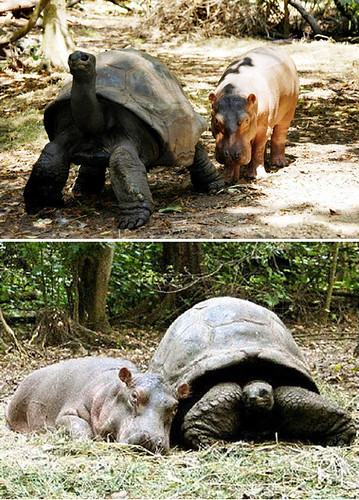
Now, regular readers of this blog will know that I have a soft spot for hippopotami - so I was doubly delighted to discover that not only tiny elephants but herds of tiny hippo actually existed in prehistoric Cyprus! This came about, not as my friend's in-laws proposed, through domestication, but as a result of the lack of predators on the island, 'great bulks being quite unnecessary if the only worry is to procure sufficient food and sex to ensure the survival of genes':
Both elephants and hippos gradually assumed the size of large pigs, the latter far more numerous and seeming to behave like pigs themselves. They were good swimmers but seemed happier scurrying through the undergrowth, feeding on leaves and shoots. The hippos had drunk from freshwater springs on the cliff-tops. In cold weather they had sheltered in coastal caves, being adept at climbing up and down steep slopes.
Controversy rages, apparently, over whether these marvellous sounding creatures were hunted to extinction by the first humans to reach Cyprus, at around 10,000 BC, or had already given up the ghost as a result of climate change. (Mithen comes down on the latter side of the argument.)
So much to write about, and I'm not yet a quarter of the way through this utterly fascinating book! (Meanwhile, here is a pair of small hippos I met in Trafalgar Square the other weekend...)