Showing posts with label sheffield. Show all posts

Thursday, 28 June 2007

It's wet up north...

By the time I got out of Sheffield on Monday morning, they were already cancelling trains. On Radio 4, a presenter said something about "the wettest day for fifty years" - but I was heading to a conference in Stoke and, beyond the nuisance of having damp feet all day, didn't give it much thought. Or not until the end of the afternoon, when I stopped to check my email and saw the pictures.


It's been a strange week to be out of town. My girlfriend got stranded and had to camp out in her office for most of the first night. My old colleagues at Radio Sheffield were working 24 hour shifts, getting official information out and talking to people on the ground. Even as the flooding went down in the city itself, there have been rolling black-outs, foul mud covering large areas, and traffic chaos with the M1 closed for days.

The Fire Brigades Union general secretary, Matt Wrack, gives a sense of the scale of events:

We have witnessed the biggest rescue effort in peacetime Britain by our emergency services, and it's not over yet. Fire crews and officers have been working to the point of collapse. Emergency fire control operators have been under major pressure, with thousands of extra calls for assistance from the public...

The government has not understood the scale, gravity and severity of what has happened.

The same could be said of large parts of the London media (the Guardian included) - which have prioritised not only the Downing Street handover, but such momentous events as the release of Paris Hilton and the Spice Girls reunion. If it were Bluewater [big shopping centre, near London] and not Meadowhall that was six feet deep in water and sewage, there would be rather more fuss.


I was in two minds whether to write this post. It seems kind of petty to moan about the metropolitan parochialism of the British media, when there are plenty of more useful things to be done. But I'm not at home to pitch in - so all I can do is admire the efforts of members of the Sheffield Forum and the local Freecycle group, and contrast them to the BBC producer who could be heard expressing his opinion over footage of the floods: "I do hate the Sheffield Accent with a passion... sorry, I don't mean to be a snob... they sound ignorant." [The offending clip has now been removed from BBC Online, but I heard it with my own ears.]

One piece of bigotry like that, for all it lets down the BBC's staff on the ground, would hardly be worth mentioning - if it wasn't something that us northerners experience on a daily basis. Stuart Maconie, a BBC broadcaster himself, writes eloquently about the same phenomenon in the conclusion to his wonderful 'Pies and Prejudice: In Search of the North':

On a rainy drive across the Lancashire moors, I caught a short Radio 4 'issue-based' story about childlessness but, for me, it was the minor detail that provoked the most thought. The protagonist was an academic with a cut-glass accent. She had lost a daughter called Cordelia and her neighbour was a TV producer. At no point was there any suggestion that these people and this milieu were in any way out of the ordinary. This was incredibly telling, I thought. Most people have never met either a Cordelia or a television producer. But as they discussed their (literally) extraordinar lives in voices of crystalline poshness, their remoteness from life as most of us live it was never acknowledged.

If, however, you turn on a Radio 4 play and the voices are northern, it will inevitably be all about 'being northern'. About how poor or cute or funny or indomitable we are. It will never be simply set in Sheffield or Hull or Wigan because it can be and should be. It will never be about an adulterous dentist who just happens to live in Bootle. It will be in some ways about his Scouseness... Some writers may think this is complimentary. In fact, it's patronising. It's in effect saying that you have to have a strong dramatic reason, a 'hook', in order to set your play outside the M25. The fact that most of the country actually lives there isn't good enough evidently.

Quite.

Tuesday, 19 June 2007

A Sheffield Icon Under Threat

After yesterday's hopeful news, today brings a more disappointing story - or rather, a challenge to avoid one.

The Tinsley cooling towers stand alongside the M1, England's principal arterial motorway, as it crosses the Lower Don Valley on the edge of Sheffield. Familiar to millions of drivers, they are as striking a roadside landmark as Antony Gormley's rightly famous Angel of the North. But unlike Gateshead's iconic figure, the towers' aesthetic impact is incidental to their origin - as part of the Blackburn Meadows Power Station, demolished nearly 40 years ago.

More recently, the towers have become icons for something larger and less tangible. It happened because of two indecently talented young men, both named Tom, who started a fanzine called Go! Sheffo - a visual and lyrical love letter to an undersung city, and a rallying call to defend its distinctiveness against a tide of blandness masquerading as regeneration. They found a voice which resonated with all kinds of people in the city. And one of the best things they did was to organise a competition to turn the towers into a work of art.

Out of that competition came a campaign that seemed like it might succeed, that gathered media coverage and endorsements from the great and the good. Finally, however, it seems to have hit a wall with the towers' owners, the electricity generator Eon, who announced today that they're going to demolish them.

It's a strange thing to get excited about, a pair of cooling towers. Especially when there's a primary school next door to the same stretch of motorway which should have been moved elsewhere years ago and still hasn't. (Though there's no reason to set the two causes against one another.)

But the message Tom and Tom just sent out gives a sense of what they've come to stand for:

We’ve always said that Sheffield needs something to represent the changes that this city has gone through, and the good things that happen here. A new icon.

We’ve always said that the cooling towers are perfect for this. They’re in a perfect position, and represent both Sheffield’s ugly past and its potentially beautiful future...

This is crunch time. We need someone else to put their money where their mouths are. We haven’t got the resources or the time to mastermind a process that ends up with two old cooling towers transformed into new symbols. We don’t get paid to do this. Maybe the people who do, should.

If the leaders of this city want to see the cooling towers transformed into spaces for international works of public art, like the Tate Modern turbine hall, like the Gasometer in Oberhausen, Germany, it needs to happen now.

If our leaders really want Sheffield to be ‘a Distinctive City of European Significance’ then do something to make it distinctive. This is an organic, positive idea, that only Sheffield can do. No-one else has two massive structures next to the M1. No-one else could change what their city means at a stroke. Not Newcastle, not Manchester, certainly not Leeds.

And here’s a message to the city.

Unless you do something big and bold soon in the regeneration of Sheffield, no-one will care. Literally, no-one outside the city will care. No-one will care about a city with the same shops as everywhere else, the same flats as everywhere else, the same cafes as everywhere else, but slightly uglier buildings.

For the last two and a half years, we’ve been trying to make a good idea happen. We still believe it’s a brilliant idea. The question is, what are you going to do about it?

Monday, 14 May 2007

Pick Me Up (Again)

How many people can say an email changed their life?

Probably quite a few these days, actually - and some with more dramatic stories than mine. But, for what it's worth, the email in question was Pick Me Up - a weekly newsletter of stories, events listings and requests, run by volunteers and held together by a DIY approach to life.

Made up of two or three line snippets, each with a link to a longer article or a website, it married culture and activism with a hopeful, playful attitude. Nothing got written about unless it involved someone actually making something happen, then telling the story in their own words. Over two years, that included:

- providing air hostess service on the London Underground
- grazing cows in the city
- stealing a concert hall from the Sarajevo mafia
- installing a street piano in Sheffield
- and naming at least one baby!

So did it really change my life? Well, by the time I became an editor for Pick Me Up, I already had form as a journalist and an activist. But working with Charlie Davies - who started the email after the demise of The Face - challenged me to raise my game, and to push at the limits of those roles.

If I hadn't got involved with Pick Me Up, I'd probably still be working in a BBC newsroom. I certainly wouldn't have left to start the School of Everything, since it was through the email that I met three of my co-founders.


Charlie Davies (right) with Sebastian Mary HarringtonPick Me Up founder Charlie Davies (right) with sMary from the School of Everything

After reaching its hundredth issue last summer, Pick Me Up went to sleep for a while. As editors, many of us had become busy with new projects. It felt like we'd graduated from the email, and to keep it going out of a sense of duty would have been missing the point.

Still, I was excited when a brand new issue arrived in my inbox earlier this year - and recently, it seems to be returning to something like its original frequency. (As you'll gather, I'm not directly involved at the moment.)

My only concern is that, where three years ago Pick Me Up felt incredibly fresh and distinctive, today the attitude it embodied seems to be all over the place! Every time I pick up an issue of Time Out, I find stories like this, about the "Guerrilla Benchers" who reinstall seating where local councils have taken it away. Where our relationship with our readers - who often provided the best stories - felt like a contrast to the cynicism of some BBC colleagues, now "user-generated content" is all across the media. Such cynicism is hardly dead, yet just tonight I was struck by BBC2's new series Power To The People, in which a Newsnight reporter turns activist - in the first programme, leading the villagers of Lanteith on an invasion of Islington, complete with echoes of Eike's urban cows.

I'm not saying we started it all - and I'm certainly not saying it's stopped being cool now everyone's at it. But I am curious as to what Pick Me Up should do next. (Any suggestions...?)

As it happens, I'm speaking on a panel with Charlie in Sheffield this Friday, so I shall ask him what he's got planned! (If you want to come along, it's a discussion called 'Free vs Open', as part of the Lovebytes digital arts festival - and we're on at the Showroom cinema at 4pm.)

You can sign up for future issues of Pick Me Up here.

Wednesday, 21 March 2007

In Praise of Customer Unfriendliness

When my School of Everything co-conspirator Paul bemoans the scarcity of free wifi in central London, I tend to feel a little smug. In Sheffield, there's a decent scattering of hotspots in independent cafes or pubs. On the other hand, when all that matters is getting something written, I prefer to escape the tentacles of the internet and hole up in more low-tech surroundings.

That's how I found the old cafe a couple of streets away from where I'm living. Let's call it Cafe #8. As a newcomer, it's a disconcerting place. The owners hardly seem enchanted at the sight of an unfamiliar face. It's more like the moment in a Western when the hero walks into a saloon and every conversation stops as every head turns to look his way.

If, despite the owners' suspicion, you stick around, you'll start to notice how most of the customers seem to know each other. They'll stop for a chat at each table on their way in or out, or ask each other for help with the crossword. After a while, if you go in often enough, you will be rewarded with a smile and a nod. They may even not object if you ask to plug in your laptop.

A few years ago, to fill the gaps between freelance work, I used to be a mystery shopper for Starbucks. It was a fascinating glimpse into the mind of a company which aims to synthesize and standardize the "customer experience" of the kind of well-loved local cafe it sends out of business. Among other things, I had to rate the staff according to whether, over and above the standard sales script, they made an effort to strike up conversations with customers. Spontaneity, it seemed, was mandatory.

Well, what occurred to me, as I slowly won the acceptance of the owners of my local cafe, was that the one thing Starbucks can't simulate is the customer unfriendliness of a place that really belongs to its neighbourhood. At Starbucks, the staff are meant to treat me like a friend because I'm a paying customer. At Cafe #8, my treatment depends on becoming part of the community, which takes time. It's not that there's any danger of being turned away. Anyone can buy a coffee there - and they know how to make coffee - but, to get all sociological about it, the staff's "emotional labour" isn't part of the bargain. And, when you come to think about it, isn't there something dirtying about anywhere where I can pay to be treated like a friend?

So let's hear it for the places where it takes time before you're welcome, where the staff are slightly wary of outsiders. It doesn't score well with mystery shoppers. It's easy enough to caricature. But set against the fake friendliness demanded by the managers of multinationals, that wariness is a little act of resistance.

Monday, 19 February 2007

Reading the Signs of Sheffield...

I've been a strange mood recently. I couldn't shake it off - not by getting on with the things I should be getting on with, and not by sitting around waiting for it to change. So this afternoon I decided to distract myself by walking home from town through the back streets, looking out for all the signs and symbols I wouldn't usually notice:

animated gif slideshow of signs and symbols

Some of them are really strange.

For example, it was only when I stopped to take a picture of the bent round signpost under the Bramall Lane roundabout that I noticed someone had changed all the wording - one way pointed to "Big Fish" and "Bigger Fish", another to "Bottom Feeders". What's the story there?

And who are the "Army of the Flying Robots"?

Others just amused me. Like the banner advertising a romantic Valentine's dinner at the football ground, which sounded like the perfect solution for a man torn between two loves - the Blades and his other half.

But if any fellow Sheffielders know the stories behind the signs, I'd be really interested to know.

Thursday, 8 February 2007

The Inconvenient Journalists

Yesterday, I was thrown out of Al Gore's climate change presentation.

Before you ask, I hadn't returned to my direct action roots and interrupted the slideshow by splashing black paint across the stage to symbolize the million air miles he and Tipper offset annually. (Though that is a lot of oil.)

I was there as a journalist and I was ejected along with the rest of the media after the first five minutes. All we got to see was the "My name's Al Gore and I used to be the next president of the United States" stand-up routine. So I can confirm that he delivers his punchlines with an impressive feel for comic timing. But that's it.

Afterwards, in the lobby, I wasted more energy than it was worth telling the PR team what I thought. As one of the newspaper reporters put it, "How are we meant to report that?" All they could tell us was that they had negotiated on our behalf with Gore's people to get us in even for five minutes. Apparently he doesn't allow media in his presentations.

Given how much Gore has done to shift attitudes over climate change, it seems petty to gripe. Anyway, having calmed down, I'm actually interested in what's going on here. When he says that the "conversation of democracy is broken", Gore has the US media in his sights, so I guess the "no journalists" policy is part of this. Although he doesn't flesh out its implications, his emphasis on the importance of democratic renewal to tackling climate change is reassuring, in comparison to the authoritarian tone of some prominent campaigners here in the UK. But that's exactly what I'm writing an article about - and it would have been good to be able to see him in action at first hand, rather than being told by a press officer that the content of his presentation would "probably be not much different to the DVD".

As it was, I went to the coffee shop round the corner and wrote up half of the article, then went to the pub with James and Tom who (as members of the invited audience) had been in for the whole presentation and were able to fill me in on what I'd missed.

(From what they told me, it really wasn't much different to the DVD. But that's not quite the point.)

Thursday, 18 January 2007

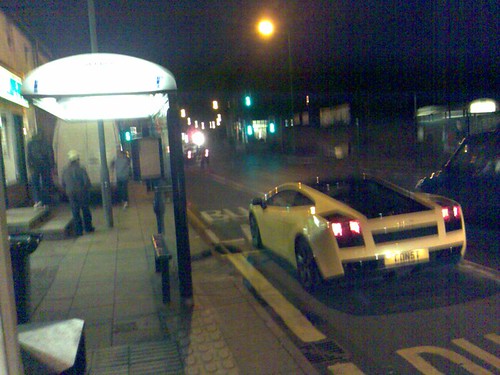
The little known perks of driving a Lamborghini

Apparently you're allowed to park on bus stops. Who knew?


My bus had to stop in the middle of the road to let us off, causing traffic to stack up across the box junction. (And another thing, why do half the drivers on the road seem oblivious to the rule that you don't enter a box junction unless the exit's clear...?)

Here's that number plate, in case anyone's in a position to name and shame:

About Me

My photo
London, United Kingdom
This blog was my online home between 2006 and 2009. Today, you'll find me scattered across the internet. To start looking, go to my personal website: http://dougald.co.uk/

My Projects

Signpostr School of Everything

MyBLOGLOG

Followers

My ClustrMap

From My Shelves

Labels