Showing posts with label the media. Show all posts

Thursday, 11 June 2009

Why journalists write so much rubbish about Twitter

Around the start of 2009, the media here in Britain discovered Twitter. At times, it's been hard to tell whether the service had just crossed the chasm or jumped the shark. What's distinctive, though, is quite how bad the reporting of Twitter has been - significantly worse, I would say, than the equivalent coverage of Facebook, when it made a similar leap into public consciousness a couple of years earlier.

"Oh yes," my dad said, when I mentioned Twitter to him back in February. "It's one of those things that people are using that means they don't have real conversations any more." I couldn't blame him for getting this impression - I'd heard the same report on Radio 4 earlier that week - and I'm no unbridled techno-enthusiast myself. Yet what has annoyed me about the reporting of Twitter is that these claims of its anti-social effects are so dramatically at odds with my experience as a user. I can honestly say I've never met a tool which has led to so many interesting offline, face-to-face experiences.

Of course, the media coverage is unlikely to harm Twitter. My mum even signed up for it the other week. (You can give her a nice surprise by following @dougaldsmum!)

But, since I keep hearing the same recycled nonsense, I thought I'd write a couple of posts about why I've found Twitter such an exciting tool - but, first, about why the media find it so difficult to report well.

As I see it, there are at least three significant problems when it comes to covering Twitter, over and above the usual reasons journalists get things wrong.

1. Because it was Stephen Fry, Russell Brand and co who brought it to their attention, they focus on celebrity Twitterers. The trouble is that trying to understand social media by looking at the behaviour of celebrity users makes about as much sense as trying to understand society by looking at the behaviour of celebrities.

2. A number of eloquent and apparently expert voices have offered very strong opinions on the service, without having used it or apparently paid much attention to how others actually use it - in some cases, making unjustified use of their authority in other fields. Oliver James, Alain de Botton and Baroness Susan Greenfield are all guilty of this. (And don't take my word for it - Ben Goldacre, the Guardian's Bad Science columnist, accuses the Baroness of "abusing her position as a professor, and head of the Royal Institution... using these roles to give weight to her speculations and prejudices in a way that is entirely inappropriate".)

3. Twitter takes time to get your head round - and journalists are permanently in a hurry:

  • The value of Google was immediately obvious the first time you used it and got good search results, whereas the value of Twitter grows on you gradually.

  • We don't have good short-hand ways of explaining what it does. ('Micro-blogging', for example, is a really misleading tag.)

  • To complicate matters further, getting the best out of Twitter generally requires the use of an external client (a program that runs on your desktop) such as Tweetdeck, rather than visiting Twitter.com directly. Most non-specialist journalists, like most internet users, are only beginning to adjust to the possibility that the web isn't about going to sites, but about information coming to you.

So unless a reporter has been using the service personally for long enough to get a feel for it, they are very likely to pick up the wrong end of the stick. Or mistake the stick for a snake.

Saturday, 10 January 2009

Hold the front page!

Gosh... That's been quite a week! And not over yet, by a long shot.


For starters, it's not often one of my talks gets a plug on the front page of the London Lite...


Article about Temporary School of Thought

From column 4: 'The squat's website, temporaryschool.org lists sessions including "labyrinth building with Steph" tomorrow followed by "deschooling society".' Guess I'd better get on with writing that talk, then!


The Temporary School of Thought also featured in Friday's Guardian, while Vinay's video of it has been picked up by the Evening Standard. Check it out:


Congratulations to the organisers on successfully getting the court case adjourned! Another two weeks in the building is going to be huge, if the amount of exciting stuff that's gone on in the past few days is anything to go by. I know they have mixed feelings about all this media interest - and particularly the focus on the property value, which is a bit of a distraction - but as an ex-journalist, I've got to say the coverage is really about as positive as I've ever seen for a story about a squat, once you get past the headlines. And most of the comments on the Standard site are very positive.


Speaking of comments, thanks for all the thoughtful responses to my questions about meditation. I'll take some time to think about them and come back to the subject. (I'm feeling a lot clearer about the "radio in your head" stuff after the Meditation & Magic session at TSoT the other night - thanks, Bad Swami!)


Had a brilliant time this morning at the Tuttle Club. It was my first time at this regular Friday gathering, which you get to by turning up at the back door of the ICA. Met some fascinating people and had three hours of back-to-back great conversation. For example, I spent ages chatting to Chris Unitt who runs the Created in Birmingham blog - exactly the kind of thing I wish had existed for the Creative Industries Quarter in Sheffield in my days there. (Oh, and if you find Melanie Phillips as unpleasant as I do, please vote for Created in Birmingham in the 2008 Weblog Awards - they've just overtaken her in the running for Best UK Blog, but it's a close run thing!)


Finally, I couldn't put the week to bed without mentioning the amazing morris men and women who swarmed through School of Everything over the last few days! We started out responding to the news stories about the gloomy prognosis for this most English of traditions - but soon discovered that reports of its death had been greatly exaggerated. The energy, enthusiasm and sense of fun that Claire and I found in the response to our little campaign made it one of my favourite weeks since School of Everything launched.


Right, time to start writing that talk. If you're in London and free, then I hope to see you at 5pm tomorrow at 39A Clarges Mews, off Curzon Street, Mayfair. There may be some surprises. (For those out of town/busy/lazy, video will be available next week.)

Monday, 17 December 2007

Newsflash: Capitalism Defeated!

You'd think this story (from Latin American news agency, Prenza Latina) might have got more coverage, really:

MEXICO FORUM DEFEATS CAPITALISM

It's a headline worthy of William Boot, the accidental hero of Evelyn Waugh's Scoop, which is my current bedtime reading.

Tuesday, 21 August 2007

In case you wondered where I've been...

Anthony and Dougald make headlinesAnthony and I spotted this outside Holborn tube while we were waiting for Andy. It was too tempting to resist.

Sunday, 12 August 2007

Do Have Nightmares!

A couple of weeks ago, I was musing about the impact of TV on the elderly. "If I were frail and lonely and reliant on BBC news for my picture of the world, I think I'd soon be too afraid to leave the house..."

Well, my friend Lucy just drew my attention to this post from the American political reporter Rick Perlstein (via the excellent Making Light):

Shortly before she died, my grandmother — one of the people, naturally, I loved the most in the world — broke my heart. Celia Perlstein, like most of our grandparents, didn't get out much in her final years; in fact, for the last few years of her life, I'm not sure she got out of her old folks home at all. I don't think she really wanted to. She was sure that beyond its threshold lay dragons: far-far-far leftists out to steal her Social Security; turbaned terrorists just itching to fly a jet into the First Wisconsin tower a few blocks to the south; quisling Democrats itching to help them do it; grandma-gutting criminal marauders just outside her door.

I'd look out of her eighth floor picture window, down at the scene she saw every day, half expecting to find that nightmare landscape before me. Nope: same as always, the brightly colored sailboats on Lake Michigan, kids and their parents feeding the ducks (Grandma used to take me to feed the ducks), happy, strolling Milwaukee couples—paradise. Where was she getting these fantasies?

One evening's visit, all became clear. She gestured at the blaring TV set. The excruciating grandma-volume was even more excruciating than usual, because she was visiting with her best TV friend. She told me how much she adored Bill O'Reilly. My wife and I cringed. Watching our latter-day Joe McCarthy on TV every night, she had learned, late in life—for this development was entirely new—how to hate her fellow Americans. I almost cried, because one of the people she was learning how to hate was me.

Over here in the UK, broadcasting regulations mean we have (thankfully) no equivalent to Fox News. So for me to pick on the BBC may be a case of not knowing how lucky you are. (It was also kind of a self-criticism, since I used to be a BBC journalist - albeit a fairly lowly one.)

Yet, powerful as I found his post, I wonder whether Perlstein isn't merging two issues? Bad journalism and outright propaganda deserve censure. One consequence of this, however, can be to present "good journalism" in an uncritical light - and overlook those structural issues which affect the news industry as a whole.

I suspect that even in the UK there are elderly people afraid to leave home because of the picture of the world they get from the news. Maybe we can blame this on the Daily Mail - or the influence that papers like the Mail have over the news agenda of the broadcast media. But can we imagine a sort of "news" which did not consist largely of the misfortunes of people we do not know - misfortunes which affect us little, except (by their retelling) to raise our general level of anxiety?

I'm reminded of a programme I haven't seen for years, but which is still a regular in the BBC1 schedules. 'Crimewatch' specialises in reconstructions of unsolved crimes, while a team stands by to field calls from viewers who think they may have information that will solve them. In a sense, this is the rebuttal of my argument - some, at least, of the misfortunes that make up our news diet are retold because someone out there might be able to help.

What comes back to me, though, is the catchphrase with which the presenter would end each show, as if to counteract the effect of the preceding 29 minutes. "Remember, the crimes featured here are rare," he'd say as he turned to the camera, "so sleep well - and don't have nightmares!"

And I wonder, isn't that just what the news industry does to us all - makes us sleep less soundly in our beds?

Friday, 27 July 2007

Good news is no news...

It's always good to discover thoughtful voices in the blogosphere - so I'm grateful to Tom for pointing me towards Andrew Brown's Helmintholog.

Brown used to be religious affairs correspondent for the Independent - and seems to have written intelligently about an intimidating range of other subjects. On the blog, he makes neat work of the "new atheism", but I was particularly struck by another post about the effect of reporting on religion:

I don’t myself know any religious correspondent whose faith has survived writing about it — possibly some of the more radically pessimistic Catholics, but even there I am not sure... The most one can believe is that some of these deluded people are doing better, both for themselves and for the world, than they would be without their delusions. This is quite enough to keep me from full-on pharyngular atheism. I don’t think human nature is modular enough that you can simply swap out the delusional bits, and leave the rest intact. Believing fewer false things is a very long struggle. Journalism teaches you that, too, if you want to learn it.

I like the way he explains his position, even if I don't share it. But the thought which came to me was that the loss of faith he describes sounds like a variant of the general tendency to cynicism among journalists. It's an occupational hazard (and one of the reasons I was glad to quit the newsroom): an understandable response to prolonged, close-quarters exposure to "news", skewed as it is towards the worst in life. Most of the things which make life worth living aren't remotely newsworthy.

This leads to another thought. Once upon a time, people used to worry about the influence of TV on young people. What I worry about is its influence on the elderly. If I were frail and lonely and reliant on BBC news for my picture of the world, I think I'd soon be too afraid to leave the house...

(Other suggestions for blogs I should check out gratefully received, by the way.)

Thursday, 28 June 2007

It's wet up north...

By the time I got out of Sheffield on Monday morning, they were already cancelling trains. On Radio 4, a presenter said something about "the wettest day for fifty years" - but I was heading to a conference in Stoke and, beyond the nuisance of having damp feet all day, didn't give it much thought. Or not until the end of the afternoon, when I stopped to check my email and saw the pictures.


It's been a strange week to be out of town. My girlfriend got stranded and had to camp out in her office for most of the first night. My old colleagues at Radio Sheffield were working 24 hour shifts, getting official information out and talking to people on the ground. Even as the flooding went down in the city itself, there have been rolling black-outs, foul mud covering large areas, and traffic chaos with the M1 closed for days.

The Fire Brigades Union general secretary, Matt Wrack, gives a sense of the scale of events:

We have witnessed the biggest rescue effort in peacetime Britain by our emergency services, and it's not over yet. Fire crews and officers have been working to the point of collapse. Emergency fire control operators have been under major pressure, with thousands of extra calls for assistance from the public...

The government has not understood the scale, gravity and severity of what has happened.

The same could be said of large parts of the London media (the Guardian included) - which have prioritised not only the Downing Street handover, but such momentous events as the release of Paris Hilton and the Spice Girls reunion. If it were Bluewater [big shopping centre, near London] and not Meadowhall that was six feet deep in water and sewage, there would be rather more fuss.


I was in two minds whether to write this post. It seems kind of petty to moan about the metropolitan parochialism of the British media, when there are plenty of more useful things to be done. But I'm not at home to pitch in - so all I can do is admire the efforts of members of the Sheffield Forum and the local Freecycle group, and contrast them to the BBC producer who could be heard expressing his opinion over footage of the floods: "I do hate the Sheffield Accent with a passion... sorry, I don't mean to be a snob... they sound ignorant." [The offending clip has now been removed from BBC Online, but I heard it with my own ears.]

One piece of bigotry like that, for all it lets down the BBC's staff on the ground, would hardly be worth mentioning - if it wasn't something that us northerners experience on a daily basis. Stuart Maconie, a BBC broadcaster himself, writes eloquently about the same phenomenon in the conclusion to his wonderful 'Pies and Prejudice: In Search of the North':

On a rainy drive across the Lancashire moors, I caught a short Radio 4 'issue-based' story about childlessness but, for me, it was the minor detail that provoked the most thought. The protagonist was an academic with a cut-glass accent. She had lost a daughter called Cordelia and her neighbour was a TV producer. At no point was there any suggestion that these people and this milieu were in any way out of the ordinary. This was incredibly telling, I thought. Most people have never met either a Cordelia or a television producer. But as they discussed their (literally) extraordinar lives in voices of crystalline poshness, their remoteness from life as most of us live it was never acknowledged.

If, however, you turn on a Radio 4 play and the voices are northern, it will inevitably be all about 'being northern'. About how poor or cute or funny or indomitable we are. It will never be simply set in Sheffield or Hull or Wigan because it can be and should be. It will never be about an adulterous dentist who just happens to live in Bootle. It will be in some ways about his Scouseness... Some writers may think this is complimentary. In fact, it's patronising. It's in effect saying that you have to have a strong dramatic reason, a 'hook', in order to set your play outside the M25. The fact that most of the country actually lives there isn't good enough evidently.

Quite.

Sunday, 24 June 2007

Black Bloc, White Bloc - Part II

Back to the book I never wrote - the one about good protesters, bad protesters, governments and terrorists...

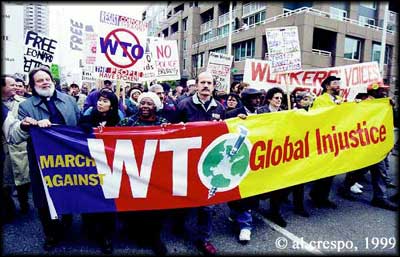
In the discussion on my post from a couple of weeks ago, Tim reminded me of the (in)famous protests at the WTO meeting in Seattle in 1999:

The only thing I remember of it is images of chaos, tear gas, bandaned young people throwing rocks, police behind barricades, fires, looting (I may be adding that now to the memory). It was a series of clips which spoke of danger, chaos, anarchy, etc.

Did it happen? Yes.

Did it come close to describing what the majority of people who were at the protest wanted to be seen and heard? My guess is, probably not. But it made for good sound and video bites.

Part of what drew me into trying to write about events like this is that, as a journalist, I felt the news media were peculiarly bad at handling them - and I was both fascinated and troubled by the way this interacted with the agendas of politicians and different groups of protesters.

The Gleneagles summit was the second time the G8 leaders had met in the UK since New Labour came to power. The fact that they met this time in the wilds of Scotland rather than in a major city was a reflection of the bandwagon of international protests, for which the Seattle WTO is often seen as the starting point. However, for the Blair government, there was also the memory of the 1998 summit in Birmingham - where their media managers were wrong-footed by the scale of public protest.

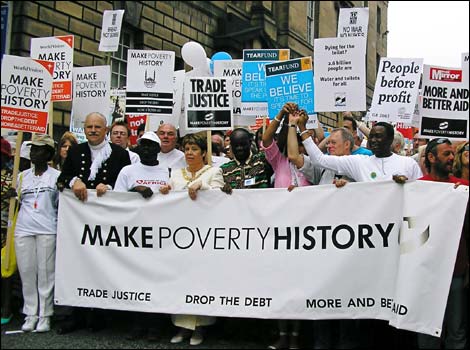
I remember arriving that day with a seasoned activist, a veteran of the anti-road building and Reclaim The Streets protests of the 1990s, who was simply gobsmacked by the coachload after coachload of ordinary people who had turned up to picket the world leaders - 70,000 of them formed a human chain around the city centre. This was the work of Jubilee 2000, a campaign for the cancellation of third world debt (which my School of Everything colleague Paul Miller helped organise), which did an outstanding job of raising consciousness of global injustice and mobilising a new constituency of protesters, many of them white-haired churchgoers, through an alliance of mainstream charities and campaign groups. Ann Pettifor, the campaign's founder, has written about the impact this had on the summit:

In what we thought of as a calculated move to de-mobilise our supporters, (but which they argued was just a security measure) the Foreign Office had made a surprise announcement the Tuesday before: G7 leaders would not be in Birmingham on Saturday 16th...

And so it was, that on the day, at 11 a.m. Birmingham was brimming with 70,000 peaceful, cheerful Jubilee 2000 campaigners, their banners and posters. Present also, were about 3,000 journalists, sent to cover the event. Only the G7 leaders were absent, giving the journalists very little to write about. So naturally they turned to the demonstrators. Overwhelmed by calls from hacks, we had done dozens of interviews by 11 a.m. It did not take long for No. 10’s spin doctors to realise that a major strategic error had been made. Soon the call came. The Prime Minister, Tony Blair, was flying back from the country-house meeting earlier than expected. Would it be possible to meet with Jubilee 2000’s leaders?

Given New Labour's permanent anxiety about controlling the media agenda, it is easy to imagine that avoiding any such strategic errors came high on the agenda in the planning of the Gleneagles summit. And so, months beforehand, a strategy seems to have been adopted to polarise activists into two apparently antithetical camps - the good protesters and the bad protesters. This was spelt out by Blair himself, in a newspaper interview in March 2005 (republished on Indymedia):

It would be very odd if people came to protest against this G8, as we're focusing on poverty in Africa and climate change. I don't quite know what they'll be protesting against... There will be people who come out on the street in favour of the Make Poverty History campaign and that's a good thing.

This strategy was at once reasonable-sounding and dangerous - dangerous, because all legitimate, non-violent, "good" protesters are represented as supporters of the government, while all opposition becomes associated with violence, irrationality and illegitimacy. (In the same interview, Blair told the reporter he "couldn't rule out" using recently passed anti-terrorist laws against anti-G8 protesters.)

On the ground, for anyone looking for more than a soundbite, it was obvious that this black-and-white polarisation didn't hold. There was a spectrum of dissent, of deep concern and anger at the consequences of the policies the G8 leaders represented, which ran from the white-clad Make Poverty History marchers through the various shades of red and green and no particular colour, to the black bloc anarchists at the other end.

However, the effectiveness of the government's media management was reinforced by journalists' desire for simple, black-and-white narratives.


One measure of its success was the BBC's uncritical presentation of the Make Poverty History campaign and the Live 8 concerts. This was the subject of an official report just this week, which acknowledged that:

the BBC’s involvement with Make Poverty History in 2005 presented challenging dilemmas and was, for some, a difficult experience... there remain, even now, scars which have not fully healed.

Libby Purves, herself a well-known BBC presenter, expresses this discomfort more explicitly:

Personally, I applaud the nerve and passion of [campaign organisers] Geldof and Curtis, but not the BBC’s massive loss of perspective over Live 8. Carried by the vastness and suddenness of the enterprise... senior management rolled over whenever the campaigners – backed by Gordon Brown – pushed. Valid scepticism about Live 8’s demands was ignored. Even when Geldof arrogantly told Paul Martin, the Canadian Prime Minister, he was “not welcome” at the G8 summit unless he obeyed, the BBC continued presenting the event as uncritically as a Prom. It was all very uncomfortable and clearly won’t be allowed to happen again.

What Purves doesn't highlight is the way uncritical representation of the "good protesters" compounded the false polarisation of that wider spectrum of protest.

I spent the day of the Edinburgh march reporting for Make Poverty History Radio - a temporary station with no need for impartiality! But towards the end of the afternoon, I remember ducking into a pub a few streets away to catch some of the BBC coverage. As I watched, they cut from a helicopter view of a small group of black bloc kids penned in by riot police, to a reporter striding side by side with a group of marchers, chatting away to them. Whatever the exigencies of covering such an event, the contrast between the two shots - the embedded reporter with the "official" protesters, the aerial view of the trouble-makers - told its own story, one which chimed with much of that week's coverage.

There are various reasons why the unoffical protesters seldom get a hearing for their side of the story. Some of it has to do with their own suspicion and sometimes hostility towards the mainstream media, and the fact that they often become visible only when a minority start smashing windows. Some of it has to do with journalists' preference for talking to people their audience can identify with or who they themselves feel comfortable around. One big piece in the puzzle, though, is the relationship between the police and the media.

In the ordinary course of news reporting, the police are a privileged source of information. So much of the daily news agenda is made up of crime stories, court reports and other situations in which the police speak with authority. As a rule, you don't see interviewers challenge police officers the way they challenge politicians. This is just how things work, and while not always perfect, it's hard to think of an alternative.

The problem comes, though, when the police become one side of a story. Protests which don't have the endorsement of the authorities are a feature of democracy - a situation in which you can only protest with the government's permission is undemocratic. But such protests are often the scene of confrontations in which the police play a role - sometimes on their own initiative, sometimes on political orders - which is worthy of journalistic questioning. On the whole, however, this is not recognised, and it is common practice for the police version of events to be reported with the same uncritical attitude as in a crime story. (One TV reporter told me how his copy was rewritten to tally with a police press release, with the effect that shots of an activist being beaten by police were accompanied by a newsreader's description of "violence by protesters".)

For activists who see themselves misrepresented, it is easy to buy into conspiracy narratives about the forces which control the media. In my experience, what actually goes on is slipperier and less driven by intentions, though the effect may sometimes look like a conspiracy.

But there are at least two good reasons why anyone who wants to change the world should avoid conspiracy narratives. One is that if you believe them, you might as well give up - since the logic of the conspiracy narrative involves imputing such overwhelming power and capacity for control to the state/the multinationals/the 12ft-high lizards. The second reason is that, if you attribute your failures to conspiracies against you, you're unlikely to engage in the kind of reflection that gives you a chance of achieving more next time round.

The time I spent hanging out with anti-globalisation activists and getting involved with those campaigns was incredibly inspiring, as well as (sometimes) deeply frustrating. Whatever else, it challenged me to do something more constructive with my life than working as a mainstream news reporter. And, while I never got that book published, the process of writing allowed me to think through how you turn good intentions into making a real difference for people's lives - which certainly contributed to what I'm doing now.

But more on that in a future post...

Sunday, 10 June 2007

Black Bloc, White Bloc

This blog got its name from a book I failed to write.

It was July 7th 2005 and, as news came through of the terrorist attacks on London, I was in the middle of an anti-G8 protest camp in Scotland. For the past week, I had been weaving in and out of different groups of campaigners, from the Make Poverty History march to a collective of anarchist hill-walkers, from the Black Bloc kids fighting with the police at Gleneagles to the Edinburgh leg of Bob Geldof's Live8 concerts.

After staying for James Brown's last encore at Murrayfield, I ended up spending the night on the steps of Waverley station with a group of teenage concert-goers who'd missed the last train home - and it was there, in the early hours of July 7th, that I had a conversation which brought my puzzlement into focus. "What I don't get," said the girl from Middlesbrough, "is these anti-G8 protesters. I mean, why do they want to stop the G8 making poverty history?"

Here was this intelligent young woman, trying to make sense of the world on the basis of what she saw on the news and read in the papers, and she'd decided that the anti-G8 protests must be some kind of pro-poverty campaign. It was at once insane and an entirely understandable conclusion.

The next morning, back inside the police lines at Stirling, I was still thinking about that conversation when the news from London spread through the camp. The mood changed in moments. People clustered around wind-up radios, listening to the live news reports, or tried to call friends and relatives to check that they were safe. The confirmation came through that this was being treated as a terrorist attack.

A few minutes later, I heard the BBC presenter interview a terrorism expert, a man called MJ Gohel. Yes, he said, this looked like a coordinated attack, but we mustn't be too quick to point the finger of blame: it could be Al Q'aeda, but it was "equally possible" (those were his precise words) that this had been done by people protesting against the G8.

For months, I kept going back to those words. You had to tread carefully, in the context of so much horror and grief, to place significance on one pundit's off the cuff opinion. Yet what I wanted to know was how it became thinkable for a "terrorism expert" to put the anti-G8 activists on a par with Osama bin Laden as likely suspects for an act of mass murder.

So far as I could tell, the only deaths with which the anti-globalisation movement had been associated were the shooting by Italian police of a young protester at Genoa, and the self-immolation of a Korean farmer during the protests at Cancun. Anyway, I had spent months hanging out with these activists - and, while the more militant believed in the destruction of property and picking fights with the police, even this minority had no taste for violence against innocent civilians. In that respect, they stood in contrast to the leaders gathered inside the Gleneagles Hotel, among them the architects of the invasion of Iraq. Anyone suggesting Bush and Blair might have a hand in the London bombings would (understandably, I think) be branded a conspiracy theorist - yet the anti-G8 activists had somehow become plausible suspects.

This plausibility was, I felt sure, part of the same distortion that had confused the girl from Middlesbrough. Somehow the spectrum of protest I had seen on the ground in Scotland was polarised, in the media and the language of politicians, until it seemed like two opposed forces - the moderates and the extremists. I started writing about this, trying to work out how it came about. Plenty of the activists I talked to were happy to believe it was a deliberate policy on the part of the media - yet I had worked in BBC newsrooms and I knew that such "paranoia" (as journalists saw it) was part of why activists were treated with suspicion. At the same time, I was fascinated by the way that elements within the different groups of protesters seemed to contribute to the polarised portrayal - most obviously, in the iconic (if accidental) contrast between the "infamous" Black Bloc anarchists and the white-clad Make Poverty History marchers. (None of which excused journalistic laziness or political cynicism.)

As the summer went on, it became clear that something very similar was happening in the portrayal of British Islam in the wake of the bombings. Muslims were divided (by the media and politicians) into "moderates", whose leaders were happy to be photographed shaking hands with government ministers, and "extremists", who were evil and beyond reason. It was striking how this mirrored the representation of campaigners in the run up to Gleneagles - Geldof with his arm round Blair's shoulder, while police chiefs thundered warnings about the dangerous and irrational anti-G8 protesters...

To cut a long story short, I wrote a first draft of the book over the summer and, after some delay, found an agent who wanted to help me get it published - but as I tried to act on her advice, the project seemed to lose shape. To be honest, I wasn't ready to write a book - I hadn't grasped the disciplines of form which apply to a project of that scale and are quite distinct from the ability to write a half-decent sentence or paragraph. But every now and then, when I watch news reports (such as those from Germany last week) or hear a politician speaking, I am reminded of those themes and find myself wishing I'd managed to give them the treatment they deserved.

Thursday, 8 February 2007

The Inconvenient Journalists

Yesterday, I was thrown out of Al Gore's climate change presentation.

Before you ask, I hadn't returned to my direct action roots and interrupted the slideshow by splashing black paint across the stage to symbolize the million air miles he and Tipper offset annually. (Though that is a lot of oil.)

I was there as a journalist and I was ejected along with the rest of the media after the first five minutes. All we got to see was the "My name's Al Gore and I used to be the next president of the United States" stand-up routine. So I can confirm that he delivers his punchlines with an impressive feel for comic timing. But that's it.

Afterwards, in the lobby, I wasted more energy than it was worth telling the PR team what I thought. As one of the newspaper reporters put it, "How are we meant to report that?" All they could tell us was that they had negotiated on our behalf with Gore's people to get us in even for five minutes. Apparently he doesn't allow media in his presentations.

Given how much Gore has done to shift attitudes over climate change, it seems petty to gripe. Anyway, having calmed down, I'm actually interested in what's going on here. When he says that the "conversation of democracy is broken", Gore has the US media in his sights, so I guess the "no journalists" policy is part of this. Although he doesn't flesh out its implications, his emphasis on the importance of democratic renewal to tackling climate change is reassuring, in comparison to the authoritarian tone of some prominent campaigners here in the UK. But that's exactly what I'm writing an article about - and it would have been good to be able to see him in action at first hand, rather than being told by a press officer that the content of his presentation would "probably be not much different to the DVD".

As it was, I went to the coffee shop round the corner and wrote up half of the article, then went to the pub with James and Tom who (as members of the invited audience) had been in for the whole presentation and were able to fill me in on what I'd missed.

(From what they told me, it really wasn't much different to the DVD. But that's not quite the point.)

About Me

My photo
London, United Kingdom
This blog was my online home between 2006 and 2009. Today, you'll find me scattered across the internet. To start looking, go to my personal website: http://dougald.co.uk/

My Projects

Signpostr School of Everything

MyBLOGLOG

Followers

My ClustrMap

From My Shelves

Labels