Showing posts with label global warming. Show all posts

Wednesday, 18 April 2007

A Fine Piece of Mischief

There's a nice story in today's Guardian Society section about an unusual piece of corporate generosity. A dozen tiny grassroots campaign groups got a surprise earlier this year, when letters arrived from the cosmetics chain Lush, swiftly followed by cheques for £1000. Among them was the campaign against the widening of the M1 motorway run by my friend Julie White.

These are groups that generally run on a mixture of sweat and imagination, so the cash should come in handy. As impressive (to me) as the gifts is the logic which led Lush CEO Mark Constantine and campaigner Rebecca Lush (no relation!) to them:

"My son and one of the buyers went out to Thailand after the tsunami and it was pretty horrific," he explains. "They saw all the wasted money, all the schools bought for children that weren't alive, boats that will never sail, houses for people that don't exist, a general waste of all the money that everyone chucked in. And that's why we're so specific, that's why I asked Rebecca to get the activists on board. We could give a hundred grand to the Prince's Trust (who we like very much) or we could give that in one grand lots to people stopping climate change. Frankly, that sounds more fun."

The waste of money by large charities Constantine describes sounds very much like the phenomenon Ivan Illich called 'paradoxical counterproductivity' - the tendency of modern institutions to produce the opposite of their stated purpose, so that (for example) the education system becomes an obstacle to learning. He associated this with a tendency for activities which begin as a means to an end to end up being performed for their own sake.

For Illich, examples of such counterproductivity are not simply unfortunate accidents, but a consequence of the very structures by which we organise the institutional delivery of care. It is not that learning cannot take place within our education systems, but that it does so in spite of them - where people manage to open a space in which the hold of institutions is loosened, allowing the possibility of convivial relationships, based on invitation and free response.

What is startling about Illich is that, unlike most critics of contemporary capitalism, he doesn't focus on the obvious targets - multinational corporations, the military-industrial complex. His attacks on the caring professions, the institutions of the social democratic state, even the concept of "responsibility", have seemed blasphemous to many. (In fact, it is precisely the "sacredness" of his targets which he sees as making them so dangerous!) Others, on the left, portray him as an unworldly intellectual whose ideas were hijacked by Thatcherites - a well-meaning fool.

Part of the difficulty is (and I realise I may lose anyone who's still following this here!) that, while his mode of expression was largely secular, Illich's thought is at bottom deeply theological - it is 'foolishness to the Greeks'! It is an invitation to turn your view of the world upside down, which is a frightening prospect. Later texts such as 'Health as one's own responsibility - no, thank you!' make stark reading - and, even among his admirers, there are those who see him as descending into backward-looking pessimism. This is a convenient misreading, which allows the reader to sidestep the full implications of his work. But to face its force, it may help to notice the playful smile with which it was delivered, the joyful foolishness which is the other side of Illich's invitation.


There is a sense of that, too, in Mark Constantine's explanation of why he chooses to donate to such small, grassroots groups:

"If you're going to give money away you might as well give it to someone who's going to do something stupid with it." His favourites among the groups are Sardine Man, who travels the country highlighting congestion problems, or the Guerilla Gardeners, who plant flowers on ugly traffic islands in the dead of the night. In that spirit he's also created the Charity Pot, a hand lotion from which all the proceeds, save the VAT, will be going to more of these small grassroots groups.

"I hate cars, I really hate them, but I'd been giving up the ghost, until Rebecca came along and we started all this up," says Constantine. "It's really rekindled my bloodymindedness. When you think about it, you think how much mischief you can do with a thousand here, a thousand there, it's great. If we get a million out of the Charity Pot, we could create absolute chaos."

His face lights up and he starts to laugh. "They won't be able to get a digger to move across the whole of Britain!"

Illich once calculated that - once you take into account all the hours spent working to pay for a car, petrol, insurance and taxes to build roads - drivers manage an average speed of around four miles per hour. I can't help feeling that, were he still around, he'd approve of Mark Constantine's mischief-making!


More Illich links:

A useful introduction to Illich's thought
A selection of online texts
Reflections from Illich's friends, following his death in December, 2002
Thinking after Illich - English version of a site created by some of his friends and collaborators

Friday, 9 March 2007

Prehistoric Totalitarianism and Tiny Elephants

after the ice - coverI just got round to starting Steven Mithen's 'After the Ice: A Global Human History 20,000-50,000 BC'. As befits a book which comes recommended by Alan Garner, it is both a damned good read and an education.

Without abandoning his professional rigour, Mithen provides the layman with a tour of a prehistoric world, many of whose 'most remarkable events remain hidden from all but a few academics and specialist readers in scholarly works of impenetrable and jargon-laden prose.' This is the story of the origins of farming, towns and civilisation against the backdrop of (at times dramatic) shifts in climate.

As Mithen acknowledges, the bumpy journey from the Last Glacial Maximum to the more hospitable world of the Holocene offers food for thought for us, facing the unknowns of man-made climate change. There are stories here which put a quietness on you. Consider the Natufians, who lived comfortably in villages across the Middle East for fifty generations, before the climatic switchback of the Younger Dryas brought in a thousand years of cold and drought, scattering them to a hungry, wandering existence.

Then there is a nightmarish reconstruction of the early town of Çatalhöyük, with its fearsome iconography of bulls and women whose breasts split apart to reveal the skulls of dead animals. Mithen suspects its residents, alienated from nature, became trapped inside their own myths: 'every aspect of their lives had become ritualised, any independence of thought and behaviour crushed out of them by an oppressive ideology manifest in the bulls, breasts, skulls and vultures.'

After this, it is a relief to reach the chapter on Cyprus, which reminded me - somewhat improbably - of a post from my favourite blogging librarian, relating a visit from her inlaws. The following dialogue was originally offered as proof of their deepening strangeness:

MiL: You know they made small animals out of bigger animals?

Me: *wondering if we're about to get a Talk on the Miracle of Birth* Not exactly...?

MiL: Well, you know, like domestic cats were bred from big wild cats, and dogs from wolves, and so on.

Me: Oh! Yes, what of it?

MiL: Well, don't you think they should make tiny elephants? You could stroke them *vigorously mimes stroking 2ft high elephant* They would look so cute scampering around the house, and they wouldn't shed on the carpet.

FiL: They're terrible for shedding skin, though, elephants are. *nods wisely*

Me: *boggles*

Now, regular readers of this blog will know that I have a soft spot for hippopotami - so I was doubly delighted to discover that not only tiny elephants but herds of tiny hippo actually existed in prehistoric Cyprus! This came about, not as my friend's in-laws proposed, through domestication, but as a result of the lack of predators on the island, 'great bulks being quite unnecessary if the only worry is to procure sufficient food and sex to ensure the survival of genes':

Both elephants and hippos gradually assumed the size of large pigs, the latter far more numerous and seeming to behave like pigs themselves. They were good swimmers but seemed happier scurrying through the undergrowth, feeding on leaves and shoots. The hippos had drunk from freshwater springs on the cliff-tops. In cold weather they had sheltered in coastal caves, being adept at climbing up and down steep slopes.

Controversy rages, apparently, over whether these marvellous sounding creatures were hunted to extinction by the first humans to reach Cyprus, at around 10,000 BC, or had already given up the ghost as a result of climate change. (Mithen comes down on the latter side of the argument.)

So much to write about, and I'm not yet a quarter of the way through this utterly fascinating book! (Meanwhile, here is a pair of small hippos I met in Trafalgar Square the other weekend...)

Monday, 5 March 2007

Driving Climate Change...?

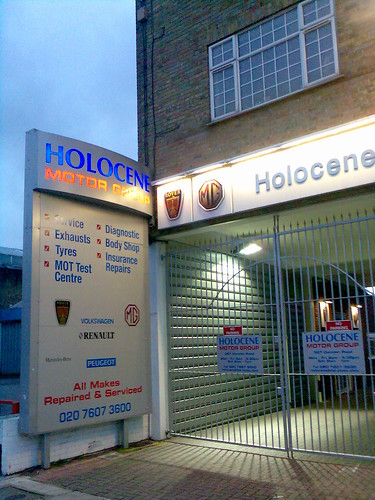
I was wandering around Holloway, trying to find the Islington Arts Factory, when the sign outside this car showroom made me do a double-take. If they had been open, I would have gone in to ask how they got the name - and whether anyone has pointed out the irony:

Holocene Motor Group

"I was at a conference where someone said something about the Holocene, the long period of relatively stable climate since the end of the last ice age. I suddenly thought that this was wrong. The world has changed too much. So I said: 'No, we are in the Anthropocene.' I just made up the word on the spur of the moment. Everyone was shocked. But it seems to have stuck." - Paul Crutzen, climate scientist and winner of the Nobel Prize for Chemistry

(Quote from Fred Pearce, 'The Last Generation: How Nature Will Take Her Revenge for Climate Change')

Friday, 2 March 2007

Climate Change and the Democratic Imagination

I've been rambling on here about climate change as a challenge to the imagination, rather than simply a technical problem in need of solutions. Now openDemocracy have published some of my more considered thoughts on the subject - in particular, on the visions of an authoritarian future I've noticed over the last year or so.

Here's a taster:

When Tony Blair told a reporter he was "still waiting for the first politician who's actually running for office who's going to come out and say" that we need to fly less, the headlines that followed were a measure of the way the debate over climate change has shifted. In 2005, similar remarks the British prime minister made to a parliamentary committee barely touched the news agenda. But in that time, the media here have moved on from debating the reality and the seriousness of climate change, to predicting how bad things will get and asking what needs to be done.

After years in which no BBC report on the subject was complete without airing the views of climate-change sceptics, this is progress. Where business leaders and politicians gather, there is talk of momentum, a tipping-point, history in the making. Yet behind this confidence, the fear remains that our democratic structures will not be up to the task: that the boundaries of what is politically "practical", in Blair's language, will not accommodate the kind of measures required to prevent runaway climate change.

It is this fear which feeds the visions of an authoritarian future which have begun to enter the debate from more than one side. The fact that few informed observers believe individual restraint and technological innovation will generate the necessary cuts in emissions, so that a significant increase in government intervention in individual behaviour is to be anticipated means such visions deserve to be taken seriously. They suggest that it is time to consider tackling climate change not simply as a technical problem but as a challenge to the democratic imagination.

Read the rest here.

Thursday, 1 March 2007

A Lost Whale and a Polar Bear Swimming in the Footlights

It was like a sequence from the opening minutes of a disaster movie, that day last winter when a whale swam up the Thames and past the palace of Westminster. Two Leviathans, ominously juxtaposed: Hobbes' force of the state and this ancient, biblical force of nature, disorientated now and dying painfully. As in a film, the story played out through TV reporters and crowds gathering along the riverside, excited and amazed, yet oblivious to the significance of what they are witnessing. If only they knew, they would run for the hills...

Well, maybe not. But sitting in a concrete bunker on the opposite bank of the Thames the other night, listening as Iain Sinclair recalled that extraordinary event, it seemed to me that here was another example of the signs of the times I wrote about last month.

Climate change may be implicated in the death of the Thames whale. Colin MacLeod of Aberdeen University, who carried out the autopsy, believes changes in water temperature may have altered the distribution of her normal food, the marvellously named "gonatus armhook squid", driving it southwards into the North Sea. "If the whale then followed its natural migratory instincts to go south and west it will find all its pathways blocked by coastline."

Whether or not this is what happened, the whale in the Thames was a powerful symbol of a world out of joint. I guess this kind of eschatological tea-leaf reading could seem a poor use of time, given all the practical stuff to be done to raise awareness and limit the impact of climate change. Yet I believe that without such ways of thinking we will fail in more dangerous ways than we are likely to fail anyway.

As individuals, if we respond to our present circumstances with the ways of thinking currently respectable, we are likely to end in despair. Just yesterday, Paul Kingsnorth - one of Britain's most dedicated environmental journalists - demonstrated this tendency:

Imagine you are a visiting alien from another planet. Appraise the situation for yourself, and give me an unbiased and honest account of how likely you think it is that this species, at this time, in this situation, can do what is necessary to prevent potential climate disaster. What is the answer you get? Not good, is it?

Collectively, worse fates than despair beckon. There is a real danger that the application of existing ways of thinking to the circumstances of climate change will lead to the intensification of structures of domination, violence and oppression so as to preserve our ways of life - and that good people will actively support this in ways they would not ordinarily conscion.

In this context, the few voices which seem both hopeful and not obviously deluded belong to people able to operate outside the ways of thinking generally regarded as "grown up" in modern western societies. For example, one of my heroes, the Reverend Billy of the Church of Stop Shopping! Now, I've met people who think the Reverend Billy is simply satirising religion. It's certainly true that he spoofs the hypocrisies of Christianity, yet he does so from a deep understanding of what religion can be at its best. (Very much in the line of Ivan Illich, in fact - that other turbulent priest and hero of mine.)

Anyway, I was struck by the difference between the despair towards which Paul Kingsnorth's article points, and a recent epistle from the Reverend Billy. He seems to be saying something I've been edging towards myself, that the force of nature which is starting to hit us is also an experience of the sublime, and may offer our last best chance of escaping the ways of thinking which have contributed to the mess we're in:

All activists are aware that we must take our strategies now from a more powerful partner in activism. Call it the Fabulous Unknown. We know that we are no match for the activist powers of this cataclysmic force.

We are all activists, or we think we are. We have searched for a theory of change. The apocalyptic Christians have their pillar of fire, war as a permanent weather system on their horizon. The liberals believe that change comes from some form of advertising, the industrial persuasion that they call democracy. People who claim to be changing the world are constantly offering alternatives for our lives which encourage a strict gradualism.

Western leaders, from Bush to Bono - they all have an idea for change, but they fear sudden change like a Puritan fears the sexual act. Arnold Schwarzenegger committed one of his four Hummers to a stern diet of veggie fuel. Glamorous gradualism. But our more powerful partner is both Fabulous and Unknowable, and has no fear of suddenness.

Last night, a friend of mine from "The Theater," shouted to an entire restaurant, "My art form hasn't changed the world since 'Angels in America' in 1995! I'll start the North Pole Theater. Yes, we'll go up there and... we'll raise our curtain on our play, and perform until our stage melts, and then we'll go down into the black freezing sea, and it will be a triumph!" I liked hearing this. She senses that now we must be extreme to be kind.

(Read the rest here.)

Monday, 26 February 2007

Offset Your Infidelity 2.0

Remember Cheatcare (featured here last month), the mocked-up webpage which claimed to offset your infidelity?

Well, there's now a functioning site offering this (rather Bauman-esque) service. Cheatneutral features stories from satisfied users:

Steve and Lisa met while on holiday in Spain, and quickly fell head over heels for each other. That Christmas, at his office party, Steve got drunk and unavoidably repeatedly cheated on Lisa with Cheri, a co-worker. He paid Cheatneutral just £2.50 and we invested his money in Alex, a single man with no prospect of finding a partner. In return for the payments, Alex agreed to remain single.

Thanks to Cheatneutral, Steve was able to come clean about his cheating to Lisa, and when he presented her with the Cheatneutral certificate they realised they wanted to get married. Their wedding is taking place in the summer. Steve continues to regularly cheat on Lisa and Cheatneutral continues to fund projects like Alex with his offset payments.

As the site's founders say, Cheatneutral is a joke - but then so is carbon offsetting...

(Found via the one and only RealClimate.org!)

Tuesday, 13 February 2007

Looking for the Signs of the Times

The rarely seen frilled (above) and goblin sharks which have appeared in shallow water (and distress!) off Japan in recent weeks may be no more than the kind of freak catch of which fishermen have always told stories. Yet, as a friend said the other day, there is just the chance that they are the canaries of the ocean - alerting us to a sudden acceleration of climate change in deep-sea ecosystems. And, even if this isn't the case, we know that rapid climate change is a real possibility, which makes it reasonable to look for such omens.

We are faced with so mysterious a process, so full of unknowns, that it plunges us back into something very like an eschatological relationship to the world: looking for the signs of the times that could augur a rapid overturning of the ways of life we take for granted. For those of us who have grown up in stable, relatively secular countries, surrounded by the assumption that we are the beneficiaries of progress (political and technological), this is psychologically disorientating.

In the early summer of 2004, I returned from China, travelling overland across the former Soviet Union. While living in Xinjiang, I had enjoyed an extended online correspondence with Sebastian Mary, who was then in rural Kentucky, working on a novel. We both arrived back in London that August with a feeling that Europe was sleepwalking: even the fundamentalist visions of the American end-timers seemed, by comparison, a better preparation for the changes we might live to see - though not, unfortunately, for the kinds of action needed to mitigate them.

I was reminded of this by Mark Dowd's documentary, God is Green, which aired in the UK last night. It was heartening to hear about the shift of attitudes in the American heartland being achieved by the Evangelical Climate Initiative. It reminded me of a story Steve Hayes told recently of the theologian Karl Barth. Speaking of the "Doppers", the most conservative and fundamentalist of the Dutch Reformed Churches in Apartheid era South Africa, Barth commented that "one should not worry too much about them, because they believed that the Bible was the Word of God, and so one day God would speak to them through the Bible." Similarly, there is more hope in middle America turning green from within than of it being convinced of the errors of its ways by secular liberals.

For all of us, whether or not we expect to be spoken to by God, climate change poses an eschatological challenge. How do we live in the knowledge that the world as we have known it is in a deeply precarious position and that our small, everyday actions may bring about a future which is unrecognisably different? How do we hold onto that knowledge when day to day life gives most of us an experience of continuity - and, often, of the insignificance of our individual actions? For those of us involved in running businesses or organisations, how do we incorporate that knowledge into our decisions? For all of us, how do we live as if our actions are going to catch up with us, rather than in the hope that they won't?

Friday, 9 February 2007

Climate Change is keeping me up at night...

It is ten past five in the morning and I have finally completed a draft of the first of the articles on climate change and democracy that I'm working on. In the process, I came across a couple of interesting accounts of speeches by Al Gore - and given that I spent most of my last post whining about getting thrown out of his presentation, I thought I'd show a little maturity and post some of the passages that caught my attention.

For one thing, I was impressed to find a politician namechecking Habermas and Adorno. Gore has a whole theory about the corruption of American democracy, which he sees as echoing Adorno's characterisation of the rise of the Third Reich as "the reconfiguration of all questions of truth into those of power". Alastair McKay provides an edited version of his remarks at the Edinburgh International Film Festival:

In order to solve the climate crisis we have to address the democracy crisis. Especially in the US... I believe that a campaign that’s based on a very large set of ideas focused on the future and the public interest now faces such a withering headwind that a higher priority is to change democracy and open it up again to citizens – to air it out – and to democratise the dominant medium of television, which has been a form omf information flow that has stultified modern life.

On the same trip, he told the Edinburgh International TV Festival, "What is needed is to reverse the flow and find ways to use the Internet to give individuals access to the public forum, which is television." (Some video clips here - though they rather give the lie to the idea that he's metamorphosed into a brilliant public speaker...)

Also, I'd had the impression from seeing 'An Inconvenient Truth' and watching the Guardian webcast from the Hay Festival last year that he was strong on selling the urgency of the crisis, but soft on the detail of what action it's going to take. But this policy speech he gave at NYU School of Law last September is a lot more detailed. There's stuff in there which needs challenging - for example, the implications for world food supply of the big growth in biofuels he's proposing. But he's clearly thinking in some detail about the technical challenges - as well as the political ones:

This debate over solutions has been slow to start in earnest not only because some of our leaders still find it more convenient to deny the reality of the crisis, but also because the hard truth for the rest of us is that the maximum that seems politically feasible still falls far short of the minimum that would be effective in solving the crisis. This no-man’s land - or no politician zone - falling between the farthest reaches of political feasibility and the first beginnings of truly effective change is the area that I would like to explore...

Finally, I was really interested to read Serge de Gheldere's account of travelling to Nashville to train in Gore's Climate Project. (For any other ex-Southwesterners, there's just a shade of déja vu!)

Thursday, 8 February 2007

The Inconvenient Journalists

Yesterday, I was thrown out of Al Gore's climate change presentation.

Before you ask, I hadn't returned to my direct action roots and interrupted the slideshow by splashing black paint across the stage to symbolize the million air miles he and Tipper offset annually. (Though that is a lot of oil.)

I was there as a journalist and I was ejected along with the rest of the media after the first five minutes. All we got to see was the "My name's Al Gore and I used to be the next president of the United States" stand-up routine. So I can confirm that he delivers his punchlines with an impressive feel for comic timing. But that's it.

Afterwards, in the lobby, I wasted more energy than it was worth telling the PR team what I thought. As one of the newspaper reporters put it, "How are we meant to report that?" All they could tell us was that they had negotiated on our behalf with Gore's people to get us in even for five minutes. Apparently he doesn't allow media in his presentations.

Given how much Gore has done to shift attitudes over climate change, it seems petty to gripe. Anyway, having calmed down, I'm actually interested in what's going on here. When he says that the "conversation of democracy is broken", Gore has the US media in his sights, so I guess the "no journalists" policy is part of this. Although he doesn't flesh out its implications, his emphasis on the importance of democratic renewal to tackling climate change is reassuring, in comparison to the authoritarian tone of some prominent campaigners here in the UK. But that's exactly what I'm writing an article about - and it would have been good to be able to see him in action at first hand, rather than being told by a press officer that the content of his presentation would "probably be not much different to the DVD".

As it was, I went to the coffee shop round the corner and wrote up half of the article, then went to the pub with James and Tom who (as members of the invited audience) had been in for the whole presentation and were able to fill me in on what I'd missed.

(From what they told me, it really wasn't much different to the DVD. But that's not quite the point.)

Thursday, 25 January 2007

Only Connect

The people who most inspire me tend to be straddlers of boundaries: Alastair McIntosh and Alan Garner, John Berger and Hugh Brody and others. Polymaths, you might call some of them, but the word makes me wince. It seems to condemn the rest of us, if we get to use our brains at all, to the stark choice which my LiveJournal friend, Chris, perceives between obscure specialism and shallow generalism.

I don't mean to disparage detailed scholarship or excellence of any kind, but I think we suffer from the failure to connect our thinking. It's bad for the soul - but it's also bad for the planet, as George Marshall argues:

A friend of mine - a social scientist by training - was working in the offices of the British Antarctic Survey and noticed that scientists made no attempt to put together their different and very specialised areas of research to form a single picture. She believes that this is a deliberate psychological strategy. By looking at only one small part of the problem, scientists can avoid facing the overall catastrophic conclusions and can hide behind their specialism.

I believe that many scientists adopt elaborate denial strategies to protect themselves from the extreme seriousness of climate change. They intellectualise the issue and deliberately avoid facing its implications. They define emotional engagement as ‘political’ and irresponsible and castigate those, fellow scientists included, who express fear or despair, or seek to communicate the real urgency to the general public.

Finally, scientists are prone to leave climate change at work and live like everyone else the rest of the time. Whenever I have the chance I ask climate scientists if they still fly for their holidays. Most are surprised that I even ask the question. One admitted to me in the pub after a heated public meeting that he flies three times a year to the Alps and even south America for skiing holidays. He said that his job was very hard and stressful and that he needs the break.

The connection between specialisation and the clear separation between work and life is significant: the narrowness of the roles which life seems to offer us has much to do with the consequences of the economic and political structures we inhabit. The Marxist philosopher, Ernst Fischer, put it more fiercely:

The categories we make between different aspects of experience - so that, for instance, some people say I should not have spoken about love and about the Comintern in the same book - these categories are mostly there for the convenience of liars.

What set me thinking about this tonight is the work my longtime fellow troublemaker Sebastian Mary has been doing with the Institute for the Future of the Book. This is a group of incredibly bright people doing fascinating, important work with a powerful sense of purpose - and my only excuse for singling them out is that I'm really interested in what they're doing.

In this context, though, I am singling them out because (at the risk of monotony) I wonder if it's healthy to think about the future of anything at this moment in history, without relating that thinking to the social consequences of our ways of living - and particularly to how climate change is going to reshape our lives. Really, then, this is a challenge to myself, to if:book and to anyone else to try to think across the boundaries necessary if we are going to respond to the situation we are in.

With that in mind, then - and as a provocation rather than a prediction - here is a rather different take on the Future of the Book from a winner of the Nobel Prize for Literature:

Our world is voracious and still becoming more so. Sooner or later, unless we exercise a care and forethought which is seldom evident in the mass of human beings, we shall be left with little more than village or small town economy. It is worth noting, therefore, that the making of books can be a cottage industry. If the need is there, anyone could learn that careful swirl of the tray and flick of the wrist that distributes the pulp evenly over the mesh and gives us handmade paper...

I say all this because I sometimes hear people say that the age of the book is past; and I suppose these statements to come from people who have a couple of thousand television sets on their shelves. But it will be a very advanced village industry that can manufacture a television set. Tapes, cassettes, records, radios, television sets are with us, certainly; but he would be a wise man who could predict how long we shall be able to afford them.

(William Golding, 'A Moving Target', Address to Les Anglicistes, Rouen, 16 May 1976)

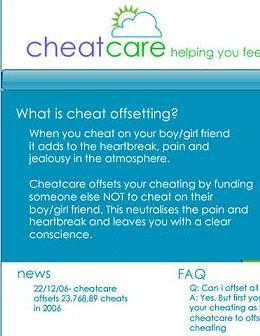
Offset Your Infidelity!

No sooner had I posted about the wonders of First Life, than I came across another overdue solution to the moral ambiguities of existence in 2007.

I present to you, Cheatcare: helping you feel better about bad stuff:

Your cheating is offset by these people who we pay not to cheat on their partners...

(Courtesy of the highly recommended Paul Kingsnorth.)

Tuesday, 16 January 2007

Talking about Climate Change

I have spent a lot of time lately thinking and reading about climate change. In the process, I realised how well I had previously done at not thinking about it too much - catching it out of the corner of my mind, but not full on thinking.

Why? My friend and co-conspirator Paul spoke a few weeks ago about the way climate change confronts us with 'deep emotional questions about ourselves and about society':

Without being too simplistic about the climate change debate, it’s basically we’re all going to die but we might be able to do something about it. It’s a big serious challenge to us as individuals and it lurches between optimism and pessimism. It’s pessimistic as a way of encouraging optimism and that's emotionally exhausting...

But among the emotional exhaustion, I did make one rather wonderful discovery. I will rush no more! is Tim Hodgens' blog. It is also his mantra, as he goes about trying to make a change and simplify his life. I am slowly reading my way through several months of entries, but one of his posts about climate change gave me back a lot of hope.

Having been thinking about how to get talking to people about global warming, Tim is having a late lunch at Harry's Pastrami Shack, when his attention is drawn to a conversation at the counter:

Counter Guy: "People complain about having to reset their clocks when there's a power outage. (On the TV they were talking about the storm in Denver) But it's much more serious when it's much more serious."

Mr. C: "Big changes in the weather."

Counter Guy: "the spring was worse with all that rain. I work for a pool company and we couldn't put in the pools. We were down $100,000 in receipts by July and there's no way you can regroup after that."

Later, and after Counter Guy leaves, I say, like out of the blue: "how do you think this will all play out?"

He looks at me and I say: "with the weather, the changes."

Mr. C: "Ya don't know. We haven't been there before."

I start talking about my previous posting about climate change and talk about Jim at Big Bear, California (he knew it instantly - I could see him 20 years ago growling up the mountain on a good old fashioned hog) and Laura in Sasketchewan. He listens attentively.

He tells me about how there was "flowering going on, on the north side of PJ Rhodadendruns; 6 months early."

He then goes on talking about the melting arctic ice shelf and how that's all fresh water and how it will upset the current (that circulates from the North Atlantic to the Gulf of Mexico and then up the Eastern seaboard of the States.)

You really have to wonder how this is all going to play out.

For my part I liked how I got into the conversation with the elevator pitch of "how do you think this is all going to play out."

His comment of "ya don't know, we haven't been there before" is incisively spot-on

The other thing I took away from this conversation was how easy it actually turned out to be to "get at" what was going on beneath the surface with the right question.

He offered his hand, we shook and I left.

About Me

My photo
London, United Kingdom
This blog was my online home between 2006 and 2009. Today, you'll find me scattered across the internet. To start looking, go to my personal website: http://dougald.co.uk/

My Projects

Signpostr School of Everything

MyBLOGLOG

Followers

My ClustrMap

From My Shelves

Labels