Showing posts with label learning. Show all posts

Tuesday, 18 August 2009

School of Everything: Time to Unplug?

It's been ages since I've written anything about School of Everything on here. That's a reflection of the direction my life has taken since the start of 2009: I've gone from full time involvement with SoE to spending two days a week there and the other five starting all kinds of new projects. But for the next few weeks (and possibly longer) I'll be going back to basics and hosting School of Everything: Unplugged! on Wednesday mornings (10.30-12.30) at the Royal Festival Hall in London.
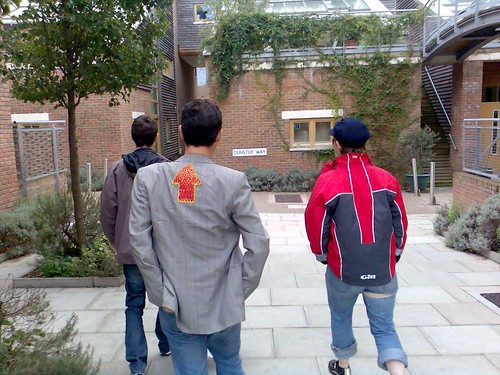
The only way is up: Paul, Pete and Mary at BedZed in October 2006, the day we started work on School of Everything


There were five of us who started School of Everything - Pete Brownell (aka Greenman), Andy Gibson, Mary Harrington (aka Sebastian Mary), Paul Miller and me. We met through a series of experiments with online/offline culture and DIY education - particularly the Pick Me Up email zine and the London School of Art and Business. (Bryony Hendersen, who helped start LSAB, remembers it as "a playful meeting place for established and emerging artists and businesses to meet, challenge each other and provoke learning systems.")

Individually or collectively, we'd also been involved in things like the University of Openness and the Boxing Club at Limehouse Town Hall, Access Space media lab in Sheffield and the Knowledge Lab events at Lancaster. It was those experiences which inspired School of Everything - along with the ideas of Ivan Illich's Deschooling Society and the story of the Free U at Palo Alto.

Over the past three years, the five of us have taken that inspiration and created a website which does some of what Illich envisaged when he wrote about "learning webs" and "peer-matching networks". We raised two rounds of funding from Channel 4, the Young Foundation and some great individuals who believed in us - and won a New Statesman New Media Award, a UK Catalyst Award, and were Honourees in the 2009 Webbys. The site now has over 20,000 members and thousands of people come to it every day, most of whom are looking to learn something new in their local area.

Along the way, I've tried to stay grounded in the culture of self-organised, curiosity-driven learning that School of Everything grew out of. Those roots have been nourished by experiences like the Illich colloquium in Cuernavaca in 2007 and the Temporary School of Thought this January, as well as working with organisations like Personalised Education Now and the Blackden Trust.

That said, the process of building a commercially-sustainable organisation means that the big picture can sometimes disappear from view. This was brought into focus a couple of months ago, by the lively discussions on TechCrunch when we were nominated for the Social Innovation category of their Europa awards. Dejan from aleveo.com asked what was so socially innovative about "aggregation of teacher ads"? At the time, Pete wrote a piece on the company blog which set out the difficult questions we've asked ourselves, as we've tried to balance vision and pragmatism:

School of Everything was founded on extremely lofty goals - we wanted to change the face of education... It is very important to us that our work is more than just a commercial enterprise - but it is just as important to us that it is a commercial enterprise. At the moment we are hard at work building the tools that will allow us to survive as a project... Perhaps we have been too quiet about our big idea, or does it make sense to quietly go about changing things step by step?

There's no easy answer to that, but as the guy with "strategy" in his job title - and standing a little further back than the full-time members of the team - I guess part of my role is to hold that long-term vision. So when one of our photography teachers, Tony Hall, suggested starting a face-to-face meetup in London, it felt like an opportunity to renew our roots in the sociable, playful, improvisational learning culture of Pick Me Up, the LSAB, the University of Openness and the rest.

That's why Tony and I have started School of Everything: Unplugged! on Wednesday mornings in the foyer of the Royal Festival Hall. Quite how these meetups will evolve neither of us knows. One inspiration is the simple, open format of Tuttle Club, the weekly meetup Lloyd Davis runs at the Institute for Contemporary Arts. We can talk about free-schooling, deschooling and e-schooling, about our own experiences of teaching and learning, or about anything else that's on our minds. There's free wifi for anyone who wants to bring their work with them, and there's coffee from the RFH cafe - though it's also the kind of place where you can hang out for hours without anyone expecting you to buy something. Various other members of the SoE team will be coming along over the next few weeks, so there will be a chance to talk about what we should do next with the site, as well as getting a makeover for your teaching profile - or advice on how to create one.

This is an experiment. If it works, Tony and I will make it an ongoing event, and we can look at working with others to start meetups at other times of week or in other parts of the country. If it doesn't, that's OK! Whatever happens, going by my experiences to date with School of Everything, I'm confident that we'll learn a lot along the way.


* Directions to the Royal Festival Hall are here. Once inside, we'll be in the foyer area, to the left of the dance floor, from 10.30 till 12.30. I'll take the big orange furry Every Thing along to make us easy to spot - but if you have difficulty finding us, give me a ring on 07810 650213.

Sunday, 18 January 2009

Temporary School of Thought - a round-up

Image courtesy of Lloyd Davies

I've had a lot of people coming here over the last few days to read about the Temporary School of Thought in Mayfair. I'm hugely inspired by what the organisers there have achieved - not least because of the contrast to the introspective factionalism of the squatted social centres I used to hang out in a few years ago. So I thought I'd do a round up of some of the great blog posts, podcasts and pictures documenting what they've achieved over the last couple of weeks.

The Temporary School's curriculum has been impressively eclectic, with hands on workshops in everything from welding to treehouse-building to portrait photography. A number of the talks from the more ideas-based strand of its activities are now available online in various forms, including my talk on Deschooling Everything:

  • Vinay Gupta on Infrastructure for Anarchists - audio / lecture notes

  • Vinay Gupta on Avoiding Capitalism for the Next 4 Billion - audio / lecture notes

  • Dougald Hine on Deschooling Everything - audio (5 mins of chat before it starts)

  • Ben on Virtual Reality and the Immersive Ideal - audio

  • Mike Bennett on Setting up the Post-Capitalist Enterprise - audio

  • Vinay Gupta on Biometrics for Freedom - audio

I'll blog the video of my talk as soon as it's edited. Meanwhile, as a balance to the newspaper headlines, here are some more thoughtful accounts of the Temporary School and responses to it from around the blogosphere:

  • Londonist writes "What do you do with five floors of long-abandoned Mayfair luxury, complete with hand painted Chinese wallpaper and a warren of servants' quarters? Tidy the place up, for starters. Then launch your own school."

  • (You) Enoch has pictures which convey the full the grandeur of the place - while there are more images here.

  • Travels with my Teenager has a nice account of her visit, concluding: "This is real education. I just wish my daughter didn't have to spend so long at school."

  • Lloyd Davies tells how he ended up at the Temporary School as a result of The Tuttle Club - and has a video of the juggling workshop.

  • Dan Gould puts the Temporary School in the context of School of Everything and The School of Life (which I must go and check out soon...).

  • Badger on Fire went down for the Virtual Utopias session and ended up offering to run a Super 8 movie-making workshop.

  • Ligress focuses on the wider context of squatting and the number of empty properties in London and beyond - as well as the French book binding workshop.

  • Dave Bones reflects on how the Temporary School and squatters in general deal with the mainstream media. (For what it's worth, I agree with him about working with journalists rather than excluding them, though I understand why people are cautious about this.)

  • Speaking of the mainstream media, I was amused to discover TSoT had made The Washington Post! [Registration required.]

  • Contemporary art review site Axis has a rather snotty write-up from Josie Faure Walker, who - in true postmodernist style - seems to have difficulty remembering whether she's being ironic or not.

  • Finally, one of my favourite pieces is from the (difficult to link to) The More I [...] Blog:
    Worth observing about these schools is how much better than universities they are at promoting learning. Universities, these days – all thinkpods and co-ordinated swivel-chairs, in drab contrast to the joyfully cobbled-together Temporary School of Thought – all look much the same. The tube posters advertising higher education here in London echo this, be they intense and corporate, stressing the exact probability of a career after graduation, or trying desperately to be down-with-it. There just isn't enough be-tweeded, elbow-patched, avuncular rambling in those classrooms; nothing, in short, to hark back to a time before league tables.

    Instead, learning is miserably positioned as a means to an end. Compare, for instance, the respective websites for a leading university and the School of Life. The latter encourages a thorough flurry of clicks from the get-go, with the welcome accompaniment of intellectual whimsy. Most importantly, perhaps, it assumes a base level of scholarly curiosity. You don't get that with the university – instead, what comes across is a one-track treadmill; a site segregated immediately into department and subject, before you even get any proper sense of what the institution stands for. [see entry for Tuesday, 13 January 2009]

The organisers are finalising the programme for week 3 - and I'm back there on Wednesday at 5pm with a session on Economic Chemotherapy. (I'll be thinking out loud about the possibilities for reversing economic growth, why this might be desireable and how we could thrive in such a scenario.) Beyond that, who knows? I'm hoping the Temporary School is a sign of a renaissance of improvised, informal learning spaces across London and beyond in 2009. The London Free School folks are already organising a weekender for 20-22nd February. And there are plenty more under-used spaces around the city that could be put to use.


*UPDATE*


Jim pointed me towards his blog, The Posh Squatter, which has some great stories from the heart of the Temporary School. I particularly liked his account of the day the house's former owners, a down-at-heel aristocratic family, come round to visit:

When they left, they took my number so they could find out how we get on when the building's owners take us back to court. They wished us luck and wondered "Is there any chance you might get to keep it?"

Meanwhile, messenger-zine Moving Target has a great write-up of Jim's talk about his experiences as a bike messenger, No Fixed Ideas. It's a great example of the mixture of worlds that come into contact with each other in a temporary space like this.

Thursday, 3 January 2008

Education as "being us-and-no-one-else"

I've been writing about giving up television, but it's really a rather easy example for me, since I'm seldom tempted to watch more than a couple of hours a week. (Spending less time online is more of a challenge.)

My friend Anthony has been more of a TV watcher - though he could always give you a fascinating critical analysis of whatever he'd been watching, just in case you thought his brain switched off as the box switched on. Anyway, he posted the other day that he's unplugged his TV and is getting back to reading and writing, instead. Long may it last, because I'd love to see more of his thinking in print.

He's just republished, on his blog, some notes on the term 'tradition'. Reading these, I came across a passage on education which relates to some of my thinking-out-loud last month, about what an alternative to learning as 'knowledge production' (or teaching as 'information transmission') might look like:

Speaking as an educator, I find that approaching education as information transmission, protection, and/or preservation can easily lead me to ignore the richness of educational encounter, the personal, present, affectual dimensions of how education can work. Education in face-to-face contexts can be understood to be predominantly about being with, about living 'withness', about the attitudes of the people in the room, about the respect or lack of it within the interactions. When education or 'tradition' are understood as entity-transfer of some sort, it is very hard to even have discussions about respect, attitude, presence, or, dare I say it, gentleness. It's all too easy to default to those attitudes that facilitate the most efficient transaction of resources, those attitudes that allow us to distance ourselves from being us-and-no-one-else and instead allow us to play the roles of 'providers' in an exchange relationship (if you're lucky).

Do read the rest of his post - there's a lot of food for thought in it.

Wednesday, 1 August 2007

Serendipitous Learning and Zemblanitous Education

What did you learn today? It's a question plenty of kids get asked when they come home from school - but maybe one we don't ask ourselves so often as grown-ups...

Well, in the past twenty four hours I learned at least two things. One is that the word 'serendipity' comes from an old name for Sri Lanka - Serendip. For a word of such a vintage, its origins can be dated with unusual precision, to the 28th of January, 1754. It was coined by Horace Walpole in a letter, referring to a fairy tale called 'The Three Princes of Serendip'. These princes 'were always making discoveries by accidents and sagacity, of things they were not in quest of'. Hence, serendipity.

My second learning of the day was that serendipity has an opposite. An antonym, in fact. (And how often do you get to use that word?) 'Zemblanity' is a more recent coinage, the work of the novelist William Boyd:

So what is the opposite of Serendip, a southern land of spice and warmth, lush greenery and hummingbirds, seawashed, sunbasted? Think of another world in the far north, barren, icebound, cold, a world of flint and stone. Call it Zembla. Ergo: zemblanity, the opposite of serendipity, the faculty of making unhappy, unlucky and expected discoveries by design.

All this I learned by following up a presentation by a Finnish guy called Teemu Arina - which I came across thanks to a post from Artichoke. Teemu reckons (and I agree) that "making unhappy, unlucky and expected discoveries by design" is a pretty good description of what happens in formal education, when "learning outcomes" are specified in advance.

Meanwhile, elsewhere, Will Davies is concerned that "Web 2.0" threatens to eliminate serendipity from whole areas of our lives, in the pursuit of more efficient ways of finding music we'll like or people to whom we're indirectly connected:

Outside of the economy - and very often within the economy too - we find that the constraints and accidents of everyday life are the basis for enjoyable and meaningful activities. They don't necessarily connect us to the people we most want to speak to or the music we most want to listen to. Sometimes they even frustrate us.

But this shouldn't lead to business process re-engineering. ...when we vote, chat to neighbours, browse through a record shop we are not seeking some outcome in the most efficient manner available. We are engaging in an activity that we find valuable.

That reminded me of an experiment by Matt Jones (who's on our advisory board for the School of Everything). A few years ago, he asked the readers of his blog to help him make contact with Brian Eno - a quest in which he succeeded within two days. Afterwards, he reflected (in a less apocalyptic tone than Will) on the unsatisfactoriness of social networking tools which leave no room for serendipity:

...the goal of all the 'Sters is to collapse our social web to a surveyable size, bringing our friends and connections close enough to see beyond them to new people. A little like glancing over the shoulder of someone you’re talking to at a party in order to see who’s coming through the door.

The picturesque and playful exploring of our social connections is sacrificed. The mathematics of coincidence are intruding on the delusions we enjoyed every time we exclaimed to a new acquaintance the reassuring cliche “what a small world!”.

Where’s the business model in social networks? The same as email and other generators of information overload: the new luxury of meaning. I will pay to sustain the space, the silence and the signal. Give me privacy and anonymity, but also possibility. Extend my connections, but don’t collapse them.

I share Will's concern about the ways in which the tools we use shape us - deform us, even. There is too much hype about Web 2.0 and that means not only that its strengths are over-rated, but that its more troubling aspects are overlooked. Yet compared to the compulsory zemblanity of the education system, my meanderings across the internet continue to be spiced with serendipity...

About Me

My photo
London, United Kingdom
This blog was my online home between 2006 and 2009. Today, you'll find me scattered across the internet. To start looking, go to my personal website: http://dougald.co.uk/

My Projects

Signpostr School of Everything

MyBLOGLOG

Followers

My ClustrMap

From My Shelves

Labels