Showing posts with label the possibility of change. Show all posts

Saturday, 15 September 2007

Plan B

After Thursday's lengthy post, I remembered another stand-out passage from that Ran Prieur essay, one that relates to a lot of conversations I've had over the last couple of years. He's talking about the motives for what policy-makers call "behaviour change":

We think we're turning off the air conditioner and bicycling to work to save the Earth. In fact, other people and other economies will just take our place at the Earth-gobbling table and eat it just as fast. What we're really saving is our future sanity, by practicing for the day when we're forced to reduce consumption...

This is the honest answer when someone asks, "What's the point?" But it's an answer that even the greenest mainstream companies and politicians are unlikely to give you - because it involves imagining a world in which they lose their current dominance.

Here in the UK, the upmarket retailer Marks & Spencer has been running a campaign to change its behaviour, under the banner: 'Plan A - Because There Is No Plan B'. I find that a really disturbing message, because personally I can imagine a world in which people live well without much of the current retail apparatus. So while there may be no Plan B for a company like Marks & Spencer, that's not an argument for putting all our eggs in one (supermarket) basket...*

In fact, over the last two years I've met all kinds of people who are developing something that looks a lot like a Plan B. It doesn't look much like a plan, more like a great distributed research project with no overseeing structure. For months now, I've been intending to write a longer article about this - something I may still do. But in the mean time, I've decided to dedicate most of my blogging for the next little while to writing about examples of this kind of 'action research' - people who are practicing for the day when we're forced to change our ways of living.


* Just to be clear, I'm not saying Marks & Spencer shouldn't be doing what they're doing - reducing their carbon footprint, stocking fair trade products, encouraging people to use less plastic bags. But the slogan they've chosen provides an unusually clear statement of a far more widespread approach to 'sustainability', the subtext of which is that we must preserve our current lifestyles at all costs.

Thursday, 15 February 2007

The Hippo, the Tortoise and the Possibility of Change

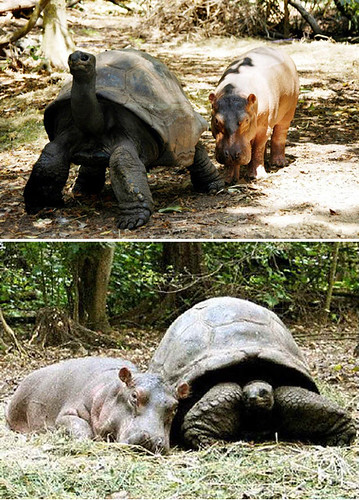
It seems to have been all doominess on here lately, so I'm grateful to Anthony for reminding me of a more hopeful story. Maybe you heard about Owen the baby hippo, orphaned in the tsunami disaster of December 2004, who was adopted by an ancient giant tortoise.

owen and mzee pictures

As soon as he was placed in his enclosure, the orphaned youngster immediately ran to the giant tortoise also housed in that space. The tortoise, named Mzee (Swahili for "old man") and estimated to be between 100 and 130 years old, was not immediately taken with the brash newcomer — he turned and hissed, forcing the hippo to back away. Yet Owen persisted in following the tortoise around the park (and even into a pool), and within days the pair had forged a friendship, eating and sleeping together. Owen has even been seen to lick the tortoise, whom he regards as his new mother.

What stuck with me was a report one year on that the pair had developed a way of communicating. "We discovered that somebody was making a sound in the pen, we'd never heard it before, not even from other hippos. And then we realised it was coming from both Owen and Mzee... It's just very unusual."

Set against the devastation of the tsunami disaster, you might write this story off as a piece of kitsch. But I think it matters more than that, and here's why. We are always hearing stories about how our behaviour is shaped by our genetic code. Bookshop shelves heave under titles explaining our everyday actions as the replaying of scripts laid down by the survival needs of our cave-dwelling ancestors.

Now, I'm all for seeking a deeper understanding of the many ways in which the past plays itself out through the present, but this kind of pop science often has the opposite effect. By projecting today's supermarket or nightclub behaviour onto the almost blank canvas of prehistory, it masks the strangeness of the past. In my experience, it is by becoming familiar with that strangeness, with how differently people have lived in other times and places, that we can begin to become aware of how strange our current ways of living are.

When, as in much popular science and media coverage, the focus is all on the role of evolution in shaping our behaviour, the effect is to eternalise the present and make it seem inevitable - simply a more "developed" version of the way people have always lived. With such a perspective, there is little point in challenging anything, because it's just "human nature".

What I love about the story of Owen and Mzee is that it illustrates how much room for manoeuvre nature leaves us. If a hippo and a tortoise can learn to talk to one another, how wide a range of possibilities there are besides the ones we take for granted.

About Me

My photo
London, United Kingdom
This blog was my online home between 2006 and 2009. Today, you'll find me scattered across the internet. To start looking, go to my personal website: http://dougald.co.uk/

My Projects

Signpostr School of Everything

MyBLOGLOG

Followers

My ClustrMap

From My Shelves

Labels