Showing posts with label hope. Show all posts

Monday, 5 January 2009

"The world wasn't made to be bettered..." Discuss.

Whenever I catch myself pronouncing in self-important tones on the state of the world - in other words, about three times a week - I should really go back and re-read this passage from one of Herman Hesse's pamphlets:

Friends, we must learn to desist from judging whether the world is good or bad, and we must forgo the strange pretension that it is up to us to better it.

The world has often been denounced as bad, because the denouncer had slept badly or had too much to eat. The world has often been praised as a paradise, because the praiser had just kissed a girl.

The world wasn't made to be bettered. Nor were you made to be bettered. You were made to be yourselves.

That's from Zarathustra's Return, first published anonymously in 1919, when "world betterment" was apparently something of a buzzword. I found it in a collection of his anti-war writings, 'If This War Goes On', picked up from a bookswap in a backpackers hostel years ago. Since then, two copies of the book have slipped through my fingers, but I just discovered that you can download the full text via this site - together with those of thirteen of Hesse's other works.

What's struck me lately is how difficult and/or irrelevant it seems to talk about the changes currently going on in terms of things getting better or worse. Today, for example, Ran Prieur reposted an article suggesting "the only way to save the economy is to stop printing money and allow defaults on all the bad debts. Of course the owners of debt will never agree to that, and the big money economy will crash and burn. I'm not sure that's a bad thing."

Meanwhile, my colleague Paul had a nice piece on the Guardian's PDA blog, talking about how the internet industry is changing:

My prediction for 2009 is that startups that matter will matter more. By 'matter', I mean the ones which have an explicit goal to improve the world whether that's socially or environmentally... The outlook for 2009 if you're trying to change the world is pretty good. If you're trying to get people to throw virtual sheep at each other, it's going to be a lot tougher than 2008.

I'm closer to Hesse when it comes to talk of "improving the world", but I do think that we're living in a time that is full of possibilities, and where precisely the events which are presented as the end of the world as we know it can open up a space for hope.

Wednesday, 18 July 2007

Wounded and Hopeful

There's something rather wonderful about discovering that John Berger, whose books more or less changed my life, also happens to share my taste in music!

I mean, as man born the same year as my grandmother, it would be understandable if he had paid little attention to the popular song of recent decades. But in his new book, 'Hold Everything Dear: Dispatches on Survival and Resistance', there is an essay on erotic desire which quotes Nick Cave.

Then I came across this radio broadcast from the BBC World Service. (Be quick, it's only available till Saturday - the interview is about two thirds of the way through the programme.) Here he elaborates on his appreciation of Cave. "It's to do with the way that desperation and... not exactly pleasure, but fulfillment, are two profiles of the same face. Black beside gold, if you want to put it into colours."

He goes on to enthuse about Johnny Cash's final album, tracks from which have been haunting my playlist for months.

I've felt for a long time that there is a common theme, an attitude, which links the work of those artists and writers I admire - setting it apart from much else that you read or hear. It is touched on by the title of Berger's collected poems, 'Pages of the Wound'. What I am talking about is an attitude to brokenness which is quite at odds with the assumptions of our society - a recognition that the place of brokenness, the wound, is also the place of hope. In fact, the only place at which hope - which is quite different to optimism, or faith in Progress - can begin.

By contrast, most of our culture proclaims the desirability of unbroken perfection, fulfillment, satisfaction - so the wounds which we all carry become a source of shame, something to be evaded, or fixed with quack cures.

As I see it - and I suspect Berger and Cave might agree on this - the connection between brokenness and hope is the great, though often mislaid, insight of Christian theology.

In another key, the denial of brokenness characteristic of our culture may be connected to the categorisation of reality which Berger has always challenged. Years ago, he wrote about the last day in the life of his friend, the Austrian philosopher Ernst Fischer. A quote from Fischer has stuck with me:

The categories we make between different aspects of experience - so that, for instance, some people say I should not have spoken about love and about the Comintern in the same book - these categories are mostly there for the convenience of liars.

These categories are broken things presented as wholes. By challenging that presentation, by acknowledging the (damaged) connections between them, we may do something to limit the damage they continue to do.

In the World Service interview, Berger returns to this theme, when asked about the way he writes about Palestine, Iraq and the War on Terror alongside poetry, art and desire:

One of the reasons why we all can, at times, have a feeling of really being lost... is the way that - and this often begins at school, but now it goes on an enormous amount in the media - the way that subjects are divided up into special categories. [My understanding of this] may have something to do with the fact that I never went to a university - and universities are where all those categories and the walls between them... they are strongholds of those kinds of divisions. I never went to university, I left school when I was sixteen and that's all the formal education I ever had. After that I went to art school, but what did I do, I looked at films and drew naked models. Maybe it was something to do with that - maybe there was an advantage of feeling free to go from category to category...

I discovered Berger's books as I was beginning to recover from the disorienting experience of three years as an Oxford undergraduate. I learned from them a new way of learning, which was really an old way - led playfully, by curiosity, through conversations and encounters, across categories, wounded and hopeful. I don't know that any of my colleagues would realise this, but for me the vision of the School of Everything owes a great deal to John Berger.

Thursday, 15 February 2007

The Hippo, the Tortoise and the Possibility of Change

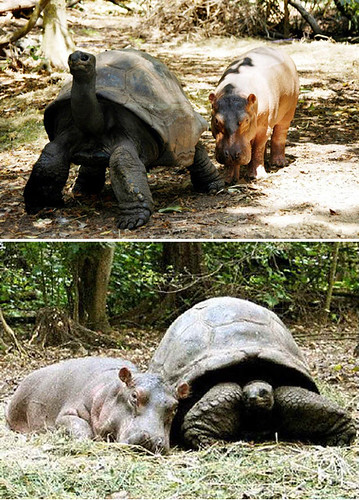
It seems to have been all doominess on here lately, so I'm grateful to Anthony for reminding me of a more hopeful story. Maybe you heard about Owen the baby hippo, orphaned in the tsunami disaster of December 2004, who was adopted by an ancient giant tortoise.

owen and mzee pictures

As soon as he was placed in his enclosure, the orphaned youngster immediately ran to the giant tortoise also housed in that space. The tortoise, named Mzee (Swahili for "old man") and estimated to be between 100 and 130 years old, was not immediately taken with the brash newcomer — he turned and hissed, forcing the hippo to back away. Yet Owen persisted in following the tortoise around the park (and even into a pool), and within days the pair had forged a friendship, eating and sleeping together. Owen has even been seen to lick the tortoise, whom he regards as his new mother.

What stuck with me was a report one year on that the pair had developed a way of communicating. "We discovered that somebody was making a sound in the pen, we'd never heard it before, not even from other hippos. And then we realised it was coming from both Owen and Mzee... It's just very unusual."

Set against the devastation of the tsunami disaster, you might write this story off as a piece of kitsch. But I think it matters more than that, and here's why. We are always hearing stories about how our behaviour is shaped by our genetic code. Bookshop shelves heave under titles explaining our everyday actions as the replaying of scripts laid down by the survival needs of our cave-dwelling ancestors.

Now, I'm all for seeking a deeper understanding of the many ways in which the past plays itself out through the present, but this kind of pop science often has the opposite effect. By projecting today's supermarket or nightclub behaviour onto the almost blank canvas of prehistory, it masks the strangeness of the past. In my experience, it is by becoming familiar with that strangeness, with how differently people have lived in other times and places, that we can begin to become aware of how strange our current ways of living are.

When, as in much popular science and media coverage, the focus is all on the role of evolution in shaping our behaviour, the effect is to eternalise the present and make it seem inevitable - simply a more "developed" version of the way people have always lived. With such a perspective, there is little point in challenging anything, because it's just "human nature".

What I love about the story of Owen and Mzee is that it illustrates how much room for manoeuvre nature leaves us. If a hippo and a tortoise can learn to talk to one another, how wide a range of possibilities there are besides the ones we take for granted.

Wednesday, 24 January 2007

More Illich

[From 'The Shadow Which The Future Throws']

Illich: The 'information revolution'... has injected new life into what would otherwise have been the exhausted logic of industrial development. This encourages expectations that, through his tools, man can escape the limits of his condition.

The social and mental construct called digital information, based on either/or, yes/no, zero/one, black/white, cannot lead us to the condition of post-scarcity. Basing the future on either/or disembedded decision-making cannot escape scarcity. This mode of thinking creates scarcity, by its very definition. Digital decision-making is not language; it is not culture; it can never recover the commons for us. Rather, it is the very creation of the most fluid market ever devised, that of information.

On the other hand, subsistence assumes culturally-bounded growth, that is, a context of commonly defined needs balanced against the limits of nature. Such a social awareness rests upon the historical knowledge of the human condition as precarious.

Gardels: Well, then, given the information revolution, can you entertain any optimism concerning the social embedding of alternatives to development/growth?

Illich: I first distinguish between the attitudes of hope and expectation in front of a "not yet." Expectation is based on a belief in instruments and the naive acceptance of socially constructed certitudes. Hope is based on historically-rooted experience, what Jean Paul Sartre called the "unsquashableness" of the phenomenological.

Giving up all optimism and pessimism, one is free to be courageous; one places no trust in tools and instruments; one comes to a hope based on human beings.

Now, I do see unsquashable signs of hope in the lifestyle of some drop-outs, for example, former professors who learn from subsistence peasants, articulated alliances among green committees, searchers for new options, transnational networks. But my practical phantasy is still unable to envisage how, short of a devastating catastrophe, the assumption on which the new alliances rest could emerge as a general common sense. One reason, I suspect, is that too many of these admirably courageous dissidents remain wedded to ideas like needs, education, health care and
so on.

[More here]

About Me

My photo
London, United Kingdom
This blog was my online home between 2006 and 2009. Today, you'll find me scattered across the internet. To start looking, go to my personal website: http://dougald.co.uk/

My Projects

Signpostr School of Everything

MyBLOGLOG

Followers

My ClustrMap

From My Shelves

Labels