Wednesday, 12 September 2007

Space Hijackers: They Did It!

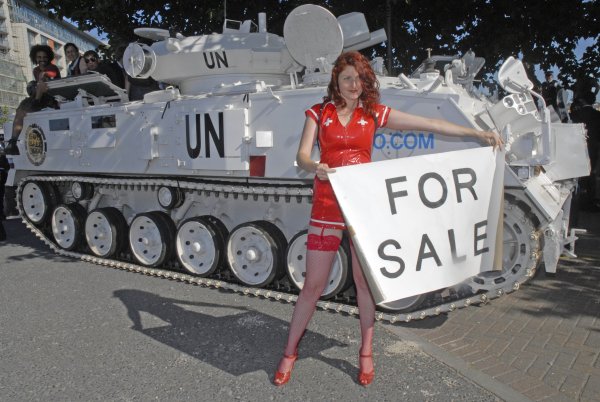
The Space Hijackers pulled a classic bait-and-switch on the police yesterday, to achieve their goal of auctioning a tank outside the front doors of the DSEi arms fair! The Met had spent all weekend following the Saracen Mk 1 which the Hijackers bought last week, finally pouncing as it left its storage location - when they pulled it over on the grounds that the suspension was dodgy.

At this point, a member of the crew climbed on top of the vehicle to announce that it was in fact a decoy! Round the corner, a rather larger tank (complete with tracks and gun turret) was rolling off the back of a low loader and up to the venue!


The auction took place, with bids of bodily organs and first-born children being turned down in favour of $50 in cash - money being worth more than human lives, when it comes to the arms trade...

Will it make any difference to anything? Who knows! On the whole, if you want to "change the world", I believe your time is better spent growing good things than protesting against bad things. But if you're going to make a protest that might well turn out to have been futile, you can at least make sure you have fun - and that's one thing you can count on with the Space Hijackers.

Monday, 10 September 2007

Illich - where to start?

Since I started this blog, I've name-checked Ivan Illich fairly regularly. His writing style takes a little getting used to, but his books and the various uncollected essays scattered across the web are pretty much all worth tracking down.

One question I get asked a lot is where someone who's new to his work should start. The long answer is, it depends on where you're coming from and what it is that most troubles you about the world in which we find ourselves - whether it is education or energy, health or work. Those looking for policy recipes were dismayed by his increasing withdrawal from that game, and mistake this for despair - but I find later texts, such as 'The Cultivation of Conspiracy', to be among the most genuinely (unillusionedly) hopeful responses to our times.

That's the long answer! The short answer is to try this little film, a reflection on 'Deschooling Society', which I discovered via Bricoleuse.

Sunday, 9 September 2007

Space Hijackers: Tank Update

You might remember the Space Hijackers and their quest for a tank, which I flagged up earlier in the summer. Well, they did it!


The Saracen Mk 1 was delivered last week and received its number plates from the DVLA on Friday. Apparently the owners of the venue where it was initially parked were put under a certain amount of pressure by the authorities - and the hijacker team has spent the rest of the weekend playing cat and mouse with the Met.

According to their press release, the plan is to drive the tank to the DSEi Arms Fair - taking place, rather tastefully, on September 11th - and auction it to the highest bidder:

If this so happens to be an angry teenager in a balaclava, then so be it. We don't see how destruction caused with our tank can possibly be our responsibility.

Several people have got in touch with us claiming that this kind of behavior is slightly reckless "what if someone drives over a police car in your tank?" Our response is simple: we are simply looking to make a profit, it's just business transaction. As with the arms dealers and their weapons, once the goods are out of our hands, how can we be held accountable for how they are used?

It's the kind of stunt that's bound to draw a certain amount of criticism - and given the trigger-happy track record of London's finest, I'd personally think twice about playing with military equipment in their vicinity...

But with organisers Reed Elsevier already quitting the arms fair business as a result of some impressive campaigning, it feels like, if enough attention is drawn to this year's event, there's just the scent of a chance that local politicians will decide it's more trouble than it's worth - and we could see this festival of death kicked out of London for good.

Thursday, 30 August 2007

Exciting times for The School of Everything

When I moved to Sheffield a few years ago, I soon discovered that the city's newsagents were more likely to stock the Morning Star than the Financial Times. If you're interested in stories with long-term consequences rather than short-term news value, either paper generally beats the rest of the British press. But when I stepped out this morning, it was in search of the distinctive salmon pink pages of the FT. At the third shop, I found a copy.

Why this urgent quest? Because today's the day the paper was to announce the finalists for Seedcamp. In fact, the article inside was mostly about Seedcamp itself - a week-long masterclass for Europe's most promising high-tech startups, with coaching from many of the leading figures in the internet scene. You had to visit FT.com for the rundown of the 20 finalists, picked from 270 applicants to participate in next week's event.

But what matters - or, at least, the reason for my trek around Sheffield's newsagents - is that The School of Everything made the list! (We'd known for a few days, but there's nothing like seeing it in print - or hypertext, as it happens...)

It's been an amazing year for Team Everything, since we quit our "proper jobs" to work on this - and the excitement has been growing over the past few weeks. We're still a little way off having a public version of the site, but making progress fast. I believe what we're building has the potential to bridge between the long-standing networks of informal learning which sit on the edge of today's education system - in areas such as music teaching or driving instruction - and the vision which many people have been reaching towards of a society in which learning is no longer thought of primarily in terms of schools, classrooms, curricula and the other structures of industrialised education.

It's a pretty grand project! You might even say we're trying to "change the world" - though that doesn't mean much until we actually do it. I wouldn't believe we had a chance, if I wasn't working with four people I trust to be good at the stuff I'm not good at. Not to mention an incredible network of older and wiser heads who've been lending us their support and credibility along the way.

Things are certainly getting exciting - but there's still a hell of a way to go before we've achieved anything substantial. Roll on next week, though. I'm looking forward to meeting all the other teams, learning from each other - and from the amazing range of mentors the Seedcamp organisers have drawn in to work with us over the week!

(Meanwhile, I'm off to spend the weekend singing folk songs and drinking good beer in a cowshed on the North York Moors...)

Tuesday, 21 August 2007

In case you wondered where I've been...

Anthony and Dougald make headlinesAnthony and I spotted this outside Holborn tube while we were waiting for Andy. It was too tempting to resist.

Tuesday, 14 August 2007

Separated at Birth?

This blog has been lacking a sense of humour lately, I fear. Blame it on the unfunny amounts of time I currently spend living on friends' sofas. (I'm lucky to have some very tolerant friends...) Normal service should resume when I finally move to London properly.

Meanwhile, relief arrives in the form of a rather random email from a reader at KPMG (who clearly has too little work on at the moment):

Dougald,

I hope you are well. You bear a striking resemblance to Jordan Collier from USA cult sci-fi series 'the 4400'. Are you in fact the same person?

Thanks,

Matt

He even goes to the trouble of attaching pictures of us both.

Now, I must expose a lacuna in my frame of cultural reference - I've never seen an episode of The 4400. So if anyone has any insight as to how flattered/alarmed I should be at the comparison, do please share it!

Sunday, 12 August 2007

Do Have Nightmares!

A couple of weeks ago, I was musing about the impact of TV on the elderly. "If I were frail and lonely and reliant on BBC news for my picture of the world, I think I'd soon be too afraid to leave the house..."

Well, my friend Lucy just drew my attention to this post from the American political reporter Rick Perlstein (via the excellent Making Light):

Shortly before she died, my grandmother — one of the people, naturally, I loved the most in the world — broke my heart. Celia Perlstein, like most of our grandparents, didn't get out much in her final years; in fact, for the last few years of her life, I'm not sure she got out of her old folks home at all. I don't think she really wanted to. She was sure that beyond its threshold lay dragons: far-far-far leftists out to steal her Social Security; turbaned terrorists just itching to fly a jet into the First Wisconsin tower a few blocks to the south; quisling Democrats itching to help them do it; grandma-gutting criminal marauders just outside her door.

I'd look out of her eighth floor picture window, down at the scene she saw every day, half expecting to find that nightmare landscape before me. Nope: same as always, the brightly colored sailboats on Lake Michigan, kids and their parents feeding the ducks (Grandma used to take me to feed the ducks), happy, strolling Milwaukee couples—paradise. Where was she getting these fantasies?

One evening's visit, all became clear. She gestured at the blaring TV set. The excruciating grandma-volume was even more excruciating than usual, because she was visiting with her best TV friend. She told me how much she adored Bill O'Reilly. My wife and I cringed. Watching our latter-day Joe McCarthy on TV every night, she had learned, late in life—for this development was entirely new—how to hate her fellow Americans. I almost cried, because one of the people she was learning how to hate was me.

Over here in the UK, broadcasting regulations mean we have (thankfully) no equivalent to Fox News. So for me to pick on the BBC may be a case of not knowing how lucky you are. (It was also kind of a self-criticism, since I used to be a BBC journalist - albeit a fairly lowly one.)

Yet, powerful as I found his post, I wonder whether Perlstein isn't merging two issues? Bad journalism and outright propaganda deserve censure. One consequence of this, however, can be to present "good journalism" in an uncritical light - and overlook those structural issues which affect the news industry as a whole.

I suspect that even in the UK there are elderly people afraid to leave home because of the picture of the world they get from the news. Maybe we can blame this on the Daily Mail - or the influence that papers like the Mail have over the news agenda of the broadcast media. But can we imagine a sort of "news" which did not consist largely of the misfortunes of people we do not know - misfortunes which affect us little, except (by their retelling) to raise our general level of anxiety?

I'm reminded of a programme I haven't seen for years, but which is still a regular in the BBC1 schedules. 'Crimewatch' specialises in reconstructions of unsolved crimes, while a team stands by to field calls from viewers who think they may have information that will solve them. In a sense, this is the rebuttal of my argument - some, at least, of the misfortunes that make up our news diet are retold because someone out there might be able to help.

What comes back to me, though, is the catchphrase with which the presenter would end each show, as if to counteract the effect of the preceding 29 minutes. "Remember, the crimes featured here are rare," he'd say as he turned to the camera, "so sleep well - and don't have nightmares!"

And I wonder, isn't that just what the news industry does to us all - makes us sleep less soundly in our beds?

Wednesday, 1 August 2007

Serendipitous Learning and Zemblanitous Education

What did you learn today? It's a question plenty of kids get asked when they come home from school - but maybe one we don't ask ourselves so often as grown-ups...

Well, in the past twenty four hours I learned at least two things. One is that the word 'serendipity' comes from an old name for Sri Lanka - Serendip. For a word of such a vintage, its origins can be dated with unusual precision, to the 28th of January, 1754. It was coined by Horace Walpole in a letter, referring to a fairy tale called 'The Three Princes of Serendip'. These princes 'were always making discoveries by accidents and sagacity, of things they were not in quest of'. Hence, serendipity.

My second learning of the day was that serendipity has an opposite. An antonym, in fact. (And how often do you get to use that word?) 'Zemblanity' is a more recent coinage, the work of the novelist William Boyd:

So what is the opposite of Serendip, a southern land of spice and warmth, lush greenery and hummingbirds, seawashed, sunbasted? Think of another world in the far north, barren, icebound, cold, a world of flint and stone. Call it Zembla. Ergo: zemblanity, the opposite of serendipity, the faculty of making unhappy, unlucky and expected discoveries by design.

All this I learned by following up a presentation by a Finnish guy called Teemu Arina - which I came across thanks to a post from Artichoke. Teemu reckons (and I agree) that "making unhappy, unlucky and expected discoveries by design" is a pretty good description of what happens in formal education, when "learning outcomes" are specified in advance.

Meanwhile, elsewhere, Will Davies is concerned that "Web 2.0" threatens to eliminate serendipity from whole areas of our lives, in the pursuit of more efficient ways of finding music we'll like or people to whom we're indirectly connected:

Outside of the economy - and very often within the economy too - we find that the constraints and accidents of everyday life are the basis for enjoyable and meaningful activities. They don't necessarily connect us to the people we most want to speak to or the music we most want to listen to. Sometimes they even frustrate us.

But this shouldn't lead to business process re-engineering. ...when we vote, chat to neighbours, browse through a record shop we are not seeking some outcome in the most efficient manner available. We are engaging in an activity that we find valuable.

That reminded me of an experiment by Matt Jones (who's on our advisory board for the School of Everything). A few years ago, he asked the readers of his blog to help him make contact with Brian Eno - a quest in which he succeeded within two days. Afterwards, he reflected (in a less apocalyptic tone than Will) on the unsatisfactoriness of social networking tools which leave no room for serendipity:

...the goal of all the 'Sters is to collapse our social web to a surveyable size, bringing our friends and connections close enough to see beyond them to new people. A little like glancing over the shoulder of someone you’re talking to at a party in order to see who’s coming through the door.

The picturesque and playful exploring of our social connections is sacrificed. The mathematics of coincidence are intruding on the delusions we enjoyed every time we exclaimed to a new acquaintance the reassuring cliche “what a small world!”.

Where’s the business model in social networks? The same as email and other generators of information overload: the new luxury of meaning. I will pay to sustain the space, the silence and the signal. Give me privacy and anonymity, but also possibility. Extend my connections, but don’t collapse them.

I share Will's concern about the ways in which the tools we use shape us - deform us, even. There is too much hype about Web 2.0 and that means not only that its strengths are over-rated, but that its more troubling aspects are overlooked. Yet compared to the compulsory zemblanity of the education system, my meanderings across the internet continue to be spiced with serendipity...

Friday, 27 July 2007

Good news is no news...

It's always good to discover thoughtful voices in the blogosphere - so I'm grateful to Tom for pointing me towards Andrew Brown's Helmintholog.

Brown used to be religious affairs correspondent for the Independent - and seems to have written intelligently about an intimidating range of other subjects. On the blog, he makes neat work of the "new atheism", but I was particularly struck by another post about the effect of reporting on religion:

I don’t myself know any religious correspondent whose faith has survived writing about it — possibly some of the more radically pessimistic Catholics, but even there I am not sure... The most one can believe is that some of these deluded people are doing better, both for themselves and for the world, than they would be without their delusions. This is quite enough to keep me from full-on pharyngular atheism. I don’t think human nature is modular enough that you can simply swap out the delusional bits, and leave the rest intact. Believing fewer false things is a very long struggle. Journalism teaches you that, too, if you want to learn it.

I like the way he explains his position, even if I don't share it. But the thought which came to me was that the loss of faith he describes sounds like a variant of the general tendency to cynicism among journalists. It's an occupational hazard (and one of the reasons I was glad to quit the newsroom): an understandable response to prolonged, close-quarters exposure to "news", skewed as it is towards the worst in life. Most of the things which make life worth living aren't remotely newsworthy.

This leads to another thought. Once upon a time, people used to worry about the influence of TV on young people. What I worry about is its influence on the elderly. If I were frail and lonely and reliant on BBC news for my picture of the world, I think I'd soon be too afraid to leave the house...

(Other suggestions for blogs I should check out gratefully received, by the way.)

Wednesday, 18 July 2007

Wounded and Hopeful

There's something rather wonderful about discovering that John Berger, whose books more or less changed my life, also happens to share my taste in music!

I mean, as man born the same year as my grandmother, it would be understandable if he had paid little attention to the popular song of recent decades. But in his new book, 'Hold Everything Dear: Dispatches on Survival and Resistance', there is an essay on erotic desire which quotes Nick Cave.

Then I came across this radio broadcast from the BBC World Service. (Be quick, it's only available till Saturday - the interview is about two thirds of the way through the programme.) Here he elaborates on his appreciation of Cave. "It's to do with the way that desperation and... not exactly pleasure, but fulfillment, are two profiles of the same face. Black beside gold, if you want to put it into colours."

He goes on to enthuse about Johnny Cash's final album, tracks from which have been haunting my playlist for months.

I've felt for a long time that there is a common theme, an attitude, which links the work of those artists and writers I admire - setting it apart from much else that you read or hear. It is touched on by the title of Berger's collected poems, 'Pages of the Wound'. What I am talking about is an attitude to brokenness which is quite at odds with the assumptions of our society - a recognition that the place of brokenness, the wound, is also the place of hope. In fact, the only place at which hope - which is quite different to optimism, or faith in Progress - can begin.

By contrast, most of our culture proclaims the desirability of unbroken perfection, fulfillment, satisfaction - so the wounds which we all carry become a source of shame, something to be evaded, or fixed with quack cures.

As I see it - and I suspect Berger and Cave might agree on this - the connection between brokenness and hope is the great, though often mislaid, insight of Christian theology.

In another key, the denial of brokenness characteristic of our culture may be connected to the categorisation of reality which Berger has always challenged. Years ago, he wrote about the last day in the life of his friend, the Austrian philosopher Ernst Fischer. A quote from Fischer has stuck with me:

The categories we make between different aspects of experience - so that, for instance, some people say I should not have spoken about love and about the Comintern in the same book - these categories are mostly there for the convenience of liars.

These categories are broken things presented as wholes. By challenging that presentation, by acknowledging the (damaged) connections between them, we may do something to limit the damage they continue to do.

In the World Service interview, Berger returns to this theme, when asked about the way he writes about Palestine, Iraq and the War on Terror alongside poetry, art and desire:

One of the reasons why we all can, at times, have a feeling of really being lost... is the way that - and this often begins at school, but now it goes on an enormous amount in the media - the way that subjects are divided up into special categories. [My understanding of this] may have something to do with the fact that I never went to a university - and universities are where all those categories and the walls between them... they are strongholds of those kinds of divisions. I never went to university, I left school when I was sixteen and that's all the formal education I ever had. After that I went to art school, but what did I do, I looked at films and drew naked models. Maybe it was something to do with that - maybe there was an advantage of feeling free to go from category to category...

I discovered Berger's books as I was beginning to recover from the disorienting experience of three years as an Oxford undergraduate. I learned from them a new way of learning, which was really an old way - led playfully, by curiosity, through conversations and encounters, across categories, wounded and hopeful. I don't know that any of my colleagues would realise this, but for me the vision of the School of Everything owes a great deal to John Berger.

Sunday, 8 July 2007

Buy the anarchists a tank!

Now, I'm not a big fan of tanks or military hardware in general. (Although I do have fond memories of driving around Cumbria with a forty foot Soviet missile my friend Ed had borrowed from his boss.) Anyway, I couldn't resist this request from the Space Hijackers:

There comes a time in every activist groups development when they realise that there is something missing in their set up. We have been striving to cause trouble, save the world and wind up the powers that be for 8 years now. However we still don't own a tank, or indeed any kind of armoured personell carrier! Please help us right this wrong!

Besides the generally usefulness of owning a tank if you're a collective of anarchitects, psychogeographic pranksters and sworn enemies of Starbucks, there is a more specific rationale at work:

Every two years the ExCeL exhibition centre in East London plays host to DSEi, Europe's largest arms fair. Representatives from all of the major arms manufacturers pimp their wares to rogue states, impoverished nations and invading armies with the full support of the UK government. In fact the police firearms squad tried to raid the fair in 2005 only to be turned back by the government.

On the last two occasions we have attempted to infiltrate the fair, embarrass the dealers and cause a ruckus. In 2003, we caught the trains to the fair with the arms dealers. Suited up and looking business-like we pulled prosthetic limbs (arms) from our cases and attempted to sell them to the dealers. In 2005, worried about their obsession with phallic objects such as rockets we attempted to sell sex toys to the dealers to make up for their lack of "weapons capabilities". Generally however we are escorted out by the police.

This year we have decided to take things up a notch or ten. We want to buy a tank, we want to drive it into the arms fair! We don't want to be shoved around by burly policemen any more. Can't really say much more at the moment, but you get the gist.

The totalizer's already approaching £1000, but there's some way to go. So please, give generously!

Maybe they could arrange a timeshare with the Rebel Clown Army...?

Tuesday, 3 July 2007

Time for Tea

This came via Tim.

I've felt for years that we suffer from the loss of a sense of 'timeliness' - or at least its marginalisation, edged out by Ben Franklin's famous equation of time with money. Believe that and time becomes purely a matter of quantity, a currency to be exchanged.

For me, the qualities of time are important: apparently contradictory actions may be equally proper at their different occasions. Lose sight of this - of the incommensurability of what matters - and life becomes harshly impoverished.

About Me

My photo
London, United Kingdom
This blog was my online home between 2006 and 2009. Today, you'll find me scattered across the internet. To start looking, go to my personal website: http://dougald.co.uk/

My Projects

Signpostr School of Everything

MyBLOGLOG

Followers

My ClustrMap

From My Shelves

Labels