Thursday, 30 August 2007

Exciting times for The School of Everything

When I moved to Sheffield a few years ago, I soon discovered that the city's newsagents were more likely to stock the Morning Star than the Financial Times. If you're interested in stories with long-term consequences rather than short-term news value, either paper generally beats the rest of the British press. But when I stepped out this morning, it was in search of the distinctive salmon pink pages of the FT. At the third shop, I found a copy.

Why this urgent quest? Because today's the day the paper was to announce the finalists for Seedcamp. In fact, the article inside was mostly about Seedcamp itself - a week-long masterclass for Europe's most promising high-tech startups, with coaching from many of the leading figures in the internet scene. You had to visit FT.com for the rundown of the 20 finalists, picked from 270 applicants to participate in next week's event.

But what matters - or, at least, the reason for my trek around Sheffield's newsagents - is that The School of Everything made the list! (We'd known for a few days, but there's nothing like seeing it in print - or hypertext, as it happens...)

It's been an amazing year for Team Everything, since we quit our "proper jobs" to work on this - and the excitement has been growing over the past few weeks. We're still a little way off having a public version of the site, but making progress fast. I believe what we're building has the potential to bridge between the long-standing networks of informal learning which sit on the edge of today's education system - in areas such as music teaching or driving instruction - and the vision which many people have been reaching towards of a society in which learning is no longer thought of primarily in terms of schools, classrooms, curricula and the other structures of industrialised education.

It's a pretty grand project! You might even say we're trying to "change the world" - though that doesn't mean much until we actually do it. I wouldn't believe we had a chance, if I wasn't working with four people I trust to be good at the stuff I'm not good at. Not to mention an incredible network of older and wiser heads who've been lending us their support and credibility along the way.

Things are certainly getting exciting - but there's still a hell of a way to go before we've achieved anything substantial. Roll on next week, though. I'm looking forward to meeting all the other teams, learning from each other - and from the amazing range of mentors the Seedcamp organisers have drawn in to work with us over the week!

(Meanwhile, I'm off to spend the weekend singing folk songs and drinking good beer in a cowshed on the North York Moors...)

Tuesday, 21 August 2007

In case you wondered where I've been...

Anthony and Dougald make headlinesAnthony and I spotted this outside Holborn tube while we were waiting for Andy. It was too tempting to resist.

Tuesday, 14 August 2007

Separated at Birth?

This blog has been lacking a sense of humour lately, I fear. Blame it on the unfunny amounts of time I currently spend living on friends' sofas. (I'm lucky to have some very tolerant friends...) Normal service should resume when I finally move to London properly.

Meanwhile, relief arrives in the form of a rather random email from a reader at KPMG (who clearly has too little work on at the moment):

Dougald,

I hope you are well. You bear a striking resemblance to Jordan Collier from USA cult sci-fi series 'the 4400'. Are you in fact the same person?

Thanks,

Matt

He even goes to the trouble of attaching pictures of us both.

Now, I must expose a lacuna in my frame of cultural reference - I've never seen an episode of The 4400. So if anyone has any insight as to how flattered/alarmed I should be at the comparison, do please share it!

Sunday, 12 August 2007

Do Have Nightmares!

A couple of weeks ago, I was musing about the impact of TV on the elderly. "If I were frail and lonely and reliant on BBC news for my picture of the world, I think I'd soon be too afraid to leave the house..."

Well, my friend Lucy just drew my attention to this post from the American political reporter Rick Perlstein (via the excellent Making Light):

Shortly before she died, my grandmother — one of the people, naturally, I loved the most in the world — broke my heart. Celia Perlstein, like most of our grandparents, didn't get out much in her final years; in fact, for the last few years of her life, I'm not sure she got out of her old folks home at all. I don't think she really wanted to. She was sure that beyond its threshold lay dragons: far-far-far leftists out to steal her Social Security; turbaned terrorists just itching to fly a jet into the First Wisconsin tower a few blocks to the south; quisling Democrats itching to help them do it; grandma-gutting criminal marauders just outside her door.

I'd look out of her eighth floor picture window, down at the scene she saw every day, half expecting to find that nightmare landscape before me. Nope: same as always, the brightly colored sailboats on Lake Michigan, kids and their parents feeding the ducks (Grandma used to take me to feed the ducks), happy, strolling Milwaukee couples—paradise. Where was she getting these fantasies?

One evening's visit, all became clear. She gestured at the blaring TV set. The excruciating grandma-volume was even more excruciating than usual, because she was visiting with her best TV friend. She told me how much she adored Bill O'Reilly. My wife and I cringed. Watching our latter-day Joe McCarthy on TV every night, she had learned, late in life—for this development was entirely new—how to hate her fellow Americans. I almost cried, because one of the people she was learning how to hate was me.

Over here in the UK, broadcasting regulations mean we have (thankfully) no equivalent to Fox News. So for me to pick on the BBC may be a case of not knowing how lucky you are. (It was also kind of a self-criticism, since I used to be a BBC journalist - albeit a fairly lowly one.)

Yet, powerful as I found his post, I wonder whether Perlstein isn't merging two issues? Bad journalism and outright propaganda deserve censure. One consequence of this, however, can be to present "good journalism" in an uncritical light - and overlook those structural issues which affect the news industry as a whole.

I suspect that even in the UK there are elderly people afraid to leave home because of the picture of the world they get from the news. Maybe we can blame this on the Daily Mail - or the influence that papers like the Mail have over the news agenda of the broadcast media. But can we imagine a sort of "news" which did not consist largely of the misfortunes of people we do not know - misfortunes which affect us little, except (by their retelling) to raise our general level of anxiety?

I'm reminded of a programme I haven't seen for years, but which is still a regular in the BBC1 schedules. 'Crimewatch' specialises in reconstructions of unsolved crimes, while a team stands by to field calls from viewers who think they may have information that will solve them. In a sense, this is the rebuttal of my argument - some, at least, of the misfortunes that make up our news diet are retold because someone out there might be able to help.

What comes back to me, though, is the catchphrase with which the presenter would end each show, as if to counteract the effect of the preceding 29 minutes. "Remember, the crimes featured here are rare," he'd say as he turned to the camera, "so sleep well - and don't have nightmares!"

And I wonder, isn't that just what the news industry does to us all - makes us sleep less soundly in our beds?

Wednesday, 1 August 2007

Serendipitous Learning and Zemblanitous Education

What did you learn today? It's a question plenty of kids get asked when they come home from school - but maybe one we don't ask ourselves so often as grown-ups...

Well, in the past twenty four hours I learned at least two things. One is that the word 'serendipity' comes from an old name for Sri Lanka - Serendip. For a word of such a vintage, its origins can be dated with unusual precision, to the 28th of January, 1754. It was coined by Horace Walpole in a letter, referring to a fairy tale called 'The Three Princes of Serendip'. These princes 'were always making discoveries by accidents and sagacity, of things they were not in quest of'. Hence, serendipity.

My second learning of the day was that serendipity has an opposite. An antonym, in fact. (And how often do you get to use that word?) 'Zemblanity' is a more recent coinage, the work of the novelist William Boyd:

So what is the opposite of Serendip, a southern land of spice and warmth, lush greenery and hummingbirds, seawashed, sunbasted? Think of another world in the far north, barren, icebound, cold, a world of flint and stone. Call it Zembla. Ergo: zemblanity, the opposite of serendipity, the faculty of making unhappy, unlucky and expected discoveries by design.

All this I learned by following up a presentation by a Finnish guy called Teemu Arina - which I came across thanks to a post from Artichoke. Teemu reckons (and I agree) that "making unhappy, unlucky and expected discoveries by design" is a pretty good description of what happens in formal education, when "learning outcomes" are specified in advance.

Meanwhile, elsewhere, Will Davies is concerned that "Web 2.0" threatens to eliminate serendipity from whole areas of our lives, in the pursuit of more efficient ways of finding music we'll like or people to whom we're indirectly connected:

Outside of the economy - and very often within the economy too - we find that the constraints and accidents of everyday life are the basis for enjoyable and meaningful activities. They don't necessarily connect us to the people we most want to speak to or the music we most want to listen to. Sometimes they even frustrate us.

But this shouldn't lead to business process re-engineering. ...when we vote, chat to neighbours, browse through a record shop we are not seeking some outcome in the most efficient manner available. We are engaging in an activity that we find valuable.

That reminded me of an experiment by Matt Jones (who's on our advisory board for the School of Everything). A few years ago, he asked the readers of his blog to help him make contact with Brian Eno - a quest in which he succeeded within two days. Afterwards, he reflected (in a less apocalyptic tone than Will) on the unsatisfactoriness of social networking tools which leave no room for serendipity:

...the goal of all the 'Sters is to collapse our social web to a surveyable size, bringing our friends and connections close enough to see beyond them to new people. A little like glancing over the shoulder of someone you’re talking to at a party in order to see who’s coming through the door.

The picturesque and playful exploring of our social connections is sacrificed. The mathematics of coincidence are intruding on the delusions we enjoyed every time we exclaimed to a new acquaintance the reassuring cliche “what a small world!”.

Where’s the business model in social networks? The same as email and other generators of information overload: the new luxury of meaning. I will pay to sustain the space, the silence and the signal. Give me privacy and anonymity, but also possibility. Extend my connections, but don’t collapse them.

I share Will's concern about the ways in which the tools we use shape us - deform us, even. There is too much hype about Web 2.0 and that means not only that its strengths are over-rated, but that its more troubling aspects are overlooked. Yet compared to the compulsory zemblanity of the education system, my meanderings across the internet continue to be spiced with serendipity...

Friday, 27 July 2007

Good news is no news...

It's always good to discover thoughtful voices in the blogosphere - so I'm grateful to Tom for pointing me towards Andrew Brown's Helmintholog.

Brown used to be religious affairs correspondent for the Independent - and seems to have written intelligently about an intimidating range of other subjects. On the blog, he makes neat work of the "new atheism", but I was particularly struck by another post about the effect of reporting on religion:

I don’t myself know any religious correspondent whose faith has survived writing about it — possibly some of the more radically pessimistic Catholics, but even there I am not sure... The most one can believe is that some of these deluded people are doing better, both for themselves and for the world, than they would be without their delusions. This is quite enough to keep me from full-on pharyngular atheism. I don’t think human nature is modular enough that you can simply swap out the delusional bits, and leave the rest intact. Believing fewer false things is a very long struggle. Journalism teaches you that, too, if you want to learn it.

I like the way he explains his position, even if I don't share it. But the thought which came to me was that the loss of faith he describes sounds like a variant of the general tendency to cynicism among journalists. It's an occupational hazard (and one of the reasons I was glad to quit the newsroom): an understandable response to prolonged, close-quarters exposure to "news", skewed as it is towards the worst in life. Most of the things which make life worth living aren't remotely newsworthy.

This leads to another thought. Once upon a time, people used to worry about the influence of TV on young people. What I worry about is its influence on the elderly. If I were frail and lonely and reliant on BBC news for my picture of the world, I think I'd soon be too afraid to leave the house...

(Other suggestions for blogs I should check out gratefully received, by the way.)

Wednesday, 18 July 2007

Wounded and Hopeful

There's something rather wonderful about discovering that John Berger, whose books more or less changed my life, also happens to share my taste in music!

I mean, as man born the same year as my grandmother, it would be understandable if he had paid little attention to the popular song of recent decades. But in his new book, 'Hold Everything Dear: Dispatches on Survival and Resistance', there is an essay on erotic desire which quotes Nick Cave.

Then I came across this radio broadcast from the BBC World Service. (Be quick, it's only available till Saturday - the interview is about two thirds of the way through the programme.) Here he elaborates on his appreciation of Cave. "It's to do with the way that desperation and... not exactly pleasure, but fulfillment, are two profiles of the same face. Black beside gold, if you want to put it into colours."

He goes on to enthuse about Johnny Cash's final album, tracks from which have been haunting my playlist for months.

I've felt for a long time that there is a common theme, an attitude, which links the work of those artists and writers I admire - setting it apart from much else that you read or hear. It is touched on by the title of Berger's collected poems, 'Pages of the Wound'. What I am talking about is an attitude to brokenness which is quite at odds with the assumptions of our society - a recognition that the place of brokenness, the wound, is also the place of hope. In fact, the only place at which hope - which is quite different to optimism, or faith in Progress - can begin.

By contrast, most of our culture proclaims the desirability of unbroken perfection, fulfillment, satisfaction - so the wounds which we all carry become a source of shame, something to be evaded, or fixed with quack cures.

As I see it - and I suspect Berger and Cave might agree on this - the connection between brokenness and hope is the great, though often mislaid, insight of Christian theology.

In another key, the denial of brokenness characteristic of our culture may be connected to the categorisation of reality which Berger has always challenged. Years ago, he wrote about the last day in the life of his friend, the Austrian philosopher Ernst Fischer. A quote from Fischer has stuck with me:

The categories we make between different aspects of experience - so that, for instance, some people say I should not have spoken about love and about the Comintern in the same book - these categories are mostly there for the convenience of liars.

These categories are broken things presented as wholes. By challenging that presentation, by acknowledging the (damaged) connections between them, we may do something to limit the damage they continue to do.

In the World Service interview, Berger returns to this theme, when asked about the way he writes about Palestine, Iraq and the War on Terror alongside poetry, art and desire:

One of the reasons why we all can, at times, have a feeling of really being lost... is the way that - and this often begins at school, but now it goes on an enormous amount in the media - the way that subjects are divided up into special categories. [My understanding of this] may have something to do with the fact that I never went to a university - and universities are where all those categories and the walls between them... they are strongholds of those kinds of divisions. I never went to university, I left school when I was sixteen and that's all the formal education I ever had. After that I went to art school, but what did I do, I looked at films and drew naked models. Maybe it was something to do with that - maybe there was an advantage of feeling free to go from category to category...

I discovered Berger's books as I was beginning to recover from the disorienting experience of three years as an Oxford undergraduate. I learned from them a new way of learning, which was really an old way - led playfully, by curiosity, through conversations and encounters, across categories, wounded and hopeful. I don't know that any of my colleagues would realise this, but for me the vision of the School of Everything owes a great deal to John Berger.

Sunday, 8 July 2007

Buy the anarchists a tank!

Now, I'm not a big fan of tanks or military hardware in general. (Although I do have fond memories of driving around Cumbria with a forty foot Soviet missile my friend Ed had borrowed from his boss.) Anyway, I couldn't resist this request from the Space Hijackers:

There comes a time in every activist groups development when they realise that there is something missing in their set up. We have been striving to cause trouble, save the world and wind up the powers that be for 8 years now. However we still don't own a tank, or indeed any kind of armoured personell carrier! Please help us right this wrong!

Besides the generally usefulness of owning a tank if you're a collective of anarchitects, psychogeographic pranksters and sworn enemies of Starbucks, there is a more specific rationale at work:

Every two years the ExCeL exhibition centre in East London plays host to DSEi, Europe's largest arms fair. Representatives from all of the major arms manufacturers pimp their wares to rogue states, impoverished nations and invading armies with the full support of the UK government. In fact the police firearms squad tried to raid the fair in 2005 only to be turned back by the government.

On the last two occasions we have attempted to infiltrate the fair, embarrass the dealers and cause a ruckus. In 2003, we caught the trains to the fair with the arms dealers. Suited up and looking business-like we pulled prosthetic limbs (arms) from our cases and attempted to sell them to the dealers. In 2005, worried about their obsession with phallic objects such as rockets we attempted to sell sex toys to the dealers to make up for their lack of "weapons capabilities". Generally however we are escorted out by the police.

This year we have decided to take things up a notch or ten. We want to buy a tank, we want to drive it into the arms fair! We don't want to be shoved around by burly policemen any more. Can't really say much more at the moment, but you get the gist.

The totalizer's already approaching £1000, but there's some way to go. So please, give generously!

Maybe they could arrange a timeshare with the Rebel Clown Army...?

Tuesday, 3 July 2007

Time for Tea

This came via Tim.

I've felt for years that we suffer from the loss of a sense of 'timeliness' - or at least its marginalisation, edged out by Ben Franklin's famous equation of time with money. Believe that and time becomes purely a matter of quantity, a currency to be exchanged.

For me, the qualities of time are important: apparently contradictory actions may be equally proper at their different occasions. Lose sight of this - of the incommensurability of what matters - and life becomes harshly impoverished.

Thursday, 28 June 2007

It's wet up north...

By the time I got out of Sheffield on Monday morning, they were already cancelling trains. On Radio 4, a presenter said something about "the wettest day for fifty years" - but I was heading to a conference in Stoke and, beyond the nuisance of having damp feet all day, didn't give it much thought. Or not until the end of the afternoon, when I stopped to check my email and saw the pictures.


It's been a strange week to be out of town. My girlfriend got stranded and had to camp out in her office for most of the first night. My old colleagues at Radio Sheffield were working 24 hour shifts, getting official information out and talking to people on the ground. Even as the flooding went down in the city itself, there have been rolling black-outs, foul mud covering large areas, and traffic chaos with the M1 closed for days.

The Fire Brigades Union general secretary, Matt Wrack, gives a sense of the scale of events:

We have witnessed the biggest rescue effort in peacetime Britain by our emergency services, and it's not over yet. Fire crews and officers have been working to the point of collapse. Emergency fire control operators have been under major pressure, with thousands of extra calls for assistance from the public...

The government has not understood the scale, gravity and severity of what has happened.

The same could be said of large parts of the London media (the Guardian included) - which have prioritised not only the Downing Street handover, but such momentous events as the release of Paris Hilton and the Spice Girls reunion. If it were Bluewater [big shopping centre, near London] and not Meadowhall that was six feet deep in water and sewage, there would be rather more fuss.


I was in two minds whether to write this post. It seems kind of petty to moan about the metropolitan parochialism of the British media, when there are plenty of more useful things to be done. But I'm not at home to pitch in - so all I can do is admire the efforts of members of the Sheffield Forum and the local Freecycle group, and contrast them to the BBC producer who could be heard expressing his opinion over footage of the floods: "I do hate the Sheffield Accent with a passion... sorry, I don't mean to be a snob... they sound ignorant." [The offending clip has now been removed from BBC Online, but I heard it with my own ears.]

One piece of bigotry like that, for all it lets down the BBC's staff on the ground, would hardly be worth mentioning - if it wasn't something that us northerners experience on a daily basis. Stuart Maconie, a BBC broadcaster himself, writes eloquently about the same phenomenon in the conclusion to his wonderful 'Pies and Prejudice: In Search of the North':

On a rainy drive across the Lancashire moors, I caught a short Radio 4 'issue-based' story about childlessness but, for me, it was the minor detail that provoked the most thought. The protagonist was an academic with a cut-glass accent. She had lost a daughter called Cordelia and her neighbour was a TV producer. At no point was there any suggestion that these people and this milieu were in any way out of the ordinary. This was incredibly telling, I thought. Most people have never met either a Cordelia or a television producer. But as they discussed their (literally) extraordinar lives in voices of crystalline poshness, their remoteness from life as most of us live it was never acknowledged.

If, however, you turn on a Radio 4 play and the voices are northern, it will inevitably be all about 'being northern'. About how poor or cute or funny or indomitable we are. It will never be simply set in Sheffield or Hull or Wigan because it can be and should be. It will never be about an adulterous dentist who just happens to live in Bootle. It will be in some ways about his Scouseness... Some writers may think this is complimentary. In fact, it's patronising. It's in effect saying that you have to have a strong dramatic reason, a 'hook', in order to set your play outside the M25. The fact that most of the country actually lives there isn't good enough evidently.

Quite.

Sunday, 24 June 2007

Black Bloc, White Bloc - Part II

Back to the book I never wrote - the one about good protesters, bad protesters, governments and terrorists...

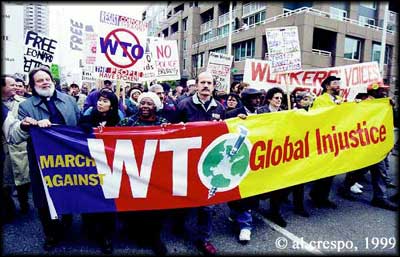
In the discussion on my post from a couple of weeks ago, Tim reminded me of the (in)famous protests at the WTO meeting in Seattle in 1999:

The only thing I remember of it is images of chaos, tear gas, bandaned young people throwing rocks, police behind barricades, fires, looting (I may be adding that now to the memory). It was a series of clips which spoke of danger, chaos, anarchy, etc.

Did it happen? Yes.

Did it come close to describing what the majority of people who were at the protest wanted to be seen and heard? My guess is, probably not. But it made for good sound and video bites.

Part of what drew me into trying to write about events like this is that, as a journalist, I felt the news media were peculiarly bad at handling them - and I was both fascinated and troubled by the way this interacted with the agendas of politicians and different groups of protesters.

The Gleneagles summit was the second time the G8 leaders had met in the UK since New Labour came to power. The fact that they met this time in the wilds of Scotland rather than in a major city was a reflection of the bandwagon of international protests, for which the Seattle WTO is often seen as the starting point. However, for the Blair government, there was also the memory of the 1998 summit in Birmingham - where their media managers were wrong-footed by the scale of public protest.

I remember arriving that day with a seasoned activist, a veteran of the anti-road building and Reclaim The Streets protests of the 1990s, who was simply gobsmacked by the coachload after coachload of ordinary people who had turned up to picket the world leaders - 70,000 of them formed a human chain around the city centre. This was the work of Jubilee 2000, a campaign for the cancellation of third world debt (which my School of Everything colleague Paul Miller helped organise), which did an outstanding job of raising consciousness of global injustice and mobilising a new constituency of protesters, many of them white-haired churchgoers, through an alliance of mainstream charities and campaign groups. Ann Pettifor, the campaign's founder, has written about the impact this had on the summit:

In what we thought of as a calculated move to de-mobilise our supporters, (but which they argued was just a security measure) the Foreign Office had made a surprise announcement the Tuesday before: G7 leaders would not be in Birmingham on Saturday 16th...

And so it was, that on the day, at 11 a.m. Birmingham was brimming with 70,000 peaceful, cheerful Jubilee 2000 campaigners, their banners and posters. Present also, were about 3,000 journalists, sent to cover the event. Only the G7 leaders were absent, giving the journalists very little to write about. So naturally they turned to the demonstrators. Overwhelmed by calls from hacks, we had done dozens of interviews by 11 a.m. It did not take long for No. 10’s spin doctors to realise that a major strategic error had been made. Soon the call came. The Prime Minister, Tony Blair, was flying back from the country-house meeting earlier than expected. Would it be possible to meet with Jubilee 2000’s leaders?

Given New Labour's permanent anxiety about controlling the media agenda, it is easy to imagine that avoiding any such strategic errors came high on the agenda in the planning of the Gleneagles summit. And so, months beforehand, a strategy seems to have been adopted to polarise activists into two apparently antithetical camps - the good protesters and the bad protesters. This was spelt out by Blair himself, in a newspaper interview in March 2005 (republished on Indymedia):

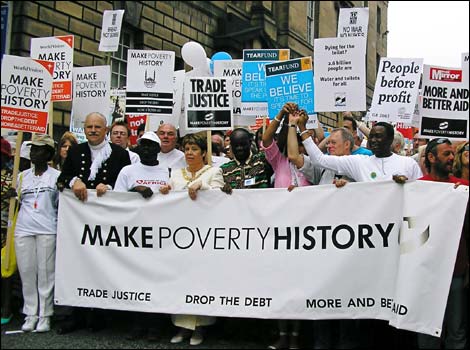
It would be very odd if people came to protest against this G8, as we're focusing on poverty in Africa and climate change. I don't quite know what they'll be protesting against... There will be people who come out on the street in favour of the Make Poverty History campaign and that's a good thing.

This strategy was at once reasonable-sounding and dangerous - dangerous, because all legitimate, non-violent, "good" protesters are represented as supporters of the government, while all opposition becomes associated with violence, irrationality and illegitimacy. (In the same interview, Blair told the reporter he "couldn't rule out" using recently passed anti-terrorist laws against anti-G8 protesters.)

On the ground, for anyone looking for more than a soundbite, it was obvious that this black-and-white polarisation didn't hold. There was a spectrum of dissent, of deep concern and anger at the consequences of the policies the G8 leaders represented, which ran from the white-clad Make Poverty History marchers through the various shades of red and green and no particular colour, to the black bloc anarchists at the other end.

However, the effectiveness of the government's media management was reinforced by journalists' desire for simple, black-and-white narratives.


One measure of its success was the BBC's uncritical presentation of the Make Poverty History campaign and the Live 8 concerts. This was the subject of an official report just this week, which acknowledged that:

the BBC’s involvement with Make Poverty History in 2005 presented challenging dilemmas and was, for some, a difficult experience... there remain, even now, scars which have not fully healed.

Libby Purves, herself a well-known BBC presenter, expresses this discomfort more explicitly:

Personally, I applaud the nerve and passion of [campaign organisers] Geldof and Curtis, but not the BBC’s massive loss of perspective over Live 8. Carried by the vastness and suddenness of the enterprise... senior management rolled over whenever the campaigners – backed by Gordon Brown – pushed. Valid scepticism about Live 8’s demands was ignored. Even when Geldof arrogantly told Paul Martin, the Canadian Prime Minister, he was “not welcome” at the G8 summit unless he obeyed, the BBC continued presenting the event as uncritically as a Prom. It was all very uncomfortable and clearly won’t be allowed to happen again.

What Purves doesn't highlight is the way uncritical representation of the "good protesters" compounded the false polarisation of that wider spectrum of protest.

I spent the day of the Edinburgh march reporting for Make Poverty History Radio - a temporary station with no need for impartiality! But towards the end of the afternoon, I remember ducking into a pub a few streets away to catch some of the BBC coverage. As I watched, they cut from a helicopter view of a small group of black bloc kids penned in by riot police, to a reporter striding side by side with a group of marchers, chatting away to them. Whatever the exigencies of covering such an event, the contrast between the two shots - the embedded reporter with the "official" protesters, the aerial view of the trouble-makers - told its own story, one which chimed with much of that week's coverage.

There are various reasons why the unoffical protesters seldom get a hearing for their side of the story. Some of it has to do with their own suspicion and sometimes hostility towards the mainstream media, and the fact that they often become visible only when a minority start smashing windows. Some of it has to do with journalists' preference for talking to people their audience can identify with or who they themselves feel comfortable around. One big piece in the puzzle, though, is the relationship between the police and the media.

In the ordinary course of news reporting, the police are a privileged source of information. So much of the daily news agenda is made up of crime stories, court reports and other situations in which the police speak with authority. As a rule, you don't see interviewers challenge police officers the way they challenge politicians. This is just how things work, and while not always perfect, it's hard to think of an alternative.

The problem comes, though, when the police become one side of a story. Protests which don't have the endorsement of the authorities are a feature of democracy - a situation in which you can only protest with the government's permission is undemocratic. But such protests are often the scene of confrontations in which the police play a role - sometimes on their own initiative, sometimes on political orders - which is worthy of journalistic questioning. On the whole, however, this is not recognised, and it is common practice for the police version of events to be reported with the same uncritical attitude as in a crime story. (One TV reporter told me how his copy was rewritten to tally with a police press release, with the effect that shots of an activist being beaten by police were accompanied by a newsreader's description of "violence by protesters".)

For activists who see themselves misrepresented, it is easy to buy into conspiracy narratives about the forces which control the media. In my experience, what actually goes on is slipperier and less driven by intentions, though the effect may sometimes look like a conspiracy.

But there are at least two good reasons why anyone who wants to change the world should avoid conspiracy narratives. One is that if you believe them, you might as well give up - since the logic of the conspiracy narrative involves imputing such overwhelming power and capacity for control to the state/the multinationals/the 12ft-high lizards. The second reason is that, if you attribute your failures to conspiracies against you, you're unlikely to engage in the kind of reflection that gives you a chance of achieving more next time round.

The time I spent hanging out with anti-globalisation activists and getting involved with those campaigns was incredibly inspiring, as well as (sometimes) deeply frustrating. Whatever else, it challenged me to do something more constructive with my life than working as a mainstream news reporter. And, while I never got that book published, the process of writing allowed me to think through how you turn good intentions into making a real difference for people's lives - which certainly contributed to what I'm doing now.

But more on that in a future post...

Tuesday, 19 June 2007

A Sheffield Icon Under Threat

After yesterday's hopeful news, today brings a more disappointing story - or rather, a challenge to avoid one.

The Tinsley cooling towers stand alongside the M1, England's principal arterial motorway, as it crosses the Lower Don Valley on the edge of Sheffield. Familiar to millions of drivers, they are as striking a roadside landmark as Antony Gormley's rightly famous Angel of the North. But unlike Gateshead's iconic figure, the towers' aesthetic impact is incidental to their origin - as part of the Blackburn Meadows Power Station, demolished nearly 40 years ago.

More recently, the towers have become icons for something larger and less tangible. It happened because of two indecently talented young men, both named Tom, who started a fanzine called Go! Sheffo - a visual and lyrical love letter to an undersung city, and a rallying call to defend its distinctiveness against a tide of blandness masquerading as regeneration. They found a voice which resonated with all kinds of people in the city. And one of the best things they did was to organise a competition to turn the towers into a work of art.

Out of that competition came a campaign that seemed like it might succeed, that gathered media coverage and endorsements from the great and the good. Finally, however, it seems to have hit a wall with the towers' owners, the electricity generator Eon, who announced today that they're going to demolish them.

It's a strange thing to get excited about, a pair of cooling towers. Especially when there's a primary school next door to the same stretch of motorway which should have been moved elsewhere years ago and still hasn't. (Though there's no reason to set the two causes against one another.)

But the message Tom and Tom just sent out gives a sense of what they've come to stand for:

We’ve always said that Sheffield needs something to represent the changes that this city has gone through, and the good things that happen here. A new icon.

We’ve always said that the cooling towers are perfect for this. They’re in a perfect position, and represent both Sheffield’s ugly past and its potentially beautiful future...

This is crunch time. We need someone else to put their money where their mouths are. We haven’t got the resources or the time to mastermind a process that ends up with two old cooling towers transformed into new symbols. We don’t get paid to do this. Maybe the people who do, should.

If the leaders of this city want to see the cooling towers transformed into spaces for international works of public art, like the Tate Modern turbine hall, like the Gasometer in Oberhausen, Germany, it needs to happen now.

If our leaders really want Sheffield to be ‘a Distinctive City of European Significance’ then do something to make it distinctive. This is an organic, positive idea, that only Sheffield can do. No-one else has two massive structures next to the M1. No-one else could change what their city means at a stroke. Not Newcastle, not Manchester, certainly not Leeds.

And here’s a message to the city.

Unless you do something big and bold soon in the regeneration of Sheffield, no-one will care. Literally, no-one outside the city will care. No-one will care about a city with the same shops as everywhere else, the same flats as everywhere else, the same cafes as everywhere else, but slightly uglier buildings.

For the last two and a half years, we’ve been trying to make a good idea happen. We still believe it’s a brilliant idea. The question is, what are you going to do about it?

About Me

My photo
London, United Kingdom
This blog was my online home between 2006 and 2009. Today, you'll find me scattered across the internet. To start looking, go to my personal website: http://dougald.co.uk/

My Projects

Signpostr School of Everything

MyBLOGLOG

Followers

My ClustrMap

From My Shelves

Labels